Jeffers Returns to Twins Lineup After 2-Month Absence; Rehab Numbers Suggest Quick Integration
By Erik Schwartz ·
Minnesota's catcher is back from a hamate fracture, and his Triple-A performance hints at immediate offensive relevance—a material upgrade to the team's catching production.
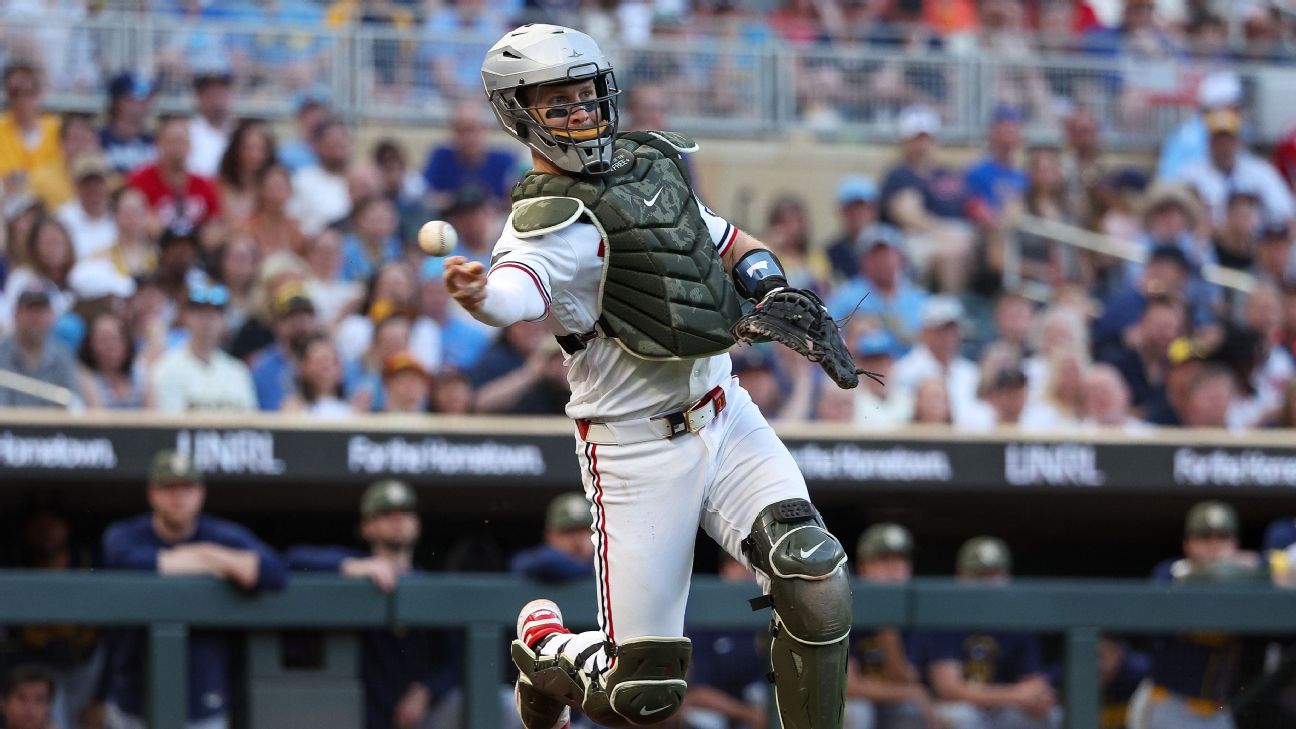
The Minnesota Twins reinstated catcher Ryan Jeffers from the injured list Friday, ending a two-month absence stemming from a left hamate bone fracture. Jeffers, 29, logged five rehab games at Triple-A, posting a .375 batting average with two home runs—a small sample that nonetheless signals he hasn't lost timing or bat speed during his recovery. The team optioned outfielder Kyler Fedko to create roster space, a straightforward roster math decision that underscores the Twins' confidence in Jeffers' readiness.
Context matters here. Before the injury, Jeffers was Minnesota's most productive hitter, carrying a .295 average, .949 OPS, seven homers, and 26 RBIs across 37 games. That's an on-base machine with pop—elite for the catching position. His absence forced the Twins to cycle through backup options, none of whom replicated that offensive profile. The hamate bone, small but load-bearing in the grip, typically demands 6-10 weeks of immobilization and rehab; Jeffers appears to have stayed within that window and passed the team's Triple-A evaluation. The .375 mark over five games isn't predictive on its own, but it clears a threshold: no lingering mechanical hesitation or reduced exit velocity.
The betting surface on Twins catchers has almost certainly priced in the Fedko placeholder. Books had no choice—they couldn't forecast whether Jeffers would return healthy, and at what capacity. Now that he's active, the offensive baseline for the position jumps materially. If Jeffers recaptures even 85-90% of his pre-injury production (a reasonable projection given the injury type and rehab trajectory), the Twins' team totals, run line leverage, and individual hitting props all become more favorable. A catcher posting a .295 average with nine homers expected over a full season is not a starter you bench when healthy.
The prop angle hinges on playing-time allocation and opposing pitcher assignment. Jeffers won't return to full duty immediately—expect a gradual ramp-over the next week, with maybe 3-4 starts in the next seven games as the team monitors workload. But by next week's matchups, assuming no setback, he's your baseline catcher, not a pinch-hitter or late-inning swap. His hitting props (batting average, home run rate, RBI projection) should be modeled against his pre-injury pace, not against the weak offensive output the team has gotten from reserve catchers. Twins team totals had likely compressed during his absence; expect modest uplift in run-expectancy models now that a .295/.949 hitter is active. That's not a dramatic shift for a contender, but in tight spreads or totals near key numbers (4.5, 5.5 runs), the return of above-average offensive production matters at the margin.