Twins Gamble on Lewis's Triple-A Reset, Bench Outman's Strikeout Risk
By Ty Whitney ·
Minnesota recalls an infielder fresh off a minor-league recalibration while cutting ties with a high-strikeout outfielder, signaling a philosophical shift in roster construction.
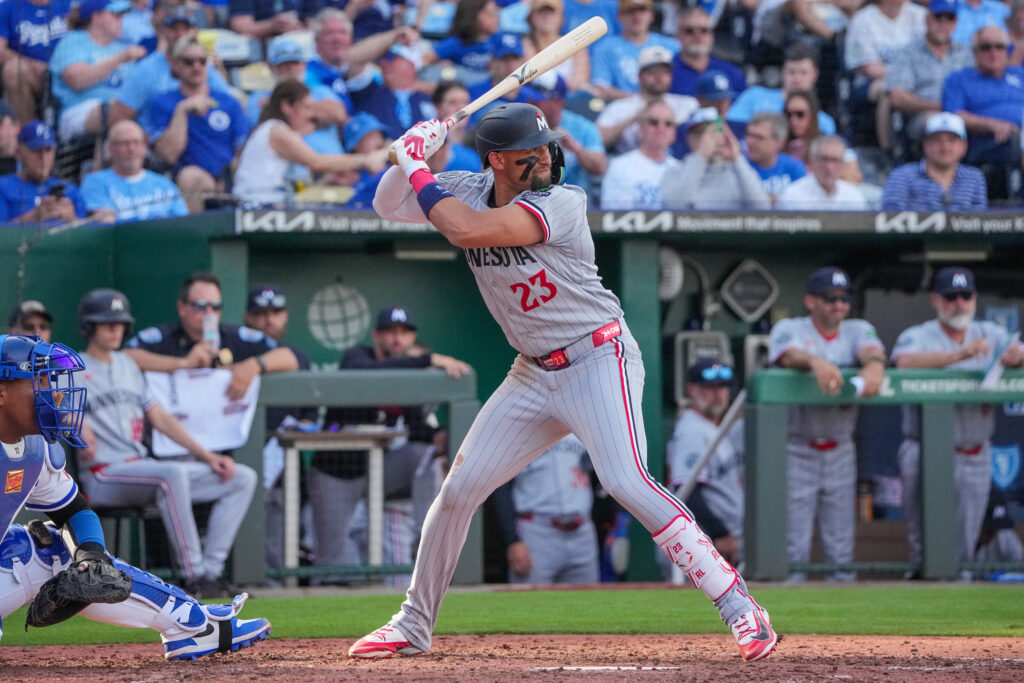
The Twins recalled Royce Lewis from Triple-A St. Paul on Saturday, designating outfielder James Outman for assignment in the corresponding move. Lewis spent roughly two weeks in the minors after posting a brutal .163/.261/.279 slash across 119 plate appearances at the major-league level this season—a performance that triggered the demotion. The move opens a spot on Minnesota's 40-man roster and gives Lewis a second chance to prove he can stabilize at the plate.
What makes this swap notable is not Lewis's bare numbers in the minors (the source doesn't disclose his Triple-A line), but rather the strategic choice to jettison Outman, a veteran outfielder who has been a consistent source of strikeout volume. Outman's profile—high swing-and-miss, low contact rate—makes him an undesirable fit in any lineup fighting to manufacture runs. By removing him, the Twins are acknowledging that roster churn at the margins matters more than hanging onto a name with name recognition.
Lewis's baseline is murkier. He possesses defensive versatility and a track record of above-average power potential, which explains why a 119-PA crater doesn't automatically end a player's viability. The two-week detour was likely meant to restore his approach—simplify his mechanics, regain confidence against velocity—rather than prove anything in a vacuum. If the recalibration has teeth, his strikeout rate should contract relative to his first stint. If it doesn't, the Twins will have burned a roster spot on an experiment that didn't work.
For betting purposes, Lewis's return creates a modest negative on Twins team strikeout totals in the near term. A hitter emerging from a 119-PA slump with a .261 on-base percentage is unlikely to immediately jump to league-average contact rates. Early books may not have fully priced in the compositional shift—losing Outman's K volume but gaining an unknown Lewis input—and that mispricing favors unders on Twins team strikeout props for the next 5-7 games, until the market recalibrates on actual performance. This edge is time-sensitive and volatile; a single strong outing from Lewis or a strikeout-heavy performance from his replacement at DH/bench will evaporate it within 48 hours.
The larger takeaway: Minnesota is optimizing for contact rate and defensive flexibility over power ceiling or established production. That's a valid organizational bet, but it's also a bet on internal recalibration working quickly. Fade any narrative that Lewis is a plug-and-play upgrade; he's a calibration experiment with a short shelf life.