Brewers' Lefty-Lineup Pivot Opens Trade Window for Right-Handed Outfield Help
By Ty Whitney ·
Milwaukee's resurgence against left-handed pitching since early May erases a critical roster weakness—but the deadline still demands a platoon-proof right fielder.
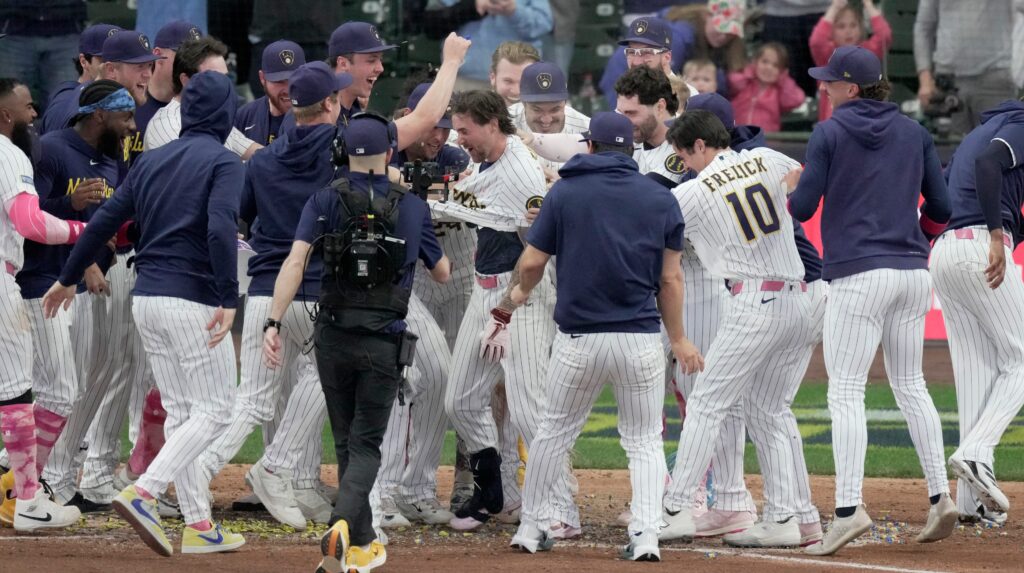
The Milwaukee Brewers enter the trade deadline window with a five-game division cushion and a clean narrative: they're built to win now. But one detail matters more than the headline record. The Brewers have quietly solved their left-handed pitching vulnerability since May 4th—when both Brent Chourio and Andrew Vaughn returned to the lineup—a shift that reframes what Milwaukee actually needs to buy at the deadline.
Prior to Chourio and Vaughn's availability, Milwaukee carried a meaningful split against southpaws. That gap has closed considerably over the past eight weeks of availability, which means the organization's internal concern—plugging a platoon liability—has largely been addressed by health and roster continuity. The calculus for a deadline acquisition changes when you're not chasing a defensive seal on a structural weakness; you're hunting for upgrades at the margin.
Right field remains the one positional need that transcends handedness. With both Frelick and Mitchell currently platooning against lefties—a reasonable short-term solution—the Brewers are signaling they'd prefer a right-handed outfielder capable of hitting both sides. This is not a desperation move; it's a quality-of-depth play. A true platoon-proof corner bat raises the floor in October baseball, where pinch-hitter usage and late-inning defensive swaps become leverage points.
From a betting standpoint, the Brewers' improved left-handed matchup data narrows the Vegas adjustment window. Books have likely already priced in Milwaukee's overall offensive stability. What hasn't fully permeated the market is that their RH/LH gap is smaller than it was three months ago—meaning unders keyed to platoon vulnerability (a common sharp tells-based angle) lose their teeth. Any deadline acquisition of a right fielder won't move the needle on team total overs; it will instead compress volatility around specific split matchups. Early July Brewers team totals at 4.2–4.4 runs already embed the assumption of a stable, league-average offense. That's fairly priced given the recent health trajectory.
The real edge for Wisconsin bettors sits in opponent-adjusted home run props. Brewers hitters are getting more consistent AB's against both handedness profiles. Consistency in plate appearances drives strikeout and power volume over any single two-week stretch. If the deadline acquisition is a contact-oriented right fielder (not a power asset), the team's K-rate should remain stable or dip—a minor but measurable shift that moves under lines in Brewers favor across the rest of July and into August.