Cincinnati's July Salvage Mission Rests on Returning Arms and Deadline Subtraction
By PropBetEdge Editorial Team ·
Hunter Greene's imminent return offers the Reds a slim mathematical path to October, but their lineup's collapse—led by Eugenio Suarez's worst season—already signals a seller's mindset before the trade deadline.
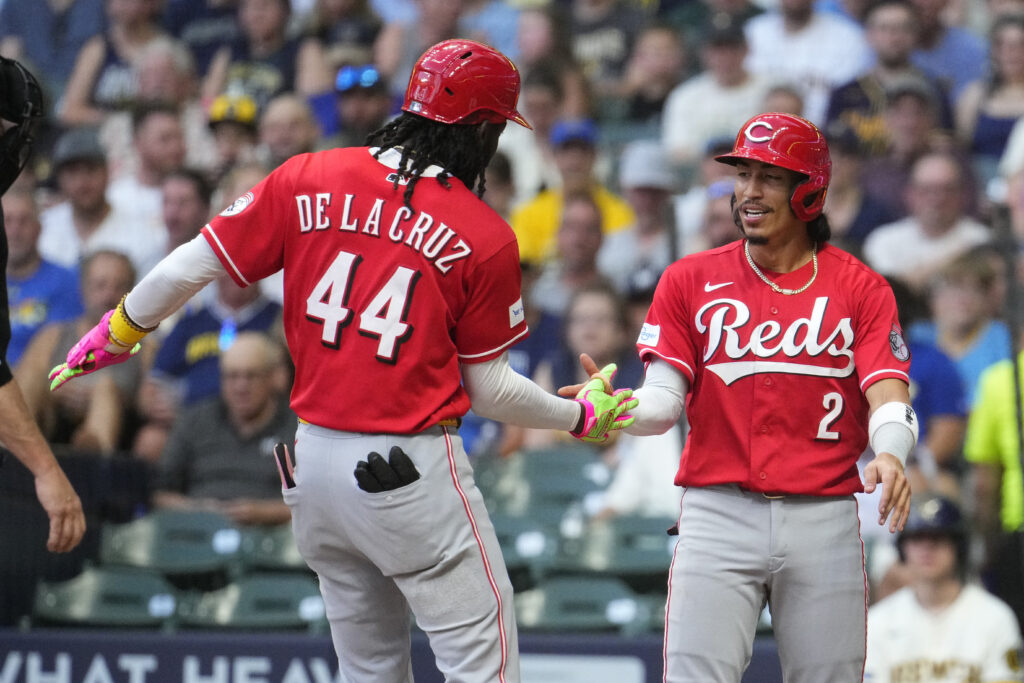
Cincinnati arrived at the July 3 trade deadline with a 40-46 record, six games shy of the final Wild Card spot but functionally eliminated in a National League where five teams stand between them and postseason entry. The collapse was swift and surgical. The Reds carried a 20-11 April record—legitimate pace-setting in the tightly-packed NL Central—then absorbed an eight-game losing streak in early May that included full sweeps to division rivals Pittsburgh and Chicago. That sequence erased the margin for error. What followed was a summer of attrition: star shortstop Elly De La Cruz lost most of June to a hamstring strain, closer Emilio Pagan missed nearly two months with a similar injury, and the organization's offseason centerpiece—ace Hunter Greene—never threw a pitch in the majors after undergoing elbow surgery before the season opened. Greene is scheduled to return this weekend, a development that matters less for Cincinnati's 2026 fortunes than it does for 2027 optionality. The math no longer works.
The most damning indicator isn't the win-loss record. It's the offensive collapse at the core of the lineup. Eugenio Suarez, the 49-home run slugger Cincinnati brought back in the offseason to anchor the middle of the order, has posted a 74 wRC+ (equivalent to 26% below league average) across 230 plate appearances. He's striking out at a career-worst 33.5% clip while managing just eight homers. Defensively, he's been a net-negative at third base with minus-5 Defensive Runs Saved. The free agent market was prescient in March when Suarez lingered into February without a multi-year offer; his 2025 power spike appears to have been a one-season aberration. With a mutual option for 2027 at $16MM, Cincinnati will almost certainly decline their side. Suarez becomes a movable asset precisely because he's a one-dimensional DH candidate on an expiring contract—a depreciating asset that other rebuilding or budget-conscious teams might absorb for minor compensation or a salary-dump sweetener.
The deadline roster reflects a fire sale in slow motion. Seven impending free agents—including outfielder Nathaniel Lowe (solid production this season) and starting pitcher Brady Singer—are available for contenders seeking depth or injury relief. Closer Emilio Pagan, whose 32-save campaign in 2025 made him an offseason centerpiece, becomes a trade candidate despite his recent return from injury; Pagan's value remains significant enough to net meaningful return, and Cincinnati gains cap flexibility by moving a high-leverage arm before free agency sets in. Caleb Ferguson, Pierce Johnson, and Tyler Stephenson round out a group of mid-tier contributors that playoff contenders routinely target. None of these names command star-level capital, but the volume matters. Cincinnati is threading a thin needle: extract whatever value remains from marginal contributors before they walk in free agency.
For bettors, the Reds' seller status and personnel upheaval create operational friction that should suppress team totals and win probability for the remainder of July. The offense has already underperformed its resource allocation (an $16MM slugger hitting below replacement level) and now faces the prospect of losing established roster depth to trades. With Greene's return offering limited offensive boost—he's a pitcher—Cincinnati's path to daily competitiveness tightens. Suarez's presence on the block doesn't immediately remove him from the lineup, but it signals internal acknowledgment of his failure, a mindset that often correlates with below-market performance from deadline-adjacent players. Fade Cincinnati team totals over the next four weeks; the organizational energy has shifted from October hopes to 2027 reconstruction.