San Diego's Division Lead Masks an Offensive Crisis in Its Core
By Ty Whitney ·
The Padres sit 1.5 games back of the Dodgers despite nearly invisible production from Tatis, Merrill, and Machado—a gap that will widen if those three don't wake up.
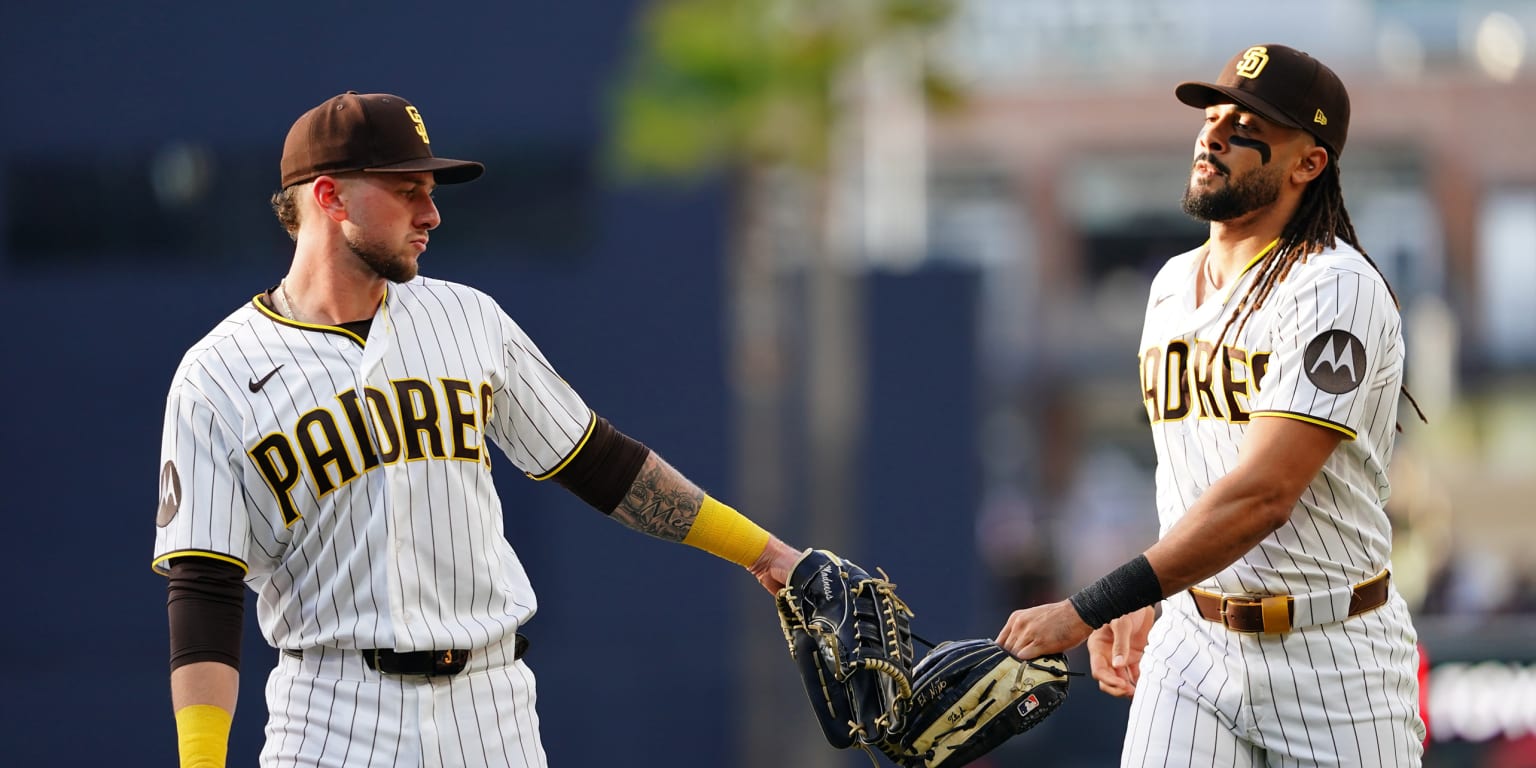
The Padres' 29-20 record and narrow margin behind Los Angeles masks a structural problem: the three hitters supposed to anchor the lineup have combined for a .600 OPS, eight home runs in two months, and 0.9 WAR across nearly 1,000 plate appearances. San Diego has functionally been winning games on pitching depth and secondary contributors, a sustainable approach only until the offense fully fails. The question isn't whether these three are legitimately good—it's whether their current slump reflects injury, mechanical drift, or a harbinger of longer decline.
Fernando Tatis Jr. presents the starkest anomaly. Through 49 games, he has not homered—a historic blank spanning 200-plus plate appearances. His 55.6 percent hard-hit rate still ranks in the 97th percentile; the problem sits in distribution. He's pulling only 6.8 percent of his batted balls in the air, nearly halving his career 14.9 percent clip. Instead, he's cranking 53.4 percent ground balls, a career peak achieved through either timing failure or mechanical adjustment (likely the closed stance adjustment visible on video). At 27, with four straight 20-plus home run seasons as recent memory, a mechanical reset is plausible. But plausible and imminent are different propositions, and every week without power production costs the Padres win probability.
Jackson Merrill's decline is subtler but more concerning because it spans consecutive years. After posting an .826 OPS as a rookie in 2024, he's now at .598 in 2026—a regression from both luck and skill. His barrel rate collapsed from 13.0 percent to 9.4 percent while his strikeout rate climbed to 25.1 percent, a career high. A back injury suffered robbing Ohtani on Wednesday compounds the issue; even if it's short-term, Merrill's already fragile timing may not recover quickly. His 44.2 percent ground-ball rate is a career low, signaling he's chasing low pitches or being pitched down-and-away. At 23, he has time to adjust, but adjustment takes reps, and reps eat into the season window.
Manny Machado, at 33 and in his 15th season, may be entering genuine decline rather than temporary slump. Seven home runs through 49 games projects to roughly 23 for a full season—a 35 percent drop from his career average. His .617 OPS is his lowest in a decade. This isn't bad luck; this is aging mechanics meeting harder stuff. The Padres bet on continuity by locking him in long-term; they're now testing whether that bet ages well.
For bettors, the Padres' win total and team-total lines have already compressed around their record and divisional proximity. The real edge lies in fading Padres offensive props—Merrill's home run line, Tatis's RBI total, Machado's extra-base hits—until one of these three demonstrates a mechanical or health breakthrough. San Diego's pitching can keep them close, but close doesn't translate to division titles when the Dodgers' lineup stays healthy. If Tatis's power returns and Merrill's strikeout spike reverses by June, the narrative flips. Until then, treat Padres offensive production as unreliably high-variance.