Pages' Postseason Amnesia Is Making the Dodgers' Offense Unstoppable
By PropBetEdge Editorial Team ·
The Dodgers' center fielder has erased his historically bad October from the calculation and become the team's second-most valuable player, with cascading effects on lineup construction and run-scoring rates.
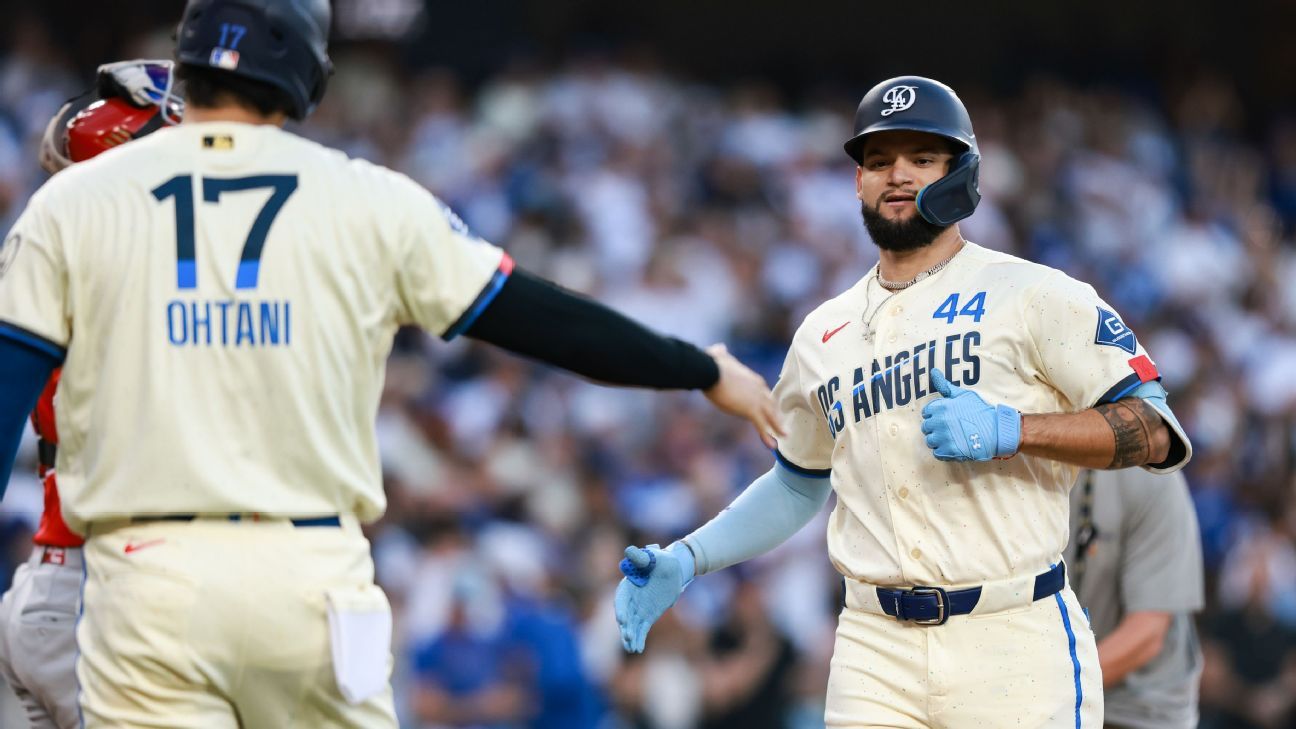
Andy Pages was historically bad in last October's postseason—a 4-for-51 slash line with 11 strikeouts, zero walks, and a .211 OPS that stands as the lowest single-postseason mark among any player with 50 plate appearances. That performance landed him on the bench during the World Series. Facing that level of public failure at age 24, on the sport's largest stage, would crater most careers. Pages instead chose to discard the memory entirely. Per ESPN, when the Dodgers coaching staff assembled him for a spring training debriefing in early February—a conversation designed to rebuild his confidence and dissect what went wrong—Pages had already moved on. His mentality was immovable.
The decision to mentally shelve the postseason has translated into one of baseball's sharpest turnarounds in 2026. Pages is slashing .282/.326/.528 with 15 home runs, 10 of which have come over his last 30 games, and he leads the majors with 56 RBIs. His 2.7 WAR trails only Ohtani's on a roster constructed around multiple Hall of Fame trajectories. He started the season hitting eighth, buried beneath the franchise's constellation of star power. By mid-June, he has climbed to the second spot, a lineup position earned entirely through performance, not prospect pedigree.
What Pages' rise reveals is a structural vulnerability in how the Dodgers offense was constructed entering the season. The team built its lineup top-to-bottom with individual talents—future Hall of Famers at nearly every position—yet that star concentration created redundancy in run-production roles and pushed high-leverage at-bats to lower spots in the order. Pages' transformation from afterthought to RBI machine has forced the organization to reorganize that hierarchy. When a 24-year-old center fielder becomes your second-best value creator, it signals that your superstar density isn't translating to optimal offensive sequencing. The Dodgers are winning with the second-best record in baseball, but Pages' emergence has quietly made them more efficient at what they were already doing well.
For bettors, Pages' sustained production carries a critical prop angle: his RBI total and run-scoring frequency have benefited from both personal excellence and a favorable batting-order placement that wasn't predictable at season's start. He sits at 56 RBIs in early June—a pace that would finish well north of 130 for a full season. The market priced his season RBI total based on his eighth-spot usage and his 2025 performance; the fact that he now occupies the two-hole means every subsequent batted ball from the top of the order increases his run-scoring probability, and every at-bat he takes lands in a higher-leverage situation. This is a persistent, multi-game edge that won't fade once the market adjusts—the Dodgers have committed to this lineup slot, and Pages' underlying metrics justify staying there. Lean toward overs on Pages' season RBI total and games-scored-in props as long as the line hasn't accounted for his jump from eighth to second in the order.
Pages' psychological compartmentalization—his ability to completely erase a catastrophic postseason and perform at near-elite levels just eight months later—is the kind of mental fortitude that doesn't show up in xwOBA or batting average. It shows up in consistency. The Dodgers' coaching staff, including Nelson Cruz and Raul Ibañez, recognized it immediately in spring training. Those who saw Pages nod stoically through the motivational speech and then shrug it off knew he was operating from a place of self-directed confidence. That's the profile of a player whose breakout is durable, not a product of small-sample variance or a lineup mismatch that will correct itself. For a Dodgers organization that endured a second-straight championship run marred by October disappointment, Pages' summer resurgence has done more than fix a weak link—it has made the team fundamentally harder to get out.