Acuña Returns to Braves Lineup After 48-Day Absence; Run Differential Tilts Hard Toward Atlanta
By Ty Whitney ·
Ronald Acuña Jr. is activated Monday against the Mets after nearly seven weeks sidelined by hamstring injury, and the Braves' offensive profile shifts dramatically.
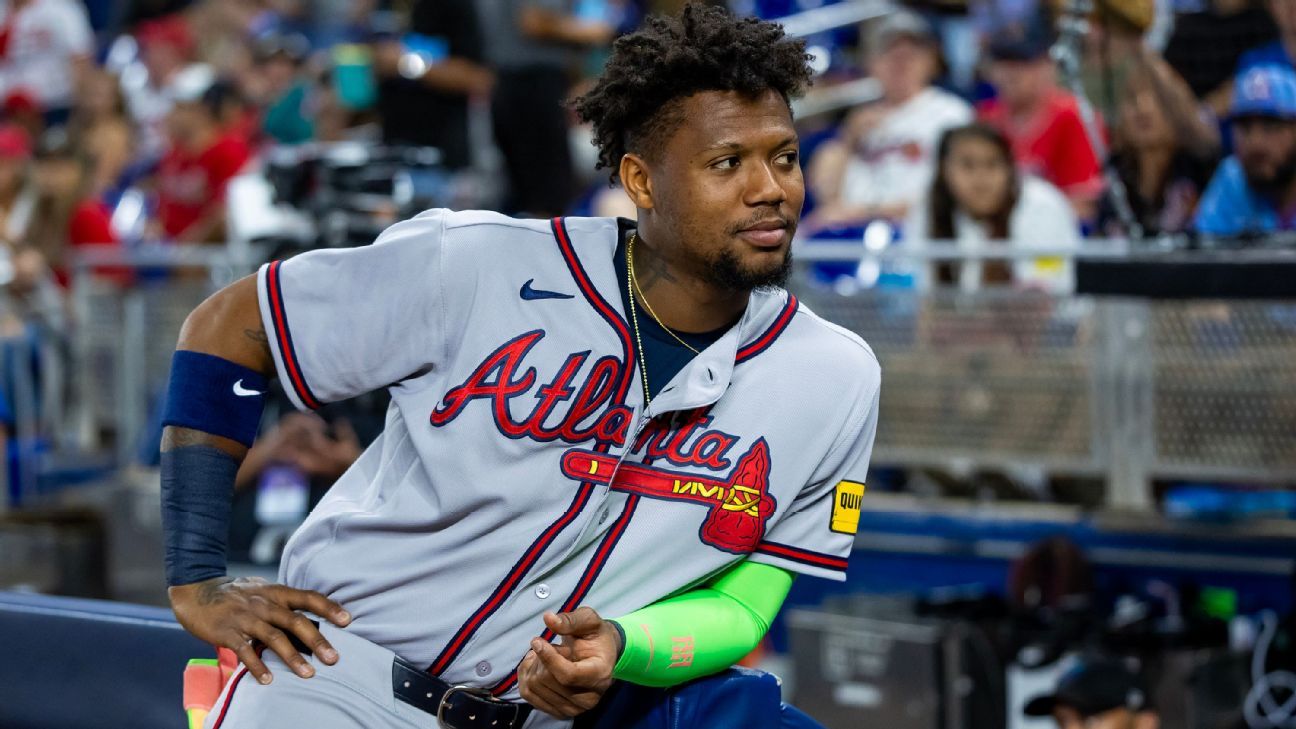
Ronald Acuña Jr. will return to the Braves' lineup Monday against the Mets, ending a 48-day absence dating back to June 9. Per ESPN, the 2023 MVP—sidelined by a left hamstring strain—has been cleared for action, marking the second time this season Atlanta's right fielder has battled the same injury. He missed 15 games in May before returning to play.
The timing of Acuña's return matters as much as the fact itself. Atlanta enters Monday with a 5½-game lead in the NL East and a 62-43 record overall. The underlying split, however, is stark: the Braves are 37-16 when Acuña plays and 25-27 without him. That 12-game win-loss swing is not noise—it's the difference between a division lock and a playoff scramble. Acuña's absence didn't just cost at-bats; it recalibrated how the offense functions. Without him, Atlanta's run production flattens, and opposing pitchers face less pressure in the middle of the order.
Acuña's offensive profile remains elite despite the injury layoff. He's hit .251/.373/.793 across 53 games with 15 stolen bases—a .435 wOBA that places him in the upper tier of NL right fielders. The low batting average masks genuine power and plate discipline; the slugging percentage and on-base rate are the real tell. When he plays, he spaces the Braves' lineup vertically and forces defenses to account for both speed and distance. That multiplies the value of Travis d'Arnaud and other run-producers batting behind him.
For betting purposes, Acuña's return resets the Braves' team-total ceiling. Against a Mets pitching staff that has shown vulnerability in splits against left-handed contact hitters and speed threats, Atlanta's offensive total should tick upward immediately. The Braves averaged 4.8 runs per game in June and July without Acuña; that figure was 5.2 in April and May when he was healthy. Look for team totals to move from the 4.0–4.5 range into the 4.5–4.8 range as the market reprices Atlanta's run expectation. This is not a single-outlier effect—it's a structural shift in lineup composition that persists game-to-game. The Mets' bullpen has also shown cracks late in close games, which amplifies the edge on Braves run totals in innings 6–9.
Moneyline value on Atlanta at even money or slight favorites also improves. The Braves' 37-16 mark with Acuña carries meaningful predictive power; a team that wins 70% of its games when a star player is on the field and only 48% without him has identified its critical dependency. The market may price Mets as a close underdog or near pick-em based on overall records, but Atlanta's relative strength advantage—built on Acuña availability—narrows the true gap.