Mets Depth Gets Real: Soto Returns, But Taylor's Absence Exposes Bullpen Fragility
By Erik Schwartz ·
Juan Soto's return from illness and A.J. Minter's first action since April give the Mets a temporary roster boost—but losing Tyrone Taylor and deploying a patched-together bullpen in a pennant race signals deeper offensive vulnerability.
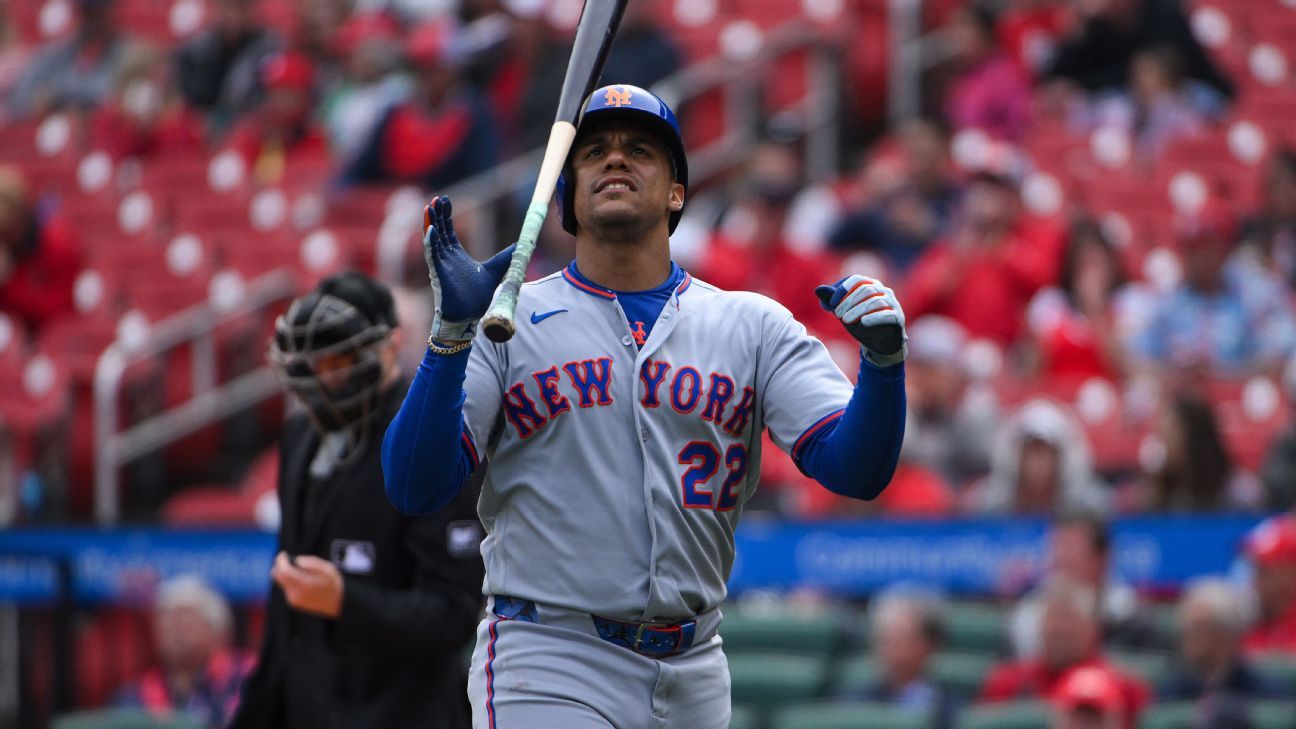
Juan Soto stepped back into the Mets' lineup Tuesday against Cincinnati after a two-game absence, batting third as the designated hitter with manager Carlos Mendoza reporting him nearly back to full health. The recovery marks a small win for a team sitting last in its division with nine members of Opening Day's roster already on injured reserve. But the symmetry is unforgiving: the same day Soto returned, the club placed Tyrone Taylor—their most reliable reserve outfielder—on the 10-day IL with a right hip flexor strain suffered while grounding out Monday night.
The volume of injuries tells the story. Francisco Alvarez, Francisco Lindor, Jorge Polanco, Luis Robert Jr., Clay Holmes, and Kodai Senga remain sidelined. Robert joined the 60-day list Tuesday, effectively removing him from short-term calculation. Young, the utility bat who missed five weeks with a torn left meniscus, is easing back in as a first-base starter and potential outfield fill-in at a .350 clip over his first 20 at-bats—a small flicker of offensive depth in an otherwise drained roster. None of this, however, solves what's become the Mets' most urgent problem: bullpen stability.
A.J. Minter hasn't pitched in a competitive game since April 26, 2025, absent due to a torn left lat. His return to the active roster positions him as a high-leverage weapon Mendoza says he'll deploy without hesitation—eighth-inning work in one-run games, even save situations if needed. That willingness signals not confidence in Minter's readiness, but desperation. Behind closer Devin Williams and eighth-inning man Luke Weaver, the Mets have little else. A pitcher taking a month-plus off from competition—even one as talented as Minter—enters the game as a statistical risk, particularly in tight spots where even a single blown pitch compounds losses in a basement-dwelling team's race for relevance.
For bettors, the Mets present a two-layered pitfall. On the run-prevention side, Minter's unpredictable availability (he also dealt with hip soreness this month) makes bullpen efficiency props unreliable for the next 7-10 games. His workload ramping up means elevated leverage opportunity, which sounds positive until you factor the mechanics: a pitcher fresh off a lat injury lacks the explosive shoulder action required for late-inning fastball velocity and precision. On the offensive side, the return of Soto and Young fails to patch the net. Soto missed illness time; Young missed five weeks of conditioning. Neither magically restores lineup continuity when your franchise player (Lindor), primary catcher (Alvarez), and two of your starting arms (Holmes, Senga) are on shelf. The Mets will scrap to steal games with bench productivity, but the baseline run environment has shifted downward.
Taylor's absence is the canary. A club with full health might absorb a reserve outfielder's week-to-week grind; a club nine deep in the IL cannot. Every daily lineup becomes a Frankenstein roster experiment. The bullpen, now counting on a recovering lat and a closer working without middle-inning support, faces every close game as a high-wire act. Oddsmakers will price Mets unders conservatively—the team can't sustain 4-plus runs on most nights—but the real edge lies in fading Mets overs on bullpen relief props (holds, strikeouts for relievers in a narrow leverage band) where Minter's ramp-up creates false volatility. The market will test whether a month-off arm can still perform in tight windows. It won't, consistently.