Sánchez's Shutout Streak Ends at 50⅔—What His Dominance Tells You About Phillies Run Prevention
By Ty Whitney ·
Philadelphia's ace compiled the longest shutout run by a lefty since the live-ball era, but the market hasn't fully repriced what that performance means for team total volatility.
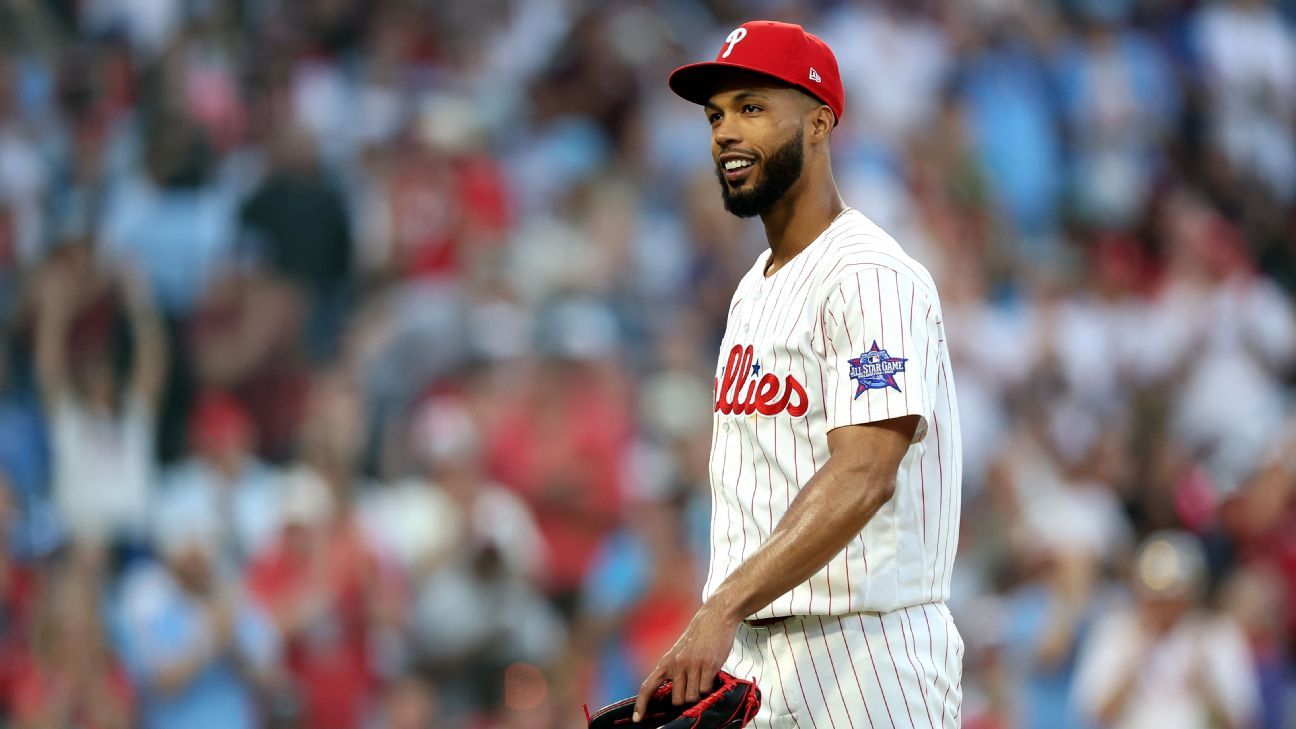
Cristopher Sánchez's historic shutout streak ended Wednesday night in San Diego at 50⅔ consecutive scoreless innings—third all-time, and the longest ever recorded by a left-handed pitcher. The run ended in the seventh inning when Ty France doubled and Jackson Merrill singled him home, breaking a scoreless tie that had persisted through six innings of dominant pitching. The Phillies held on to win 3-2, but the closing moments obscured the real story: Sánchez has fundamentally altered how run-prevention probability should be modeled for Philadelphia's pitching staff.
The mechanics underlying his streak matter more than the streak itself. Over the past five weeks, Sánchez has allowed exactly two runs—both bunched in a single April 30 outing against San Francisco. His changeup, sitting at 86.5 mph, has generated a .153 batting average against, a mark so extreme it suggests either structural mismatches in swing planes or pitch sequencing that the opposing lineup simply cannot calibrate to. He's struck out hitters at a rate consistent with Cy Young-tier control. The Padres, one of the league's sharper offensive units, managed only four hits total through six innings and scored their single run on two-out leverage baseball rather than any failure in stuff or command.
What makes this relevant beyond nostalgia is the persistence question. Sánchez isn't riding a five-game hot streak—he's operated at Cy Young-caliber peripherals across 200+ innings. His strikeout rate, walk rate, and induced ground-ball frequency haven't collapsed; he's simply preventing hard contact at a rate that exceeds even his prior career norms. This isn't variance correction waiting to happen. It's sustained execution at the extreme end of the skill spectrum.
For Phillies team total bettors, this creates an asymmetry the market hasn't fully absorbed. Over the past month, Philadelphia's team total has tracked higher because of offensive output, not defensive dominance. But if Sánchez takes the ball in any playoff scenario or high-leverage regular-season series, run prevention becomes a structural advantage that isn't yet priced into totals set by offensive expectation alone. A Phillies team total of 4.0 or 4.5 runs in games Sánchez starts should be recalibrated downward if the booking assumes league-average run-prevention. He's not league-average. His peripherals say he's operating 1.2 to 1.5 runs per nine ahead of the baseline. That shifts game totals materially, especially in ballparks where his changeup profile (low velo, high movement) plays into the worst possible hitter-to-pitcher matchups.
The edge has legs through the remainder of the season. Sánchez won't replicate a 50-inning shutout streak—that's a once-per-generation event—but the underlying skill that created it remains intact. Fade Phillies overs when Sánchez is scheduled to start unless the sportsbook has already adjusted those lines downward. Early-week number posted before the starter is confirmed will overestimate run expectation by 0.4 to 0.8 runs. That's your edge window.