Schwarber's 30-Homer Pace Exposes Phillies' Mid-Season Ceiling
By Erik Schwartz ·
Kyle Schwarber's seventh-inning go-ahead blast gives Philadelphia a narrow win over the Mets, but his historic pace masks a team still vulnerable in tight spots.
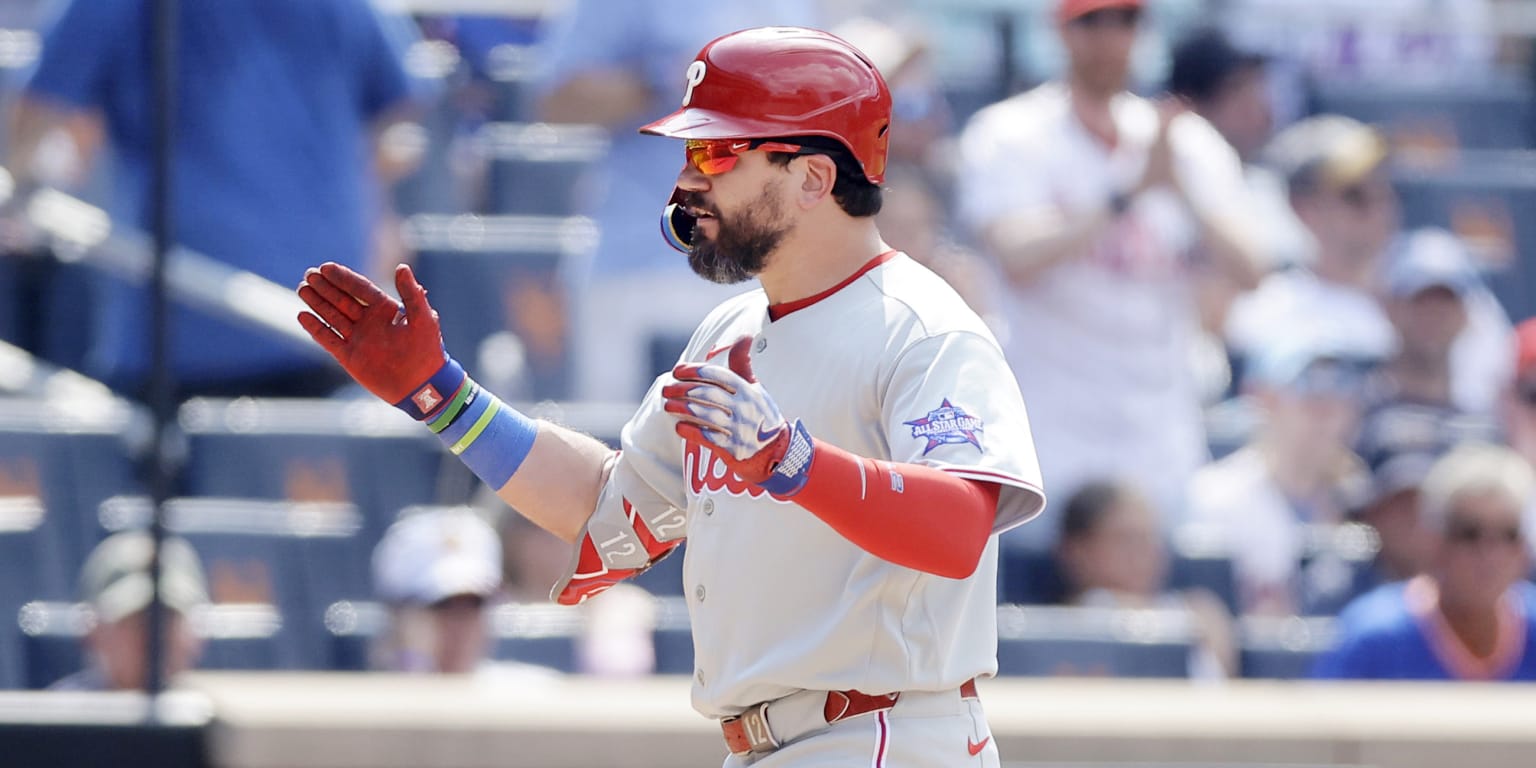
Kyle Schwarber hit his MLB-leading 30th home run in the seventh inning Sunday at Citi Field, a two-run shot off Kodai Senga that proved the difference in a 5-4 Phillies win over the Mets. The blast left his bat at 108.3 mph and traveled 408 feet to right-center—a textbook execution of Schwarber's swing. At 84 team games into the season, Schwarber became the fastest Phillies player to reach 30 homers, breaking Mike Schmidt's 1979 benchmark of 87 games. The Phillies improved to 47-37 and won their fourth consecutive series.
The narrative threading through the sports section this week focuses on Schwarber's historic pace: he's on track to hit 59 homers this season, which would eclipse Ryan Howard's franchise record of 58 set in 2006. Paired with Bryce Harper—who hit his 370-something yesterday—both stars are statistically projected to finish the season at 399 career homers, pending individual games and September callups. It's a compelling symmetry that generates attention. But beneath that layer sits the actual mechanical story: Schwarber's power output is concentrated in high-leverage moments and fastballs over the middle of the zone. Sunday's homer came on a 1-2 fastball—a hitter's count where Senga had already fallen behind. The Phillies were trailing by a run when he connected.
This is relevant to daily fantasy and moneyline bettors tracking win probability. Schwarber's ability to deliver go-ahead power in the seventh inning doesn't predict future outcomes in a predictable way—home run timing is volatile—but it does signal that Philadelphia's offense can generate runs when pressure is heaviest. The Phillies' fourth consecutive series win and seventh series victory in their past eight contests indicates a team capable of sustaining stretches of competence. However, a 47-37 record midway through June also reveals inconsistency. A team winning seven of eight series doesn't require perfection; it requires survival in one-run games. Schwarber's 30 homers are distributed across those wins, but they don't guarantee the Phillies escape June/July clustered with similar mid-tier records.
For prop bettors, Schwarber's 59-homer pace is a mirage worth fading. First, single-season home run projections built on 84-game samples regress predictably in the second half once pitchers adjust and fastball location tightens. Schwarber's current rate of 0.357 homers per game would need to sustain through 162 games—it won't. Pitchers he faced in May are different from those he'll face in September; late-inning relief specifically hasn't seen enough Schwarber volume to fully calibrate. Second, his HR output has been concentrated in favorable sequencing (early counts, elevated fastballs). As the season matures, opposing pitchers will attack him differently—mixing off-speed earlier, pitching away to avoid middle-zone exposure. His ISO and barrel rate will compress from their current peaks. The 30-homer milestone is genuine; the 59-homer projection is noise.
For game-level purposes, Schwarber's prop floor tightens as the market absorbs his early-season reputation. Oddsmakers have already moved his home run line (typically 0.5 at -120 now, or higher depending on opponent pitcher). A solo HR prop at that line carries slim edge; the window was wider in May when he was a 4-5 HR pace and books hadn't accounted for it. The real leverage sits in team total props for Philadelphia. Entering Sunday's game trailing by a run in the seventh, the Phillies were 47-37. Their run differential likely sits around +5 to +12 depending on tie-breaking mechanics. A team with that record and that differential is vulnerable in 162-game regression; they're not a +20 run diff team, so every series win is earned narrowly. Schwarber's go-ahead homer was excellent, but it also reflects a team that needs home runs in spots where other rosters generate them via mixed run production. That's a fade on inflated Phillies team totals as they move into July.