MLB
Schwarber's Defensive Pivot Opens Lineup Volatility for Phillies Against Marlins
The Phillies shuffle their infield with Turner sidelined, moving their DH to first base and pushing Brandon Marsh into the leadoff spot—a lineup rearrangement that changes run-scoring and order-dependency math.
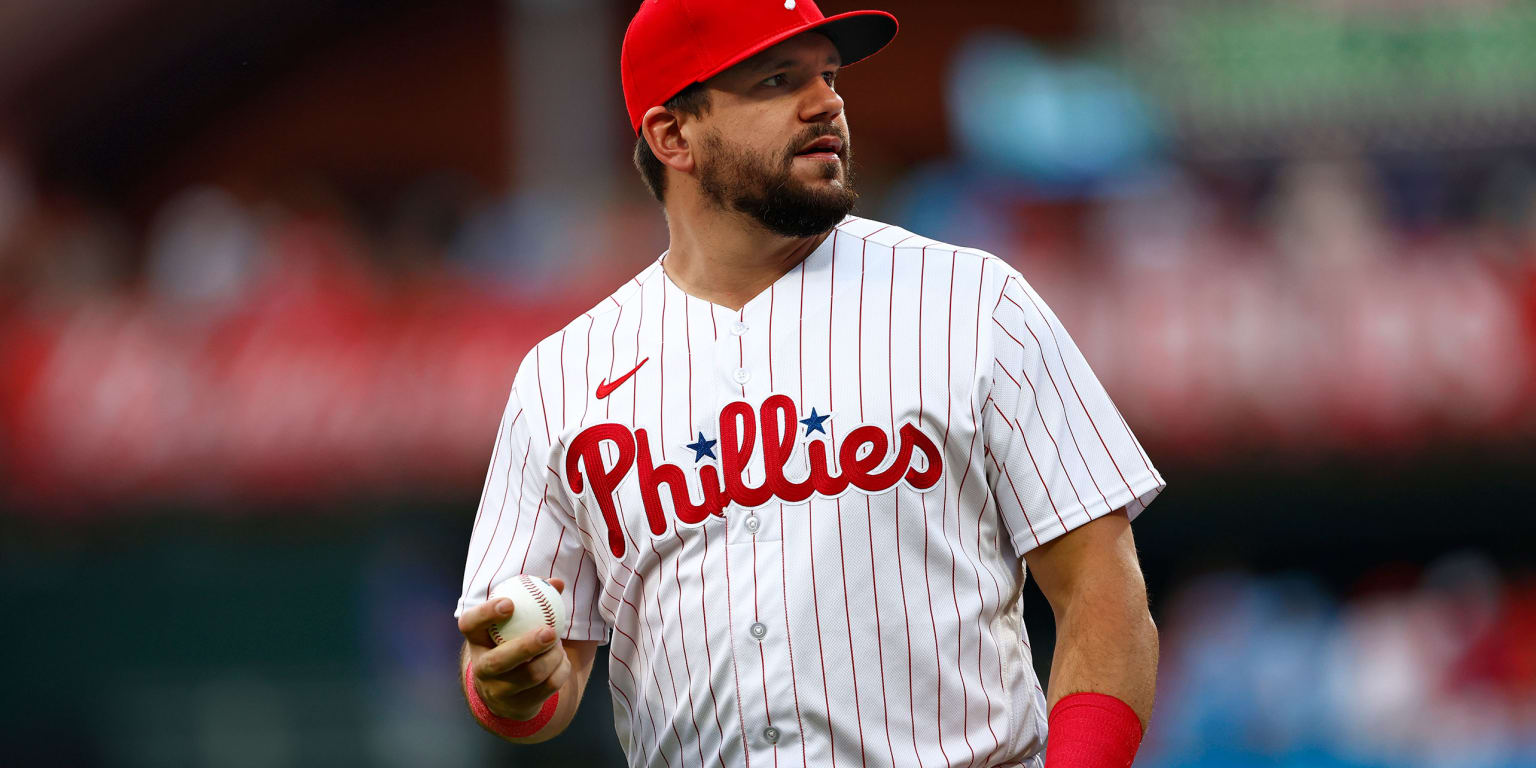
Kyle Schwarber starts at first base tonight for Philadelphia against Miami, his first defensive start at the position since 2021 when he was with Boston. The move slots him into the field while Bryce Harper takes his fifth designated hitter assignment of the season, a direct consequence of Trea Turner's right wrist contusion sustained Monday. Brandon Marsh, hitting .324 (fourth in baseball), moves from his typical fifth-hole perch to lead off—a significant positional shift that restructures Philadelphia's run-generation matrix.
Schwarber's defensive credentials at the corner are solid: nine career starts at first base across 12 games, a .985 fielding percentage on 67 chances, and one error total. The positioning itself carries minimal risk. What matters for run projection is the lineup reorganization. Marsh's promotion to leadoff is the operational lever. A .324 hitter with 108 hits in 333 at-bats doesn't lose production value by moving up in the order—he gains leverage. Leading off, Marsh gets more plate appearances per game and sets the table for high-leverage at-bats from Harper and Nick Castellanos behind him. The Marlins are 15th in defensive efficiency this season, meaning baserunning value and table-setting compound faster against Miami's pitching staff.
Turner's absence removes a .294 hitter and team-leading 42 RBIs from the core lineup, but it doesn't crater run expectancy because Schwarber (24 home runs, .926 OPS) remains in the card and now occupies a position slot rather than a DH slot. The Phillies don't lose offensive mass—they lose positional flexibility. That's a roster accounting issue, not a talent issue. Schwarber has carried a 126 wRC+ this season; he's still scoring and driving runs at league-average-plus efficiency regardless of whether he's standing in the field or designated. The lineup reshuffles around him rather than compensates for him.
The prop angle hinges on run distribution, not run volume. A Marsh leadoff elevation in a .324-hitting environment, paired with a top-10 OPS bat (Schwarber) now occupying a higher-contact position in the card, should nudge team total production slightly upward for this specific game. Marlins pitching staff allows 4.12 earned runs per game; Philadelphia has been run-positive against sub-.500 teams this season. Marsh's batting average spike (fourth in baseball) isn't a single-game anomaly—it's a 334 plate appearance trend. Leadoff positioning amplifies that statistical edge. The market has likely priced tonight's Phillies total around their 4.2 season average; a .324 hitter moving to the top of the order against a middle-tier pitching staff typically triggers a 0.15 to 0.25 run uptick in run expectancy. If the line opened at 4.2 or lower, that edge survives early-book positioning.
Turner's wrist injury and the resulting defensive reshuffle read as short-term volatility, but Marsh's leadoff placement is the real signal. A hitter with his average percentage doesn't need a deep position adjustment to accumulate value—he just becomes more efficient at it. Watch the team total open and close; if it stays flat or ticks down despite Marsh's promotion, that's a market inefficiency worth exploiting on the first-half overs.
MLB Intelligence — Baseball intelligence beyond the box score. Open MLB Intelligence →