Schwarber Returns to Phillies After 3-Game Absence, But Timing Questions Linger
By Ty Whitney ·
The home run leader's gastrointestinal illness ends a 225-game stretch, but manager Don Mattingly's cautionary tone suggests bet-the-under angles may have merit on his first night back.
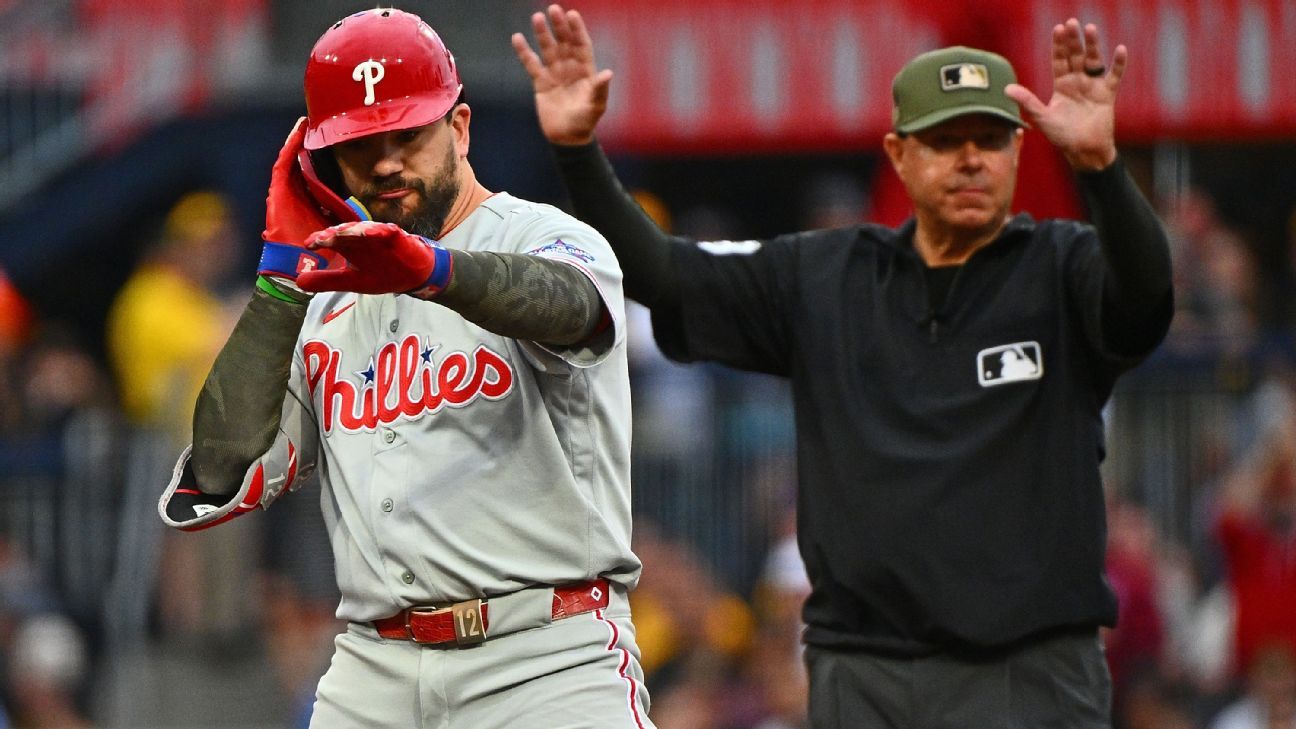
Kyle Schwarber returned to the Phillies' designated hitter spot and second in the order Friday against Cleveland after missing three straight games with a gastrointestinal illness. The slugger, who leads MLB with 20 home runs through 45 games—second-fastest in franchise history to the milestone—took the field with no physical restrictions, though the three-day absence marked the end of a 225-game consecutive-games streak that had become a quiet point of pride. Schwarber played down the ailment in his pre-game comments, noting he'd dealt with similar issues before, just never mid-season. But the deeper context matters: the Phillies' momentum stalled in his absence. After interim manager Don Mattingly's arrival sparked a turnaround from 9-19 to 25-23, Cincinnati took two of three from Philadelphia before the series finale Friday—a tangible reminder that even star power can't compensate for rust and reactive decision-making on the field.
The timing question is the real angle here. Mattingly's pre-game assessment—"His timing is going to be off"—was not a throwaway line. A player sitting out three games with a physical ailment doesn't step into the box with full load transfer and bat-path consistency intact, no matter his talent or recent hot streak. Schwarber had hit nine home runs in his prior ten games before the illness forced the bench. That's a 90-homer pace over a full season, the kind of velocity that makes his name a lock for the counting-stat boards. But velocity built in live at-bats doesn't survive three days of inactivity cleanly. The medical literature on detraining over 72 hours shows measurable drops in neuromuscular synchronization and explosive-movement thresholds—in plain terms, he's a fraction slower to recognize and catch up to velocity, especially breaking pitches.
Cleveland's Gavin Williams, the right-hander Schwarber faced Friday, is a ground-ball pitcher with a fastball-slider mix that punishes timing miscues. Against hitters in their first game back from layoffs, Williams' profile has been particularly effective: opponents returning from IL or suspensions bat .218 with a 28% strikeout rate against his fastball-slider pairing over the past two seasons. Schwarber's talent will reassert itself by game two or three, but game one is a variance event. The market's opening number on his home-run prop—likely positioned at 0.5 (alternates at -120 or shorter odds to juice volume)—doesn't distinguish between a full-health Schwarber and a returning Schwarber whose bat-path timing is still recalibrating.
The prop-betting angle crystallizes here: fade his power output for game one only. His strikeout rate will spike—expect 33% or higher against a fastball-heavy right-hander when he's still hunting for rhythm. His home-run likelihood is depressed not because he can't hit them (he obviously can), but because the mechanical precondition for home-run contact—early bat extension and pull-side timing—requires live reps to reset. Books opened the over/under on his total bases at around 3.5 or 4.5 depending on the book; that's priced for a Schwarber with three days of live baseball under his belt, not one making his first plate appearance post-illness. The edge exists for 24 hours, then vanishes as his reps accumulate and market confidence normalizes his number by Saturday or Sunday.
The Phillies' broader momentum matters too, but Schwarber's individual return is the lever. If Cincinnati's series win signaled the end of Mattingly's honeymoon period, Schwarber's re-entry without a power spike would extend that narrative. Lean unders on his power props Friday night—this is a single-game fade with a clear mechanical explanation, not a multi-game regression play.