Salas Breaks 50-Year-Old Catcher Record in Padres' Playoff Push
By Erik Schwartz ·
San Diego's 20-year-old rookie catcher just rewrote the history books—and the Padres' offensive variance may have shifted with him.
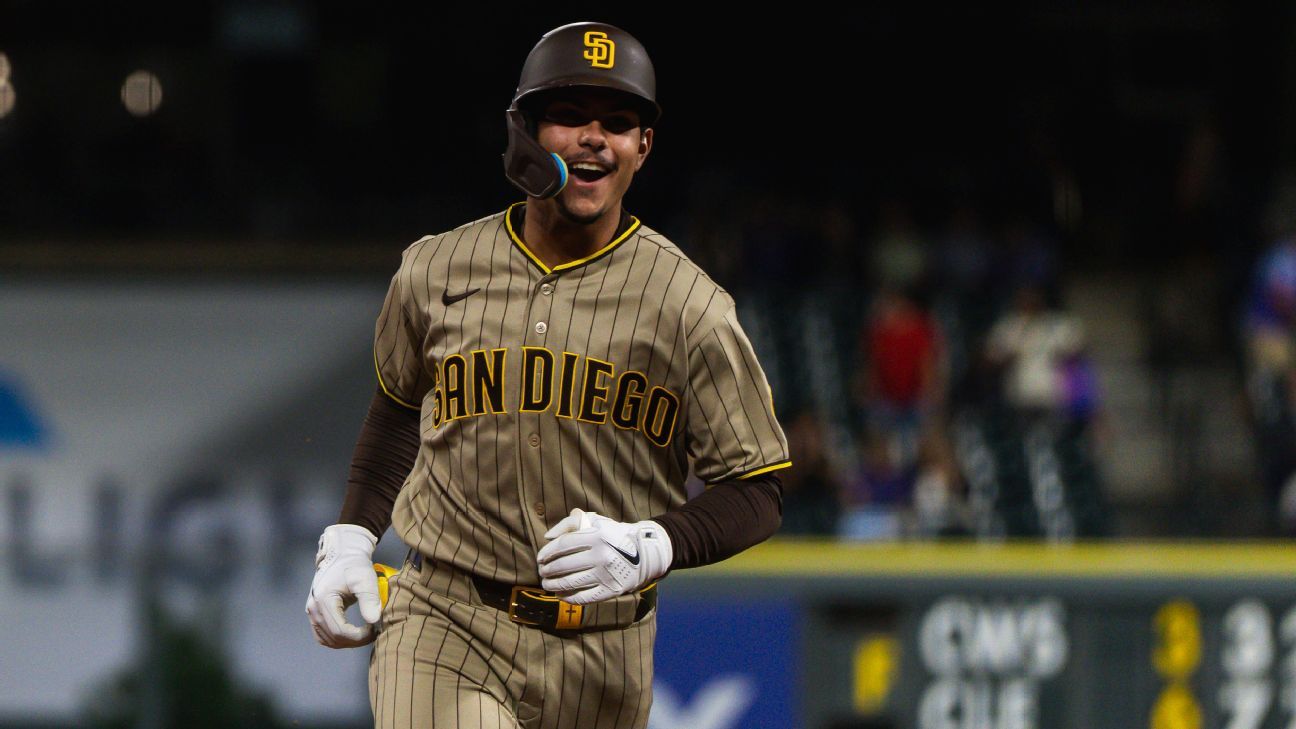
Ethan Salas hit his first two major league home runs in the same game Wednesday, becoming the youngest catcher ever to accomplish the feat at 20 years, 107 days old. The San Diego Padres beat Colorado 9-3, with Salas' 426-foot blast off Rockies starter Mason Adams in the second inning setting the tone. His second homer came in the fifth, a two-run shot that padded a margin already favoring the Padres. Salas broke a record that had stood for exactly 50 years—Butch Wynegar's mark from September 22, 1976.
The context here matters more than the novelty. The Padres entered this game clinging to a 2.5-game lead over Arizona for the final National League wild-card spot with 10 games remaining in the regular season. A nine-of-10 stretch had kept San Diego breathing in a tight playoff race. That Salas—a prospect still acclimating to big-league velocity—contributed two of the Padres' nine runs suggests the roster is accessing secondary power sources at precisely the moment roster depth becomes non-negotiable.
Robbie Ray pitched six innings of three-run ball for the Padres, striking out six against three hits. The underlying efficiency there is worth isolating: Ray induced contact that produced minimal damage despite allowing baserunners. But the offensive story cuts deeper. Samad Taylor and Ty France each drove in two runs. Jackson Merrill finished with three hits. The Padres scattered eight runs across seven innings without leaning on any single hitter for heroics—a distributional pattern that compounds scoring difficulty for any opposing pitcher.
For prop bettors, Salas himself represents acute uncertainty. A 20-year-old catcher with two career home runs in his major league debut game has zero reliable volume to project from. His hit total, RBI rate, and run-scoring frequency are all noise from a single-game sample. Vegas will almost certainly offer modest props on his next appearance (likely 0.5-1.5 total bases), but any two-homer performance in a rookie's first game is a statistical outlier that won't repeat; the market will price him conservatively in subsequent games, and the early underpricing of his next slate isn't an edge—it's just initial caution meeting novelty. That caution is warranted.
The real angle lives at the team level. San Diego's offensive variance expanded on Wednesday: they won 9-3 without a single player delivering an obvious anchor performance. That distributional redundancy—multiple contributors, no reliance on one star—is the inverse of a team that collapses when one hitter fails. The Padres' 83-69 record and mid-pack run differential entering this game suggested they'd been squeaking out wins; this one was clean. In a compressed playoff race where every final-week game carries elimination weight, the Padres' demonstrated ability to stack multiple offensive contributors (Taylor, France, Merrill, Salas, plus depth contributions from Cronenworth and Tatis Jr.) should inform team-total pricing. Padres team totals in remaining regular-season matchups should lean over, particularly against below-average pitching staffs, because the offense has shown it doesn't need any one hitter to carry the load.