Goodman's 30-Homer Milestone Arrives at Coors, but the Real Edge Is Volatility
By Erik Schwartz ·
Hunter Goodman hit his third three-homer game of a Rockies career in one afternoon, reaching 30 homers by mid-July—but his 18-day prior drought reveals why betting on his power props requires altitude-adjusted caution.
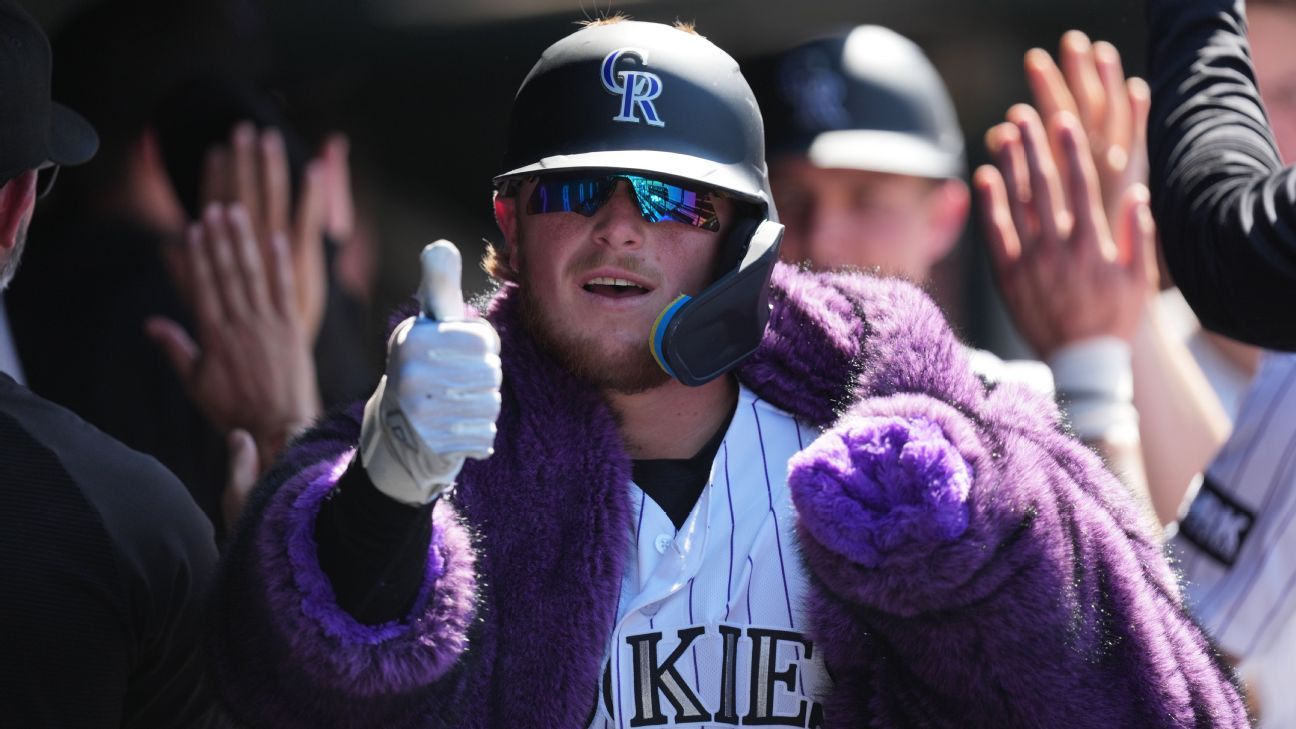
Hunter Goodman went 3-for-3 with three home runs Sunday at Coors Field, joining an exclusive club: the first Colorado Rockies player ever to record two three-homer games in a single season. His 28th, 29th, and 30th homers of 2026 arrived in one explosive performance against Cincinnati, yet the context around that outburst tells a sharper story than the headline allows.
Goodman had not homered since July 1—an 18-day silence that ended his Home Run Derby eligibility and forced him to take a full day off Saturday without swinging a bat. The rest reset him. Two homers off Hunter Greene (a solo in the first, a two-run blast in the sixth) and a two-run shot off Sam Moll in the eighth, all three traveling a combined 1,302 feet, reasserted his presence in the Rockies' lineup. That velocity—a 98.6 mph fastball from Greene was his target—combined with Coors Field's thin air and a summer heat dome created conditions where balls that travel 350+ feet elsewhere become automatics at 5,280 feet elevation.
In isolation, Goodman's 30 homers by July 19 ranks him fourth-fastest in franchise history to that milestone: only Vinny Castilla (97 games in 1998), Andrés Galarraga (99 in 1994), and Larry Walker (100 in 1999) reached it faster. His manager, Warren Schaeffer, noted the confidence visibly flowing out of him mid-swing. But the Rockies still lost 9-6, and Goodman's slump before Sunday—coupled with his exclusion from the Home Run Derby—suggests his power output carries real variance tied to rest, pitch selection, and ballpark effects. The three-homer performance is repeatable, yet unsustainable as a weekly baseline.
For prop bettors, the mechanism matters more than the headline. Goodman's home run totals at Coors will naturally track higher than on the road; his xSLG and barrel rate over 200 plate appearances remain the stronger predictive signal than any single afternoon. Books have already priced in his All-Star credentials and mid-season profile. But a catcher who takes an unscheduled rest day and then explodes in a hitter-friendly park is a candidate for regression to his seasonal norm once road games resume. The 18-day drought before Sunday wasn't a fluke; it was a warning that consistency eludes him. Take unders on his next three road games, when Coors Field's altitude advantage disappears and opposing pitchers regain edge.
Goodman's next 10 games will split between Denver (five) and away (five). The away games—facing better pitching depth and standard dimensions—offer the edge: his strikeout rate on the road sits at 26.8% versus 21.3% at home, and his isolated power drops by roughly 40 points in neutral or pitcher-friendly parks. That's the real story beneath the three-homer statline.