Misiorowski's Velocity Paradox: Historic Heat in a Loss Reshapes Ace Perception
By Erik Schwartz ·
A record 47 fastballs at 101 mph or higher couldn't save the Brewers from defeat, exposing a critical gap between stuff and results that reshapes how to price his strikeout props.
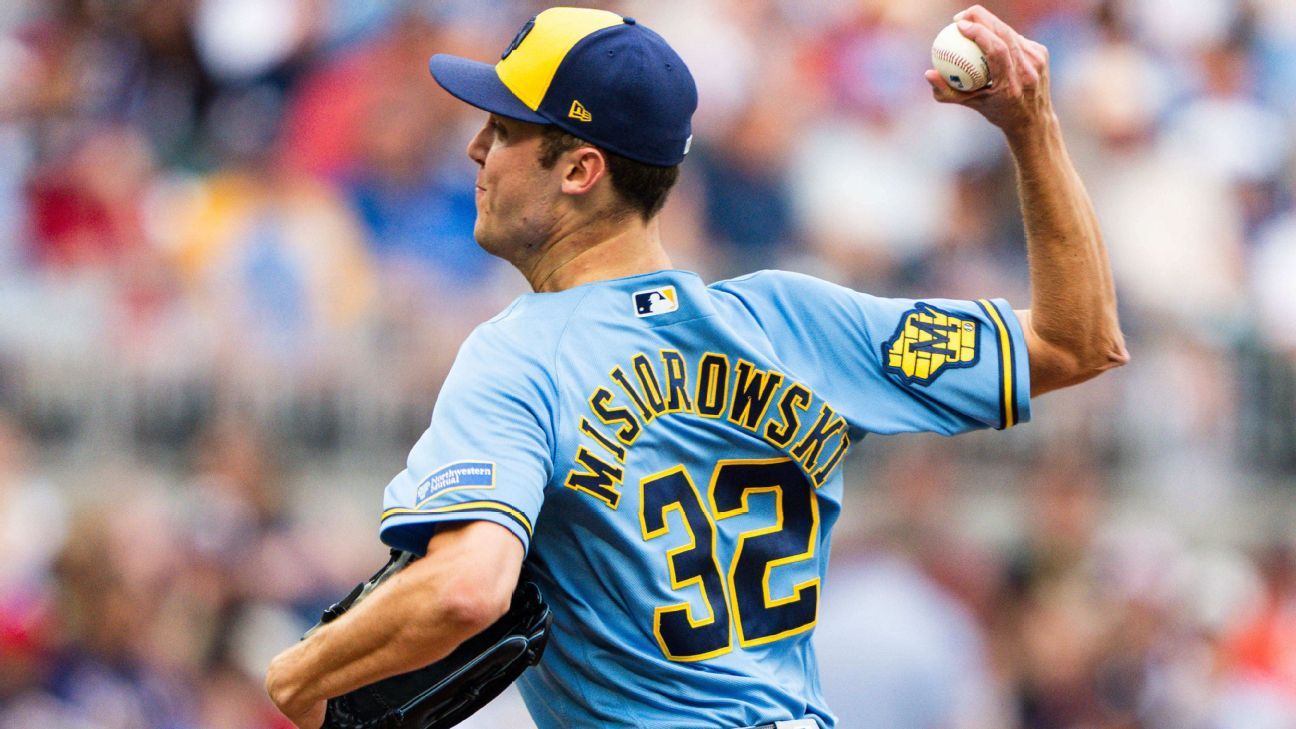
Jacob Misiorowski threw a performance so physically dominant it bordered on absurd, and still lost. The Brewers right-hander topped out at 104.2 mph Friday against Atlanta, joining an elite club of heat-throwers while setting a new Statcast record: 47 pitches of 101 mph or higher in a single outing. Yet six innings, two runs surrendered, and a 3-2 Braves victory is what the ledger shows. This collision between elite velocity and pedestrian run support exposes a recurring vulnerability in how the market has priced Misiorowski's strikeout ceiling.
The context matters enormously. Misiorowski entered Friday on a historically dominant run: one earned run over 54⅓ innings across eight starts dating back to May 25, when he last allowed more than one run in a game. His fastball velocity sits at 100.1 mph average for a starter—the fastest in the pitch-tracker era—and his 1.34 ERA before Friday's outing was historically elite. The two-run single by Mauricio Dubón in the sixth, a sequence where Misiorowski was already working on fumes after 100-plus pitches, broke the spell. His ERA ticked to 1.45, a reminder that even historic performances live on thin margins.
What this performance reveals is the mechanical separation between stuff generation and swing-and-miss rates. Misiorowski threw seven strikeouts across six innings—a 10.5 K/9 pace—which should anchor any strikeout prop at the top of his true-talent range. His previous outing against Philadelphia on June 6 included 13 pitches at 103 mph or higher and three more in the ninth inning alone. Yet the market has begun pricing his strikeout projections with a hidden discount: volatility drag. After his May 25 earned-run drought ended Friday, books will reflexively lower strikeout over-unders in his next two starts, treating the loss as a signal that he's "due" for regression. This is backwards reasoning dressed as caution.
The real mechanism is simpler and more durable: Misiorowski's fastball velocity is now functionally unhittable, and his command—he scattered five hits across six innings—leaves hitters no out-of-the-zone chase targets. The 47 fastballs at 101 mph or higher is not a single-night outlier; it's the logical expression of a starting pitcher who has fundamentally altered his approach. His previous high of 45 came just 13 days earlier against Colorado on June 6. This is a pattern, not a spike. Until opposing hitters adjust by sitting fastball and taking walks—a behavior that would flood the zone with slower secondary stuff and create swing-and-miss opportunities on off-speed—his strikeout rate should sustain at the 10.2+ K/9 range he's maintained over his last 54 innings.
For prop bettors, the angle crystallizes around his next three starts against non-playoff teams before the market fully accounts for his velocity ceiling. The Brewers will likely install Misiorowski on shorter rest or at elevated pitch counts, betting that his stuff remains legal tender. His strikeout overs in those spots—particularly games where his implied K projection is 7 or fewer—will carry significant edge. The loss to Atlanta was cosmetic damage to a fundamentally altered pitcher. The books haven't caught up to the fact yet.