Cubs Collapse Deepens: Ten-Game Skid Exposes Rotation Fragility
By Ty Whitney ·
Chicago's historic volatility—two 10-game winning streaks and now a 10-game losing streak in one season—masks a pitching infrastructure that can't survive injury.
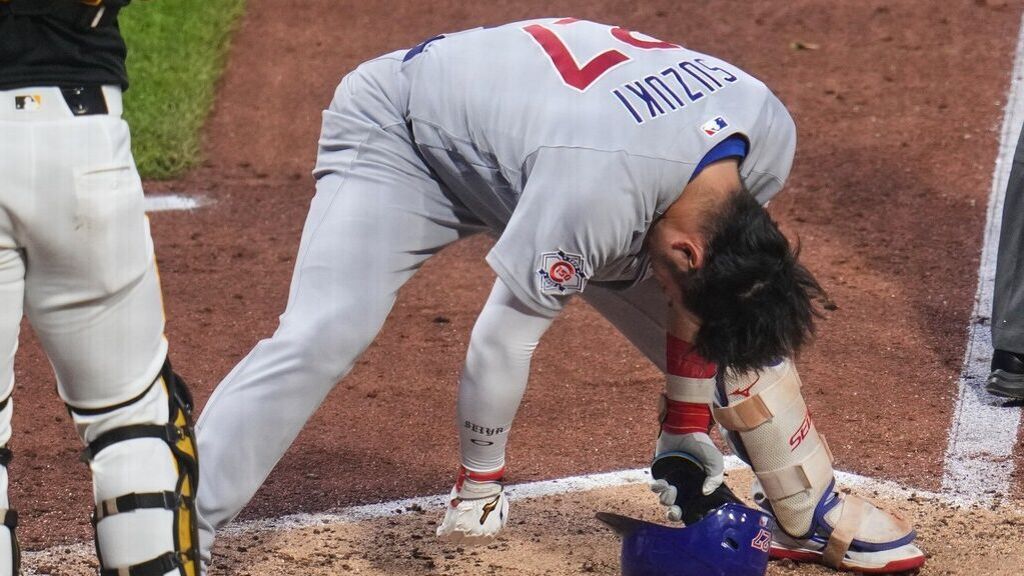
The Pittsburgh Pirates dismantled the Chicago Cubs 12-1 on Tuesday, extending the Cubs' losing streak to 10 games in a performance that revealed less about short-term momentum and more about organizational depth under duress. Esmerlyn Valdez, a 20-something rookie, crushed a two-run homer to cap a five-run first inning off Jordan Wicks, who was summoned from Triple-A Iowa on Sunday because the Cubs' rotation has been decimated by injuries. Wicks lasted 4⅓ innings and surrendered eight runs. This wasn't a coin-flip result—it was the predictable consequence of asking a minor-league fill-in to face a lineup that had just scored 35 runs in its previous three games.
The Cubs now occupy a statistical anomaly: they're the second team in baseball history—joining the 2017 Dodgers—to post two 10-game winning streaks and one 10-game losing streak in the same season. That volatility isn't random. It reflects a roster constructed to explode offensively when healthy and crumble defensively when the pitching staff thins. Chicago went 1-for-12 with runners in scoring position and stranded nine, a symptom of playing from behind after surrendering a five-run first. But the real damage was structural: Wicks' presence in a major-league game against a division rival is itself an admission that the Cubs can't sustain competition without their full complement of arms.
Braxton Ashcraft (4-3) threw 6⅓ innings of one-run ball for Pittsburgh, improving to 3-0 with a 1.82 ERA in five May starts. His stability against Chicago's offense—which managed only one run on seven hits—illustrates the chasm between a team with rotation depth and one flying blind. The Pirates have won three straight and are now positioned to exploit Chicago's vulnerabilities in Wednesday's Game 3 matchup: Bubba Chandler (1-6, 4.60 ERA) takes the mound for Pittsburgh, while the Cubs counter with Jameson Taillon (2-4, 5.20 ERA). Taillon's ERA sits well above 5.00, a sign that Chicago's injury crisis has forced load-sharing among arms that weren't built for regular late-March starts.
For bettors, the Cubs' collapse presents a directional short. Their 10-game losing streak coincides with forced rotational shuffling and offensive inefficiency in high-leverage situations (1-for-12 RISP). When a team is cycling emergency callups against opponents with stabilized starting pitching, underdogs gain structural advantage. Pittsburgh's three consecutive wins—each powered by multiple contributors, not a single star—suggest the Pirates are executing fundmentals rather than riding variance. Take the Pirates moneyline in Game 3 as a durable angle; the Cubs' next win will likely require a return to full rotation health, an event neither team can control in the next 24 hours.
Chicago's schedule ahead—facing a Pirates team that has found offensive rhythm and pitching stability—makes unders on the Cubs' team run total the secondary play. A team batting 1-for-12 in scoring position and trailing 5-0 after one inning isn't equipped to generate run volume in a short series against competent pitching. The Cubs' 10-game losing streak is historically rare, but the mechanism driving it—rotation collapse—is neither volatile nor quick to reverse.