Blake Dunn's Double Surgery Compounds Cincinnati's Outfield Crisis
By Erik Schwartz ·
A second elbow procedure in 43 days eliminates the Reds' most promising position-player prospect from contention and deepens an already-catastrophic outfield production deficit.
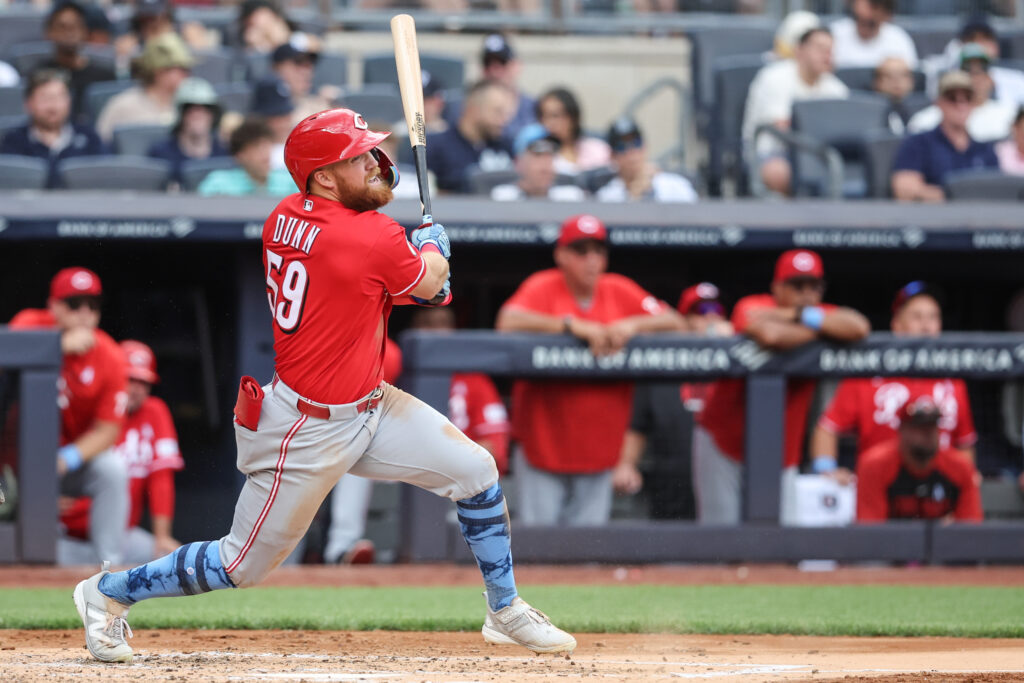
Blake Dunn will undergo ulnar nerve transposition surgery on September 16, marking the second procedure on his right elbow in six weeks. The 28-year-old outfielder had undergone an internal brace repair to his ulnar collateral ligament on August 3; the follow-up procedure, while not uncommon across baseball, compounds the timeline uncertainty around his availability heading into 2027.
The mechanism behind ulnar nerve transposition is straightforward: the procedure repositions the ulnar nerve from the medial side of the elbow to alleviate compression-related inflammation and pain. It's a secondary intervention, often necessary when initial UCL repairs don't fully resolve nerve involvement. Dunn's rapid progression from one surgery to the next suggests the internal brace alone didn't resolve the underlying compression issue. Historical precedent offers modest hope—Pirates prospect Endy Rodríguez returned to game action by spring training 2025 following his ulnar nerve procedure in August 2024—but Dunn's compressed timeline (back-to-back surgeries rather than a single intervention) introduces additional variance into any recovery projection.
What makes Dunn's injury particularly damaging to Cincinnati's 2027 planning is not Dunn's individual projection, but the context into which he was supposed to fit. The Reds' outfield has produced a .213/.297/.350 slash line in 2026—the worst in baseball by batting average and slugging percentage, with a 79 wRC+. TJ Friedl, locked into center field at the start of the season, has cratered to .167/.247/.247 across 88 games and faces non-tender consideration. Noelvi Marte, once a top organizational prospect, has been optioned multiple times and hasn't provided production. JJ Bleday, acquired off waivers, hit .272/.367/.586 in his first 188 plate appearances but collapsed to .180/.301/.311 in his remaining 317 trips. Even Héctor Rodríguez, another prospect pushed into action, sits at .230/.281/.389 in 121 major league plate appearances. Dunn, despite limited opportunity in 155 plate appearances, was one of the few bright spots—a .282/.335/.387 hitter with improved plate discipline (21.3% K rate, down from 34.6% in his early exposure) and legitimate speed (six stolen bases on solid efficiency). His minor league track record—.282/.391/.428 over six seasons—signaled a player who could eventually carve out a steady role in the majors.
For betting purposes, Dunn's absence removes one of the few plausible upside levers Cincinnati could have deployed to improve its team offensive output. The Reds' inability to generate competitive outfield WAR creates persistent downward pressure on their team totals and run-line value. With Dunn sidelined through at least spring training—and likely into early 2027 given the dual-surgery timeline—Cincinnati enters the offseason without a clear cost-controlled offensive reinforcement for a position group that has hemorrhaged production. Any Reds team total prop positioned for early 2027 should account for the possibility that their outfield remains substandard even after front-office additions, since internal development has yielded almost nothing. The gap between expectation (a prospect-laden organization) and reality (the worst-producing outfield in baseball) suggests unders on Cincinnati team totals carry value if the market hasn't fully adjusted for the structural depth of their outfield crisis and Dunn's extended absence.
Recovery timelines for dual-procedure elbows are inherently noisy. Dunn may return on schedule by April 2027; he may also face setbacks that push availability into May or June. The Reds' already-barren outfield depth chart means there is no margin for error.