Pérez's Four-Inning Exit Signals Durability Risk for Marlins Rotation
By Erik Schwartz ·
A hamstring spasm forced the 23-year-old right-hander out early despite dominant stuff, raising questions about his availability and the stability of Miami's injury-ravaged pitching staff.
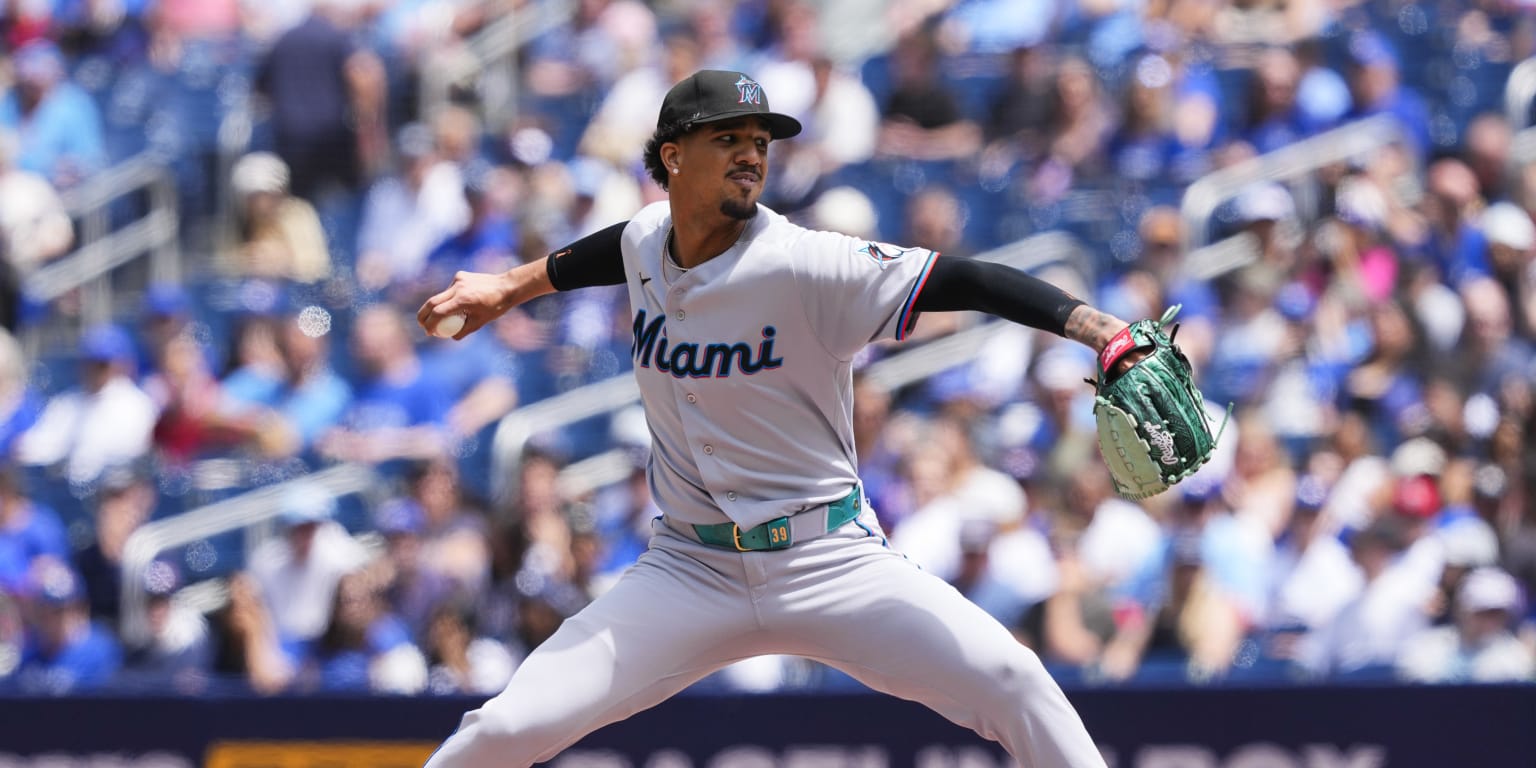
Eury Pérez exited the Marlins' Wednesday loss to Toronto in the fifth inning after suffering a right hamstring spasm, cutting short what had been one of his sharpest outings of the season. Over four scoreless frames, Pérez struck out nine batters on 73 pitches, threw a 101 mph fastball (second-fastest of his career), and allowed only three hits while walking nobody for the second consecutive start. The stuff was there. The control was there. The durability was not.
The injury itself—a hamstring spasm, not a strain or tear—leaves room for optimism about recovery timeline. But the mechanism matters: Pérez was observed stretching his shoulder and jumping between innings to stay loose, then visibly winced once he sat down in the dugout. This wasn't a sudden, violent moment. It was a body signaling accumulated fatigue in a muscle group responsible for explosive lower-body drive in the pitching motion. For a 23-year-old still ramping up his workload, hamstring issues often precede larger structural problems if not managed carefully.
Miami's rotation is already fragile—Sandy Alcantara had to help Pérez down the tunnel, a reminder that the Marlins' ace is operating in a limited capacity. The bullpen inherits innings unpredictably, and uncertainty compounds with every early exit. Michael Petersen took over in the fifth and surrendered the tying run, a sharp reminder that replacement-level arms cannot match what Pérez was generating (nine strikeouts in four innings tracks to a 20.25 K/9 rate; his season average sits around 10.8).
For prop bettors, Pérez's exit tightens the margin for plays that depend on his presence and velocity. His strikeout prop is built partly on pure stuff (that 101 mph fastball is elite for his age) but also on longevity within a game. If he's exiting by the fourth or fifth inning regularly, the qualifying thresholds on K props shrink—fewer opportunities to accumulate outs. More critically, Marlins team totals and over/unders on games he's scheduled to start now carry elevated variance. If Pérez can't go five-plus innings consistently, Miami loses a innings-eating starter and forced to lean on a thin bench. That shifts the math on total runs in a game, especially in a division where every run matters.
Watch the team's medical updates closely over the next 48 hours. If Pérez is ruled day-to-day, his next start is a fade-until-confirmed scenario for any prop tied to his output or durability. If imaging clears him for a return within a week, the strikeout props may be underpriced short-term—books will assume a full ramp-up, but a hamstring issue often means a conservative workload cap. That gap between market expectation and actual usage is where the edge lives.