A Baserunning Call Reshapes the AL East—and Opens Questions About Umpire Consistency
By PropBetEdge Editorial Team ·
Baltimore's loss to Toronto pivoted on a divisive ruling that cost the Orioles an inning-ending double play, exposing a gap between manager intent and field interpretation that bettors should monitor.
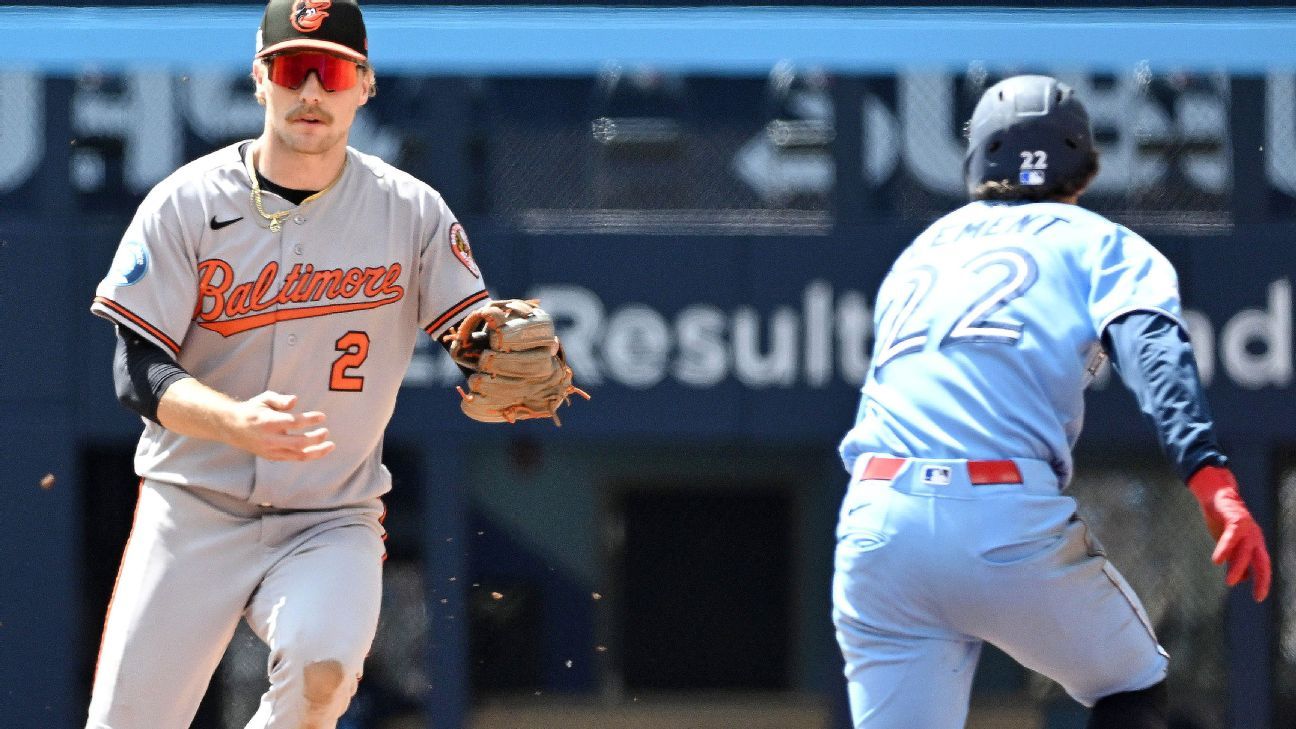
The Orioles lost 6-4 to Toronto on Sunday when umpire Nic Lentz ruled Ernie Clement safe at second base after he swerved to avoid a tag attempt by Gunnar Henderson—a decision that prevented a double play and allowed the Blue Jays to rally from a 4-1 deficit. The call hinged on whether Clement had the right to establish a base path outside his normal line to avoid interfering with Henderson's fielding motion. Lentz determined he did; Orioles manager Craig Albernaz and Henderson himself disagreed sharply, with Henderson calling it "super frustrating" and Albernaz arguing that any visible tag attempt—however minimal—should trigger the interference rule.
The substantive issue is less about whether Lentz was right and more about what his interpretation signals going forward. Albernaz's argument is mechanically sound: a fielder's glove extension constitutes an attempted tag, and a runner's obligation to stay in the baseline doesn't evaporate because that baseline would impede a play in progress. But Lentz and crew chief Hunter Wendelstedt both framed Clement's movement as a "gentlemanly" courtesy to Henderson rather than an evasive maneuver. That framing creates ambiguity. In future games, runners will now test how far they can sidestep before an umpire considers it interference. Shortstops will wonder whether a half-hearted tag attempt—glove extended but body weight held back—will get the call Lentz gave here.
For betting purposes, the immediate impact is Baltimore's bullpen management and leverage in close games. The Orioles' pitching staff entered Sunday with a 3.64 ERA in the sixth inning and beyond, above their 3.41 season mark. Losing this particular game on a judgment call compounds the psychological toll in a tight division. More concretely, if similar situations arise late in close games—runner on first, less than two outs, potential double-play ball—the uncertainty Lentz introduced means the probability of that double play being turned has compressed. Orioles bettors should factor in a modestly higher expected runs-allowed in sixth-inning-plus scenarios where Henderson or other infielders face borderline tag situations.
Beyond Sunday's final score, the real angle for prop bettors is tracking whether this interpretation becomes league-wide or remains an outlier. If similar calls show up in the next 10-15 games involving bases-loaded situations or late-inning double-play attempts, it signals a coordinated umpire shift toward runner safety and away from fielder protection on tag plays. That would depress double-play ball odds league-wide and inflate expected runs in innings six through nine. If the call fades and we see stricter enforcement of the baseline rule resume, this was noise—a single ump's interpretation that evaporates within a week. Right now, given the visibility of the controversy and the managers' public pushback, expect other crews to narrow rather than broaden Lentz's precedent. That means the edge here is temporary: fade overs on Baltimore total runs allowed in the next two games while the umpire fraternity regresses this call back to standard interpretation.