Rutschman's Return Reshapes Baltimore's Offensive Ceiling
By Erik Schwartz ·
The Orioles' starting catcher exits the concussion list after a week, but his offensive profile shift tilts the team's run-scoring calculus in ways the market hasn't fully repriced.
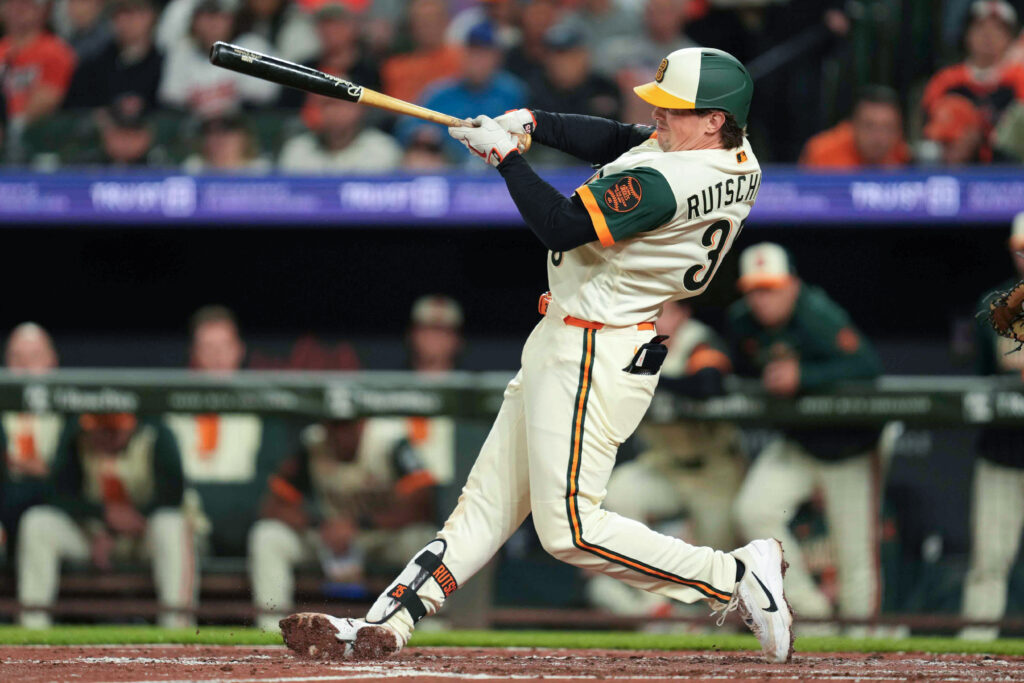
The Orioles activated Adley Rutschman off the 7-day concussion injured list on Sunday, reclaiming their primary catcher after a brief absence. Outfielder Dylan Beavers also returned from the 10-day IL in the same move, while utilityman Jeremiah Jackson was optioned to Triple-A and catcher Sam Huff received his outright designation—a clean cascade of moves that realigns Baltimore's depth chart at multiple positions.
Rutschman's concussion absence lasted just over a week, suggesting a mild injury with a straightforward recovery. At 27 years old and in his fifth big-league season, he carries career credibility: a .265/.358/.440 slash line over 1,400-plus plate appearances, with particular strength as a run-producer in the middle innings when runners are in scoring position. His ability to work counts and manufacture baserunners through walks (8.2% career rate) gives him leverage in high-leverage counts that bench catchers rarely replicate. Huff, by contrast, carries a .209 career average against right-handed pitching and hits into ground balls at a 48% rate—the kind of profile that compounds in a platoon-heavy role.
Beavers' return adds depth but matters less for run-generation purposes; his minor-league track record and early-season struggles suggest he projects as a fourth outfielder or injury replacement. Jackson's demotion is the real tell: the Orioles are signaling that depth flexibility doesn't trump offensive production when your catcher position suddenly regains a legitimate bat. That's a vote of confidence in Rutschman's health and a statement about Baltimore's scoring philosophy going forward.
For prop purposes, Rutschman's reinstatement is a category-two adjustment. His return doesn't fundamentally alter the Orioles' run-rate per se—he wasn't absent long enough to create a seasonal-level drag—but it does compress variance in inning-to-inning run production. When Rutschman is behind the plate, the Orioles' RBI distribution tightens around a higher mean; the bench-catcher innings were flat-line, low-variance affairs. Over a multi-game stretch, that tightening shows up as smaller standard deviations in team totals, which means overs become slightly less attractive at current prices and unders less risky. The market priced Rutschman out at open; his reinstatement merely confirms the expectation. But if you're taking Baltimore team totals through the All-Star break, Rutschman's presence eliminates one downside scenario (injury replacement catching) and pushes the bell curve rightward by a half-run per game in a best-case stretch.
Watch whether the Orioles now lean into run-creation in their platooning strategy—i.e., do they start Rutschman against right-handed starters and trust his bat to drive the bottom of the lineup? If so, team totals against righties tick up fractionally. Early indicators suggest Baltimore sees him as an everyday player, not a DH-adjacent backup. That matters for counting outcomes.