Kazuma Okamoto's Stance Adjustment Has Turned Toronto's Biggest Bet Into a Top-10 Hitter
By Erik Schwartz ·
One mechanical tweak — moving back in the box by more than half a foot — may have unlocked the most important hitter on a Blue Jays roster that badly needs a middle-of-the-order anchor.
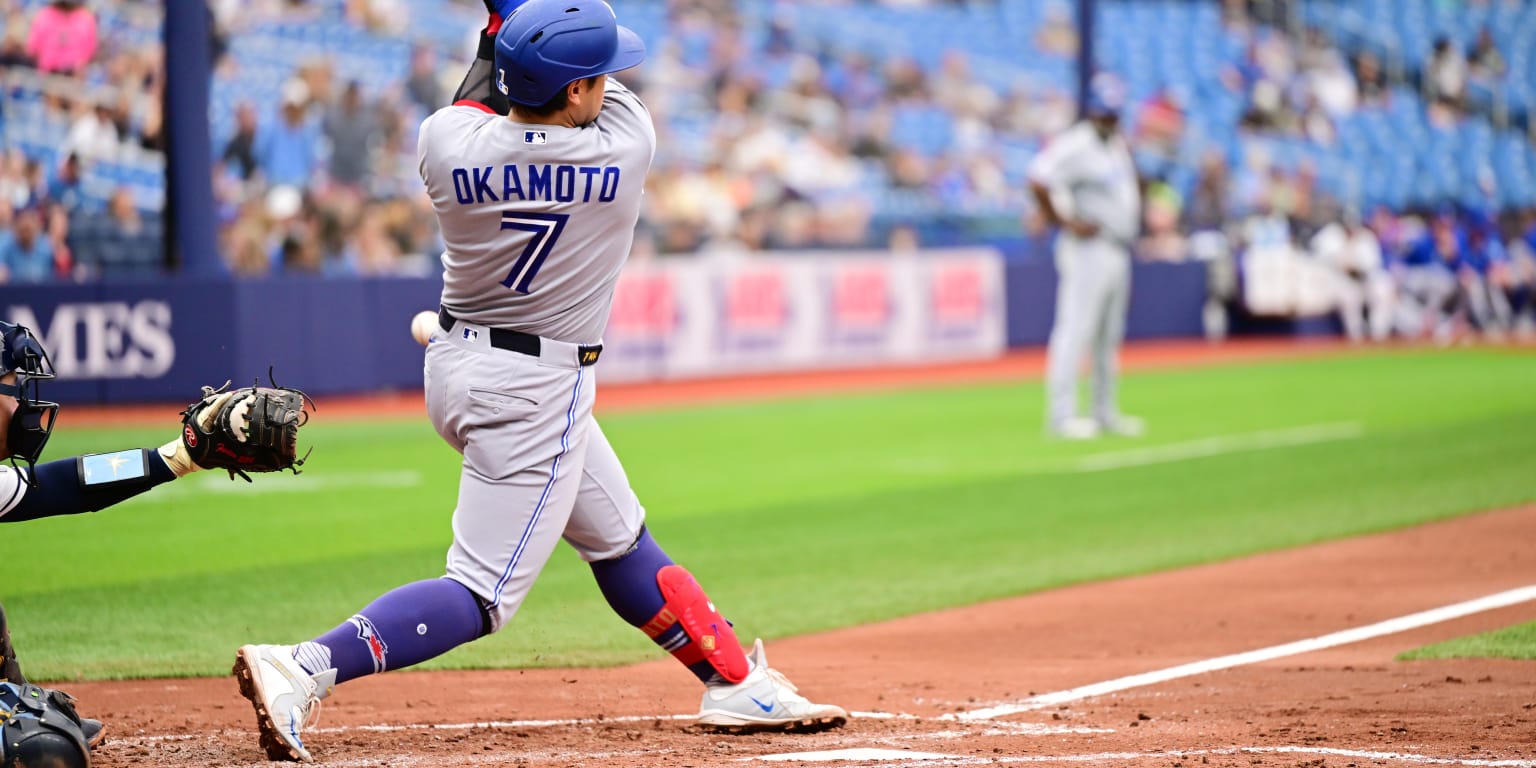
Kazuma Okamoto was struggling. Three consecutive hitless games, six in his previous seven, and a slash line of .188/.263/.290 through his first 18 MLB appearances — exactly the kind of early turbulence that turns an offseason acquisition into a cautionary tale. Then, on April 18 in Arizona, the Blue Jays' marquee offseason addition moved deeper in the batter's box. Not a subtle tweak — a full 6.8-inch repositioning, from 20.9 inches behind the front of home plate to 27.7 inches. He went 2-for-4 that day, 2-for-4 the next, including a home run. Over the 18 games since, as MLB.com reported, his line stands at .308/.400/.708, placing him among the top 10 hitters in baseball over that stretch.
The mechanics behind the turnaround are worth understanding. Okamoto entered the league with well-documented vulnerabilities to breaking balls — every advanced scout noted it, and the numbers confirmed it quickly: ten of his first 11 hits came off fastballs. Standing 20.9 inches deep put him in front of the plate relative to most big-league hitters, which is a fine approach for guys who want to catch velocity before it fades — but it leaves a right-handed power hitter with shorter reaction time on spin, and less plate coverage on breaking stuff that moves away or down late. Moving back to roughly league-average depth (27.7 inches) buys Okamoto a fraction of a second more to read pitch shape, and the slight inside move — about an inch and a half closer to the plate — theoretically tightens his coverage on pitches that try to run off the outer edge.
The results are not subtle. When Okamoto lined a double off Shane McClanahan on Wednesday, the exit velocity registered 112 mph — the second-hardest contact of his MLB career. Against one of the better left-handers in the American League, that's not noise. That's a hitter who has found his timing. The Blue Jays just swept Tampa Bay — historically one of their worst venues — and while the roster still has questions up and down the lineup, Okamoto is clearly the engine right now. A .308 average with a .708 slugging percentage over any 18-game stretch is elite production regardless of context.
For bettors, this stretch has direct implications for Toronto's team total and Okamoto's individual prop lines. His altprop total bases number has been mispriced by books that anchor to his cold first three weeks — any line sitting at 1.5 total bases deserves a serious look given his current .708 slugging pace and his demonstrated ability to drive the ball at 112 mph. His HR prop is equally relevant: three weeks of suppressed power numbers followed by a mechanical fix that has produced multiple multi-hit, extra-base-hit games suggests the market hasn't fully repriced him yet. Books adjusting slowly to a hot streak on a player most casual bettors haven't heard of creates a window.
The Blue Jays' team total also bears watching. Toronto's offense was anemic for stretches early in the season, but a middle-of-the-order hitter posting an OPS above 1.100 over the last three weeks changes run-scoring projections meaningfully. If Okamoto continues at even 75 percent of this pace, Toronto's run expectancy climbs — and team totals set around 4 or 4.5 against mid-tier pitching staffs start to look thin. This is a hitter in form, with a mechanical explanation behind the run. Bet accordingly.