Ohtani's Two-Way Load Test: Why His Shortest Start Signals Durability Over Dominance
By Erik Schwartz ·
The Dodgers flipped their workload strategy for Ohtani's dual role, batting him leadoff on his pitching day—and his 88-pitch outing reveals why load management may matter more than innings pitched.
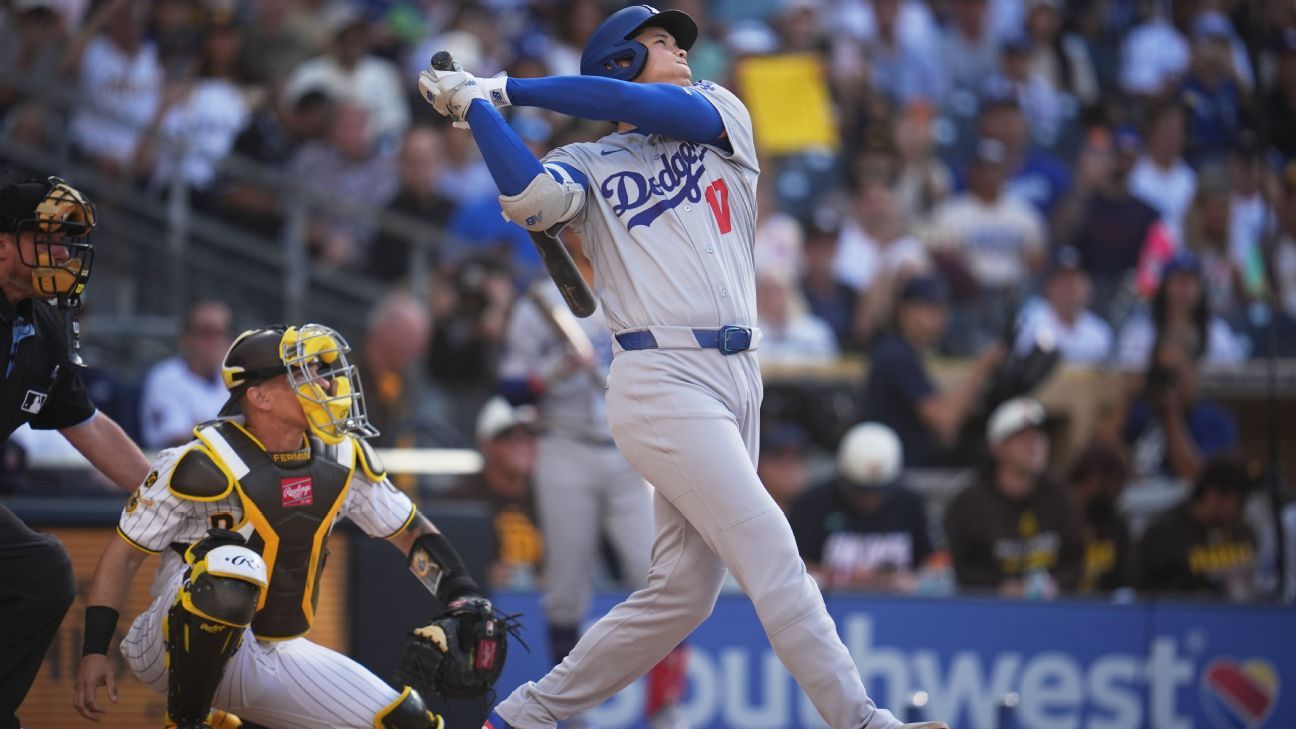
Shohei Ohtani returned to the Dodgers' lineup on his start day Wednesday, homering leadoff before pitching five innings in a 4-0 victory over San Diego. It was a rare alignment—only a handful of two-way players have batted leadoff while starting, and Ohtani is the only one ever to homer doing both simultaneously. Yet the more revealing number wasn't his power stroke: it was 88 pitches, his shortest start of the season, which he threw despite needing a double-play to escape a bases-loaded jam in the fourth.
Ohtani retired the first nine hitters in order but labored to do it, burning 52 pitches through three innings. His fastball velocity ticked down noticeably by the fourth—high-90s gas softening into the mid-90s range—a sign that dividing his energy between batting and pitching within hours does carry a real physiological cost. He triggered an emotional double-play ball on his 88th pitch to Fernando Tatis Jr., leaving the game with a 0.73 ERA, the lowest mark through eight starts for any Dodgers pitcher since Fernando Valenzuela in 1981.
The interesting wrinkle is strategic, not accidental. Manager Dave Roberts revealed that the Dodgers had kept Ohtani out of the lineup on his start days for three straight turns through the rotation, believing the toll compounded the next day rather than the day-of. That hypothesis—that rest on start day, plus play the next game, produced worse body management than batting leadoff then pitching—prompted them to reverse course. The shorter outing supports the theory: by pitching just 88 pitches (and five innings), Ohtani stayed under the physiological ceiling that longer, higher-stress outings might breach.
For prop bettors, this setup matters because it reframes Ohtani's pitching lines away from a pure performance model and into a managed-workload model. Over his next 8-12 starts, expect the Dodgers to continue this pattern—bat him leadoff, keep his pitch counts compressed, pull him early if early exits don't threaten the game. That changes the profile of strikeout props and ERA projections. Ohtani's K rate over this stretch will likely deflate not because he's lost command but because he's averaging 85-90 pitches per outing instead of 95-105. His ERA will remain elite (0.73 baseline is extraordinary), but over-under props on total strikeouts in a game become undervalued when the public still prices him as a full-load starter. The market hasn't yet priced in that the Dodgers are treating his pitching days as limited, high-efficiency events, not dominant-innings showcases.
Roberts acknowledged the variance: "I think it's just another case in point that it's good for us to be mindful of the workload." Translation: durability beats innings. For bettors, that means fading Ohtani strikeout overs in start-day lineups and leaning under on his pitch-count projections. The edge is durable because it's organizational strategy, not a one-game adjustment.