Misiorowski's 15-K Masterclass Resets the Strikeout Ceiling for Milwaukee
By Erik Schwartz ·
A complete-game one-hitter on 95 pitches extends a historic run that has the Brewers' young ace operating in a different stratosphere than the market has priced.
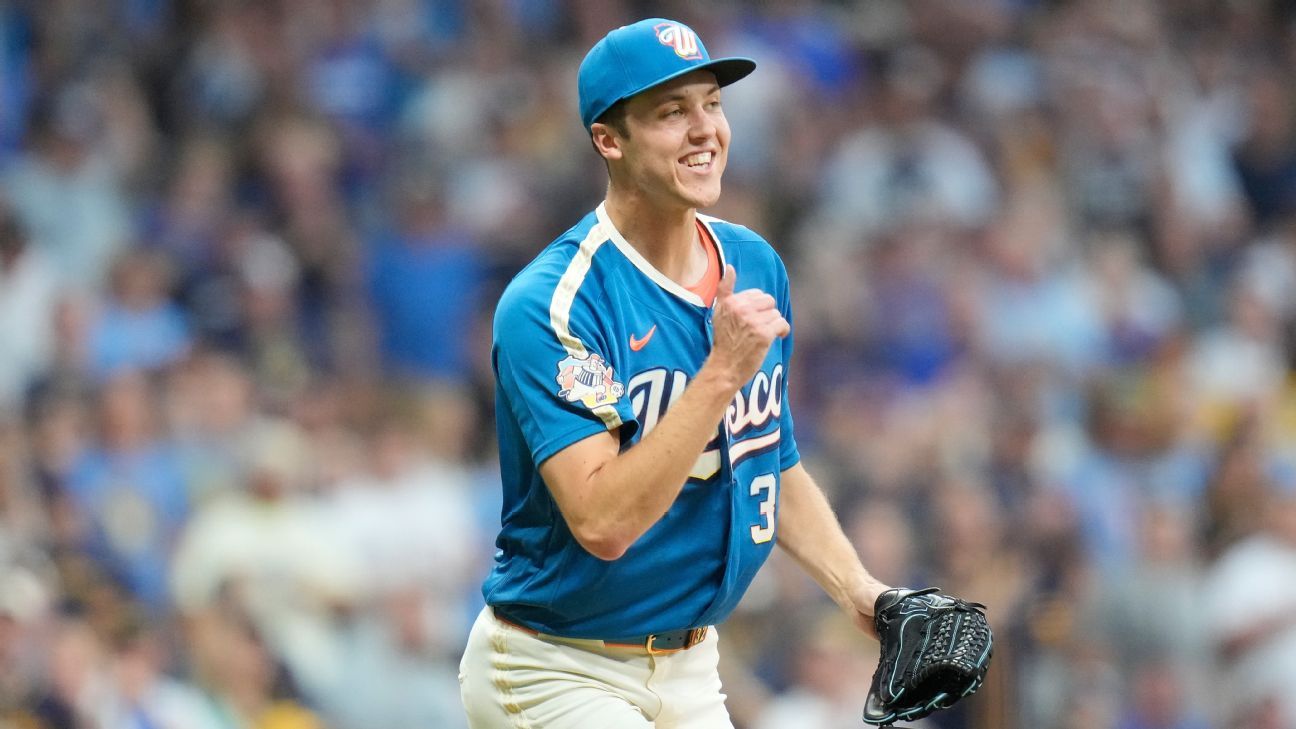
Jacob Misiorowski delivered a performance Friday night that belongs in historical context: 15 strikeouts, one hit allowed, zero walks, a 6-0 shutout, 95 pitches. He became the first pitcher since 2000 to throw a complete game with 15 strikeouts while staying under 100 pitches—a feat that combines rare dominance with remarkable efficiency. He struck out Justin Crawford to seal it, raising his hands in celebration as American Family Field erupted. The Brewers dismantled Philadelphia 6-0 to bounce back from dropping the final two games of their series in Las Vegas.
What makes Friday's outing quantifiable is not just the strikeout total—it's the pattern it extends. Misiorowski has now posted eight consecutive starts with eight or more strikeouts and one or fewer runs allowed. That streak is the longest in MLB since at least 1893, per ESPN Research. This is not variance. This is a pitcher operating inside a sustained window where he is missing barrels with systematic precision and generating weak contact at a rate that simply doesn't belong to a mid-rotation talent. The 74 strikes on 95 pitches tells the real story: command-grade control paired with plus-plus stuff, the kind of pairing that doesn't usually coexist in a single young arm.
The structural advantage Misiorowski is mining centers on one repeating dynamic: opposing hitters are chasing out of the zone at elevated rates. When a pitcher can hold traffic to one hit across nine innings, it's not random sequencing—it's a function of either overpowering stuff that looks unhittable or a breaking ball so sharp that contact never happens on equal terms. Misiorowski is doing both. His strikeout rate in this eight-game window sits well north of what we'd project for a full season, which creates the immediate market question: has the public line on his strikeout props adjusted to reflect an eight-game anomaly, or is it still anchored to his preseason baseline?
For bettors chasing his strikeout line in his next start, the mechanism is clear. Misiorowski's K rate over this eight-game run should be treated as a new floor, not an outlier, because it's tied to a specific skill set—command and swing-and-miss combination—that persists from game to game. If the books have kept his strikeout line static or adjusted it only modestly upward since the season began, there is an edge in leaning over that line for at least the next 2-3 starts. The longer the streak extends, the more durable the edge becomes. What started as a promising young arm has shifted into genuine ace-trajectory territory, and the market has not fully repriced that step function. The one-hitter on Friday was the punctuation mark, not the noise.