Misiorowski's Velocity Doesn't Stop at the Radar Gun—It Stops Him Cold
By PropBetEdge Editorial Team ·
Milwaukee's hardest-throwing starter has abandoned two of his last three outings due to muscle cramps, and the pattern points to a physical load his recovery protocols haven't yet solved.
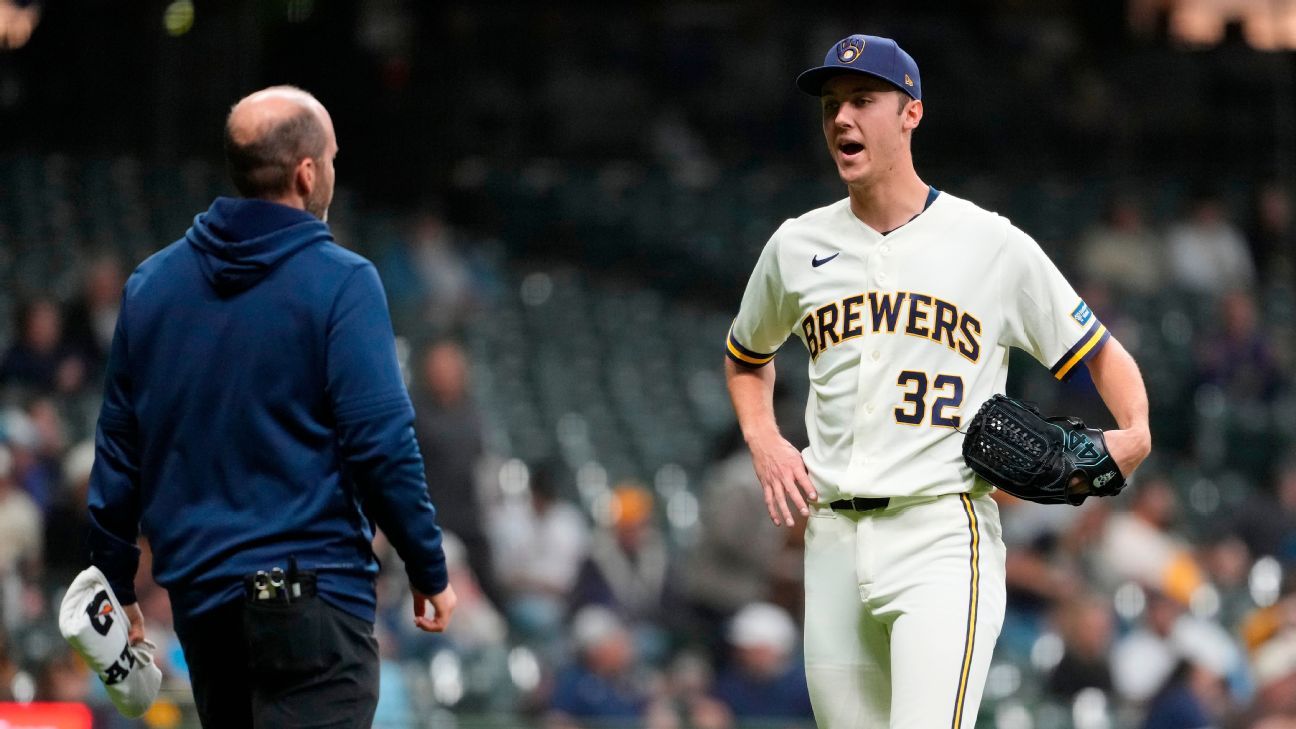
Jacob Misiorowski left Wednesday's start against San Diego after one warmup pitch in the eighth inning, his right quadriceps seized. It was the second cramping exit in three starts—the first, on May 1 against Washington, came from his right hamstring. The Brewers lost the game 3-1 after the Padres rallied on a Gavin Sheets three-run homer once Misiorowski departed his dominant effort: 10 strikeouts, four hits, no walks, seven scoreless innings. Neither the pitcher nor the organization seems alarmed. "Nothing we haven't seen before, so it'll be fine. I'm ready to go," Misiorowski said. His manager Pat Murphy echoed the sentiment, attributing the cramping to Misiorowski's intensity and the team's medical resources.
The cramping pattern, however, traces directly to Misiorowski's throwing workload—a measurable, not anecdotal, cause. The 24-year-old right-hander fires harder than any other starting pitcher in baseball. On May 9 against the Yankees, he recorded 10 pitches at 103 mph or higher, including three at 103.6 mph, the highest velocity any starter has reached since PITCHf/x began tracking in 2008. On Wednesday, he threw 40 pitches of 100 mph or higher—his third straight start clearing that threshold. To put that volume in context: elite fastballs in the high 90s demand extreme mechanical stress and muscular recruitment. Misiorowski isn't just throwing fast; he's sustaining it across 90+ pitches per outing. Cramping at the end of high-leverage innings (both exits came in the seventh-plus) suggests his legs lack adequate hydration or electrolyte reserves by that point, or his conditioning hasn't scaled to match the neurological and metabolic toll of repeatedly hitting triple-digit velocities.
Misiorowski has also racked up 35 strikeouts in his last five starts, averaging 8.8 K per game and establishing a streak of at least eight strikeouts in five consecutive outings—tying Ben Sheets for the second-longest such run in Brewers franchise history. That dominance is real and verifiable. But the cramps are equally real, and they've cost Milwaukee two competitive games and forced early exits that fracture his ability to reach deeper into contests. The team's confidence in their medical staff is warranted, but confidence isn't a mechanistic solution to dehydration or electrolyte depletion at the tail end of a 93-pitch outing loaded with max-effort deliveries.
For prop bettors, Misiorowski's situation creates a two-sided risk that traditional models are slow to capture. On the positive side, his strikeout production remains elite—his 10.2 K/9 rate and velocity profile suggest his strikeout totals (likely posted in the 8–10 range per game) are underpriced relative to his underlying stuff. He hasn't allowed a run in his past three outings, a stretch that extends his value in pitching lines built on ERA or runner-scoring models. But on the negative side, the cramping exits mean his innings ceiling is volatile and capped—he's unlikely to pitch past the seventh or eighth inning, which artificially suppresses team-total betting value and creates edge for unders on Brewers team totals in his next two to three starts as the team works through his conditioning protocols. The innings floor risk (early exit, relief bullpen stretched) compounds when Milwaukee is favored or in a tight game; those scenarios demand deeper starters, and Misiorowski may not deliver them until his body catches up to his arm.
The Brewers' medical team will adjust electrolyte protocols, load management, or both. But the mechanism—elite velocity sustained across a full outing—won't change unless Misiorowski's usage does. Until conditioning visibly improves, treat his K props as legitimate overs against soft defenses, but fade anything betting on Milwaukee's ability to manufacture runs late in his starts.