Meyer's Neck Strain Derails Marlins Rotation as Breakout Season Hits Pause
By PropBetEdge Editorial Team ·
Miami's surprise starter is headed for an eight-week absence, gutting a pitching staff already thin on depth and decimating team total expectations for August.
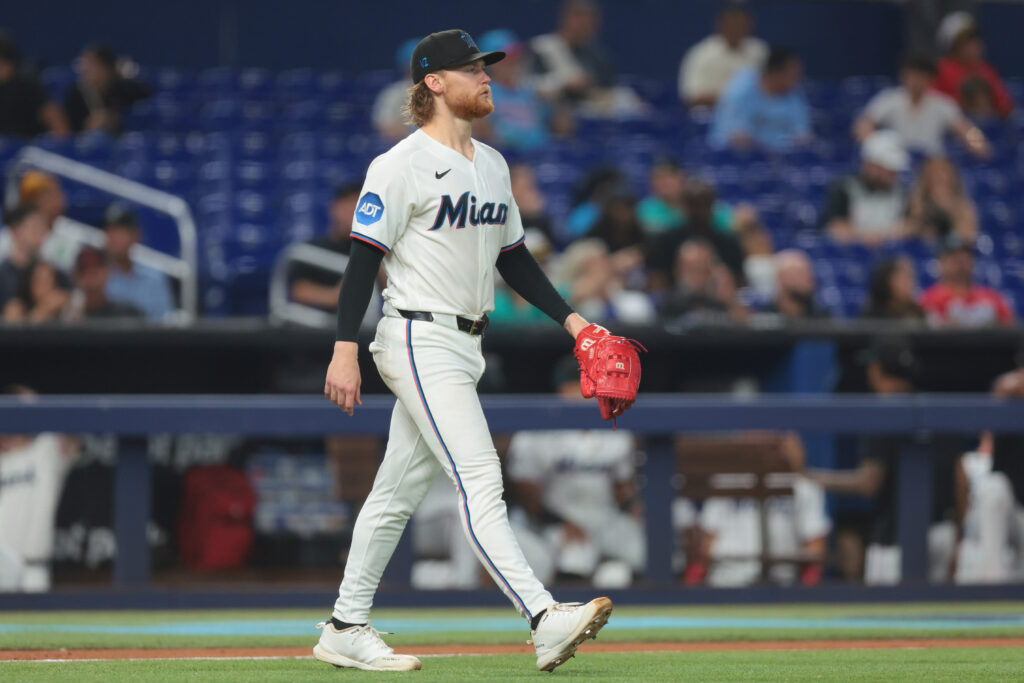
Max Meyer hit the injured list Monday with a neck strain that has now triggered a two-week throwing shutdown, per MLB.com. The right-hander won't resume any throwing activity before early August, followed by a mandatory ramp-up period that will likely cost him most of the month. For a Marlins club still clawing at Wild Card positioning, the loss of their brightest rotation arm arrives at precisely the wrong moment—mid-July, when September playoff calculus already favors teams with full rotational depth.
Meyer's injury compounds a season-long pattern of durability concerns. He missed all of 2023 recovering from Tommy John surgery, then saw his 2025 campaign ended in early June by a hip injury. This year's neck strain surfaced after his July 7 outing, though Miami didn't disclose details until the IL placement. The Marlins skipped his final start before the All-Star break to rest him, suggesting the discomfort was already known. Meyer labored through three innings in his first post-break appearance against Milwaukee—74 pitches, two earned runs, three walks—before the injury's severity became public. At 111 innings pitched through his twentieth start, he's approaching workload territory where soft-tissue injuries compound. His previous professional high of 115 innings came in 2024 (split between Triple-A and majors), and an eight-week absence virtually guarantees he'll surpass that ceiling only if he rushes back.
What makes Meyer's absence particularly damaging is the quality of what Miami is losing. The 27-year-old has delivered the best season of his career: a 2.68 ERA with a career-high 26.2% strikeout rate and elite breaking-ball execution. His sweeper and slider combine for a 99th-percentile Run Value ranking, sitting at the 5th and 12th best among all qualified pitchers in those respective metrics. Even accounting for a generous .262 BABIP, his 3.80–3.85 xERA/SIERA profile remains well above his historical baseline. He'd carved himself into a legitimate mid-rotation asset. The Marlins have no ready replacement. Braxton Garrett made a spot start at Triple-A yesterday and was hammered for seven earned runs over 2⅔ innings. Bradley Blalock carries a 6.14 ERA with Jacksonville. Top prospect Karson Milbrandt has imploded in July with a 14.09 ERA across three appearances. Miami will cycle bullpen games and lean on Sandy Alcantara, Eury Perez, and Janson Junk to carry the load—a thin roster suddenly thinner.
The betting implications radiate outward in concentric circles. Miami's team total will compress across their August schedule as Meyer's absence unfolds. With Alcantara aging and Perez unproven, the rotation's ERA floor rises materially. Every replacement starter Meyer's absence forces into the rotation carries an expected ERA 0.7–1.2 runs higher than his seasonal mark. Over a 15-game span (roughly 110 innings distributed across five starters), that differential translates to 12–18 additional earned runs allowed. Against a Marlins club already struggling at the margins of playoff contention, team totals that opened at 4.0–4.5 runs will likely recalibrate to 3.8–4.1 within 48 hours as sharps price in the rotation's degradation. The real edge sits in fading overs on Miami's next six weeks of contests—not because they'll collapse, but because the market hasn't yet digested the full arithmetic of replacing a top-20 run-value pitcher with bullpen infrastructure.
Meyer's own return timeline introduces secondary uncertainty. The two-week throwing pause ends around August 7. A realistic four-week ramp-up pushes any major-league return to early September. If inflammation recurs during throwing progression (a 30-40% probability given his injury history), he doesn't pitch again in 2026. Sportsbooks pricing his return date will initially anchor to "mid-August" before shifting rightward as August unfolds. That volatility creates an asymmetric fade opportunity: any prop market pricing Meyer's August strikeout total or appearance likelihood is overweighting early-return scenarios. The books will correct within 7-10 days once reality-based reporting replaces speculation, but early action on Meyer-specific props—K totals, innings-pitched parlays involving his return—should be avoided entirely.