Dubón's Trade Value Spike Won't Last—The Braves Know It
By PropBetEdge Editorial Team ·
A utility player's platform-year bounce will fade in free agency; Atlanta's extension calculus is about stability, not overpaying for a mirage.
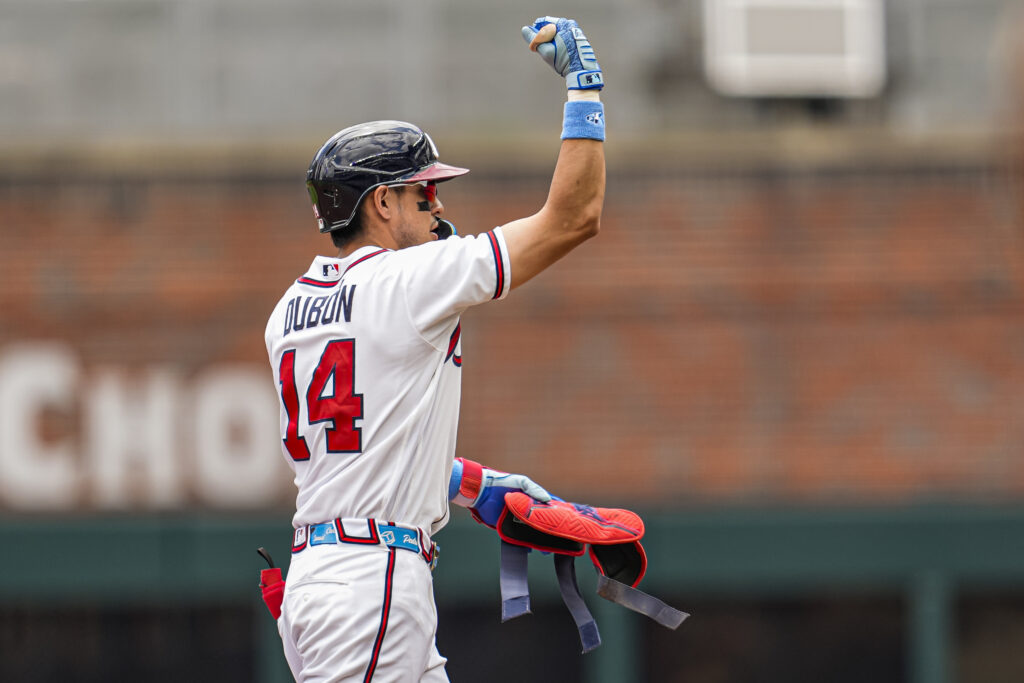
Mauricio Dubón arrived in Atlanta roughly one year ago in a nothing deal—the Braves shipped out defensive specialist Nick Allen for a player Houston was ready to non-tender. Twelve months later, Dubón has become one of the offseason's clearest wins, and now he's signaling openness to extension talks as his first free agency looms. The numbers look clean: .262/.316/.408 batting line, seven home runs already (matching his 2025 total), and a track record of glove excellence across multiple positions. For a Braves roster still hunting shortstop stability after Ha-Seong Kim's brutal return from a hand injury, keeping Dubón makes structural sense.
But the market math here is important. Dubón entered 2026 as a 31-year-old career .257/.295/.374 hitter with over 2,000 plate appearances and no track record of plate-discipline overhaul or batted-ball profile shifts. His current line-drive rate, walk rate, and whiff metrics remain consistent with his career norms—he hasn't transformed. What's changed is opportunity cost: he's logging regular reps across shortstop, outfield corners, and the bench, and the cumulative output looks solid when bundled into a season. That's a real contribution. It's also exactly the kind of performance that projects to evaporate the moment he's locked into an everyday role with a team that doesn't have Nick Markakis or Travis d'Arnaud flanking him in the lineup.
The comp class Dubón inhabits is instructive. Isiah Kiner-Falefa signed a one-year, $6 million deal with Boston last winter and is a less refined defender. Willi Castro commanded two years, $12.8 million from Colorado. Dubón's equilibrium likely sits in the two-year, $7-10 million annually range—real money, but not a multi-year anchor. The Braves, under Alex Anthopoulos, have been aggressive on extensions precisely because they understand the discount rate of signing a player before free agency opens the market to blind bidding. Dubón's willingness to listen is a pragmatic play: he locks in guaranteed dollars while he's in a Braves uniform generating surplus value. Atlanta locks in depth and familiarity while shortstop remains a rotation of question marks. The extension will likely happen, and it will almost certainly be structured as a two-year pact in the $15-20 million range—solid value for both sides, because both sides know the market won't bid much harder than that once he hits the open market in November.
For betting purposes, Dubón's utility role is a structural ceiling on his offensive props. In a league-average strikeout environment, his K-rates hover in the 18-20% range—league-average to slightly below. His home run pace this season is on track for 12-14 longballs, roughly double his career output, but that's a function of the consistent at-bats; once or if he's benched for a better everyday player or traded mid-season, the playing time collapses. Any prop bets on Dubón (strikeouts, home runs, hits) need to account for the likelihood that his plate appearances compress before season's end. If he stays in Atlanta through the deadline and the extension talks materialize, he's more likely to remain in a reserve/platoon capacity than evolve into a full-time bat, which keeps ceiling props (homers, RBIs) finite.