Langeliers' All-Star Nod Validates Oakland's Trade Algebra—And Exposes a Power Ceiling
By Ty Whitney ·
The Athletics' catcher has joined an elite A's lineage of consecutive 20-homer seasons, but his ballot success masks a timing problem for Oakland's rebuild.
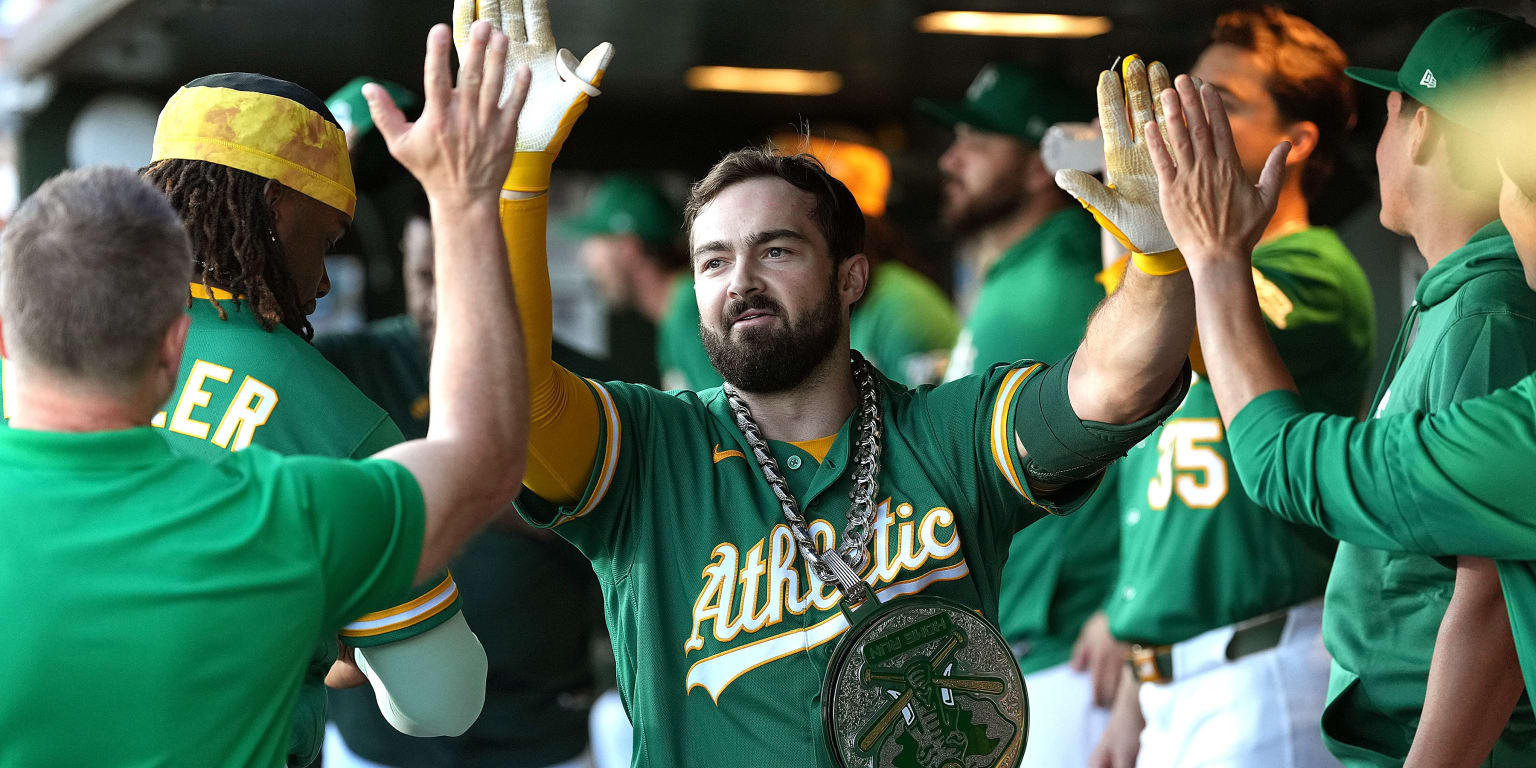
Shea Langeliers will start for the American League at the All-Star Game on July 14 in Philadelphia, four years to the month after the Athletics acquired him in the Matt Olson trade—a moment that crystallized Oakland's pivot from contention to prospect accumulation. That the franchise hasn't had a catcher start a Midsummer Classic since Terry Steinbach in 1989 adds weight to what was pitched internally as a franchise cornerstone swap: Olson to Atlanta, Langeliers and three other prospects back to the A's. General Manager David Forst called him "The Guy" in those trade negotiations, and the trajectory since has vindicated the bet.
Langeliers entered Friday with 20 home runs in 2026, extending a four-year streak of 20-plus homer seasons—a stretch that places him ninth all-time in Oakland history alongside Reggie Jackson, Eric Chavez, and Mark McGwire. The singular distinction: he's the only player on that list to accomplish it as a full-time catcher, a position that demands constant pitch-framing, game-calling, and the accumulated damage of 120-plus games behind the plate annually. His power output since the 2023 season sits at 102 home runs over that span, a volume that would make most corner infielders enviable. That's not a fluke; it's a structural competence.
What complicates the narrative, though, is Oakland's context. Langeliers' four-year arc of steady improvement—2022 as a learning year alongside Sean Murphy and Stephen Vogt, then 2023-26 as a reliable 20-homer contributor—has unfolded during a full organizational rebuild. The Athletics are not contending now, and the power consistency Langeliers has demonstrated suggests he should be playing in October for a different roster. His All-Star selection reflects his individual merit, not his team's trajectory. He's become exactly what Forst believed he could be, only to mature in a losing organization.
For prop bettors, this creates a specific angle heading into the second half: Langeliers' homer volume remains durable because it stems from a genuine swing-path and strength edge, not from ballpark inflation or lineup protection. His 102 homers over four seasons averages to 25.5 per 162 games, a rate that persists regardless of teammate injury or September callups. If Oakland moves him at the deadline—a real possibility given the rebuild's timeline and his trade value—the acquirer inherits a catcher with a proven power floor. The flip side: betting Langeliers team totals for the A's carries increasing risk. He can hit 25 homers in a 60-win season. His individual power ceiling doesn't lift a basement-level offense. Oakland's pitching development and infield depth will determine whether he finishes games in close situations, not his bat.
The All-Star Game appearance is the capstone of a five-year arc that began with Atlanta undervaluing him relative to a star first baseman. Forst's insistence on Langeliers as the centerpiece of that deal may end up being one of the shrewdest prospect evaluations of the decade. What it doesn't change is the organizational math: Oakland needed Langeliers to be great. It still needs him on a team trying to win.