Keibert Ruiz's Defensive Overhaul Reshapes Washington's Catching Calculus
By Ty Whitney ·
A lower crouch and two concussions later, the Nationals catcher has flipped from baseball's worst framer to league-average, remaking his value proposition mid-contract.
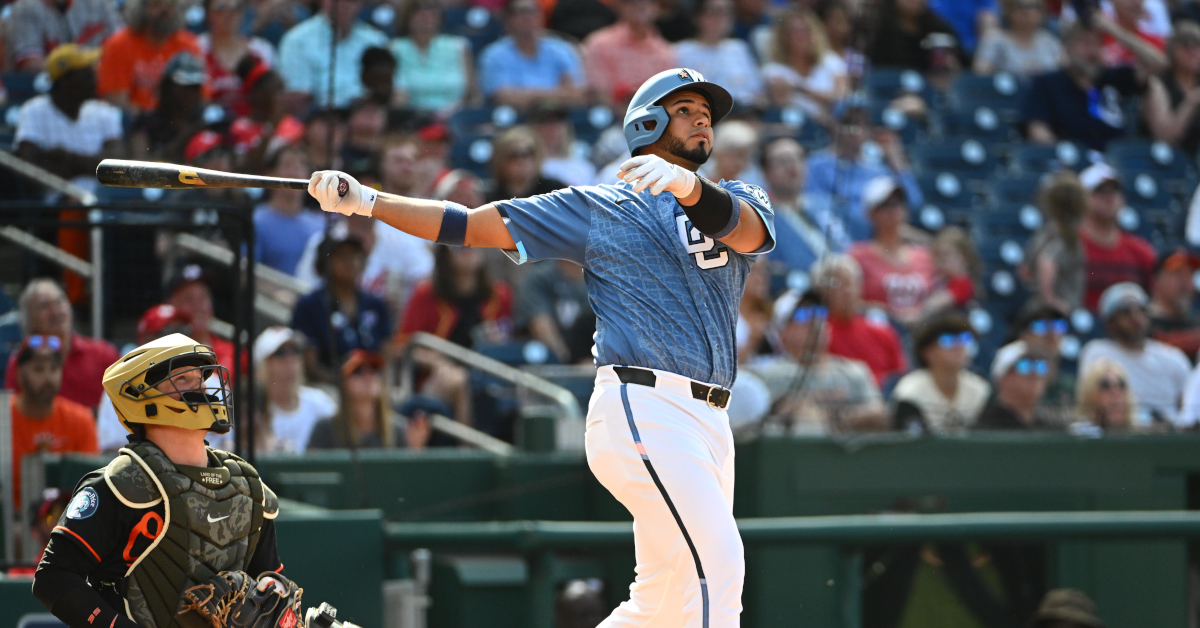
Keibert Ruiz was supposed to be a cornerstone. The Nationals paid $50 million over eight years in March 2023 for a prospect who had arrived as a centerpiece of the Max Scherzer–Trea Turner deal. Then he became historically bad—accumulating minus-1.9 WAR over three seasons, his 79 wRC+ placing him near the bottom of qualified position players league-wide. When Washington acquired Harry Ford from Seattle this offseason, the subtext was clear: Ruiz's tenure as the primary backstop was in jeopardy.
What's happened since is disorienting. In 34 games this season, Ruiz has already posted 0.8 WAR and ranked 11th among major league catchers in total value. The most startling shift is defensive. Over his last three seasons—a sample of 1,000-plus innings—Ruiz ranked second-worst in pitch framing and throwing out base stealers, sixth-worst in blocking. This year he's added two runs via framing and sits slightly above average as a blocker. The mechanical explanation is unglamorous but effective: the Nationals adjusted his crouch lower to the ground after he suffered two concussions within a span of ten days last season (one from a foul ball in the dugout, another from a foul tip to the mask just days after his initial activation). The lower posture allows more foul tips to sail over his head instead of into his face mask.
That mechanical shift has had an outsized effect on his receiving ability. Ruiz's previous frame showed profound weakness on low pitches and offerings to his right—zones where borderline pitches slip past or move into the strike zone depending on framing precision. The lower stance fixes both problems geometrically: his head position and angle of approach to the baseball have fundamentally changed his ability to manipulate borderline calls. The defensive renaissance isn't a mirage born of small-sample luck; it's the product of a measurable, repeatable adjustment that directly addresses his historic weaknesses.
For betting purposes, this matters immediately on two fronts. First, Ruiz's strikeout prop becomes more interesting because his improved framing will suppress swinging strikes—he's getting more called strikes on borderline pitches, meaning fewer pitcher-induced whiffs. Fade strikeout overs on Nationals starters when Ruiz is behind the plate, particularly against pitchers who rely on breaking balls outside the zone; his framing now works in the batter's favor. Second, Nationals team totals should tick upward modestly. Ruiz's offensive profile hasn't transformed—his wRC+ is still below league average—but his presence no longer drains value on defense. The team is no longer absorbing minus-30 to minus-50 runs annually from its catcher position. That's a real credit to the Nationals' run prevention calculus, and it's priced into their season projection but may not yet be fully baked into nightly totals set before this season's data accumulated.
The broader narrative is one of organizational problem-solving: medical staff identified a physiological vulnerability (concussion risk in an upright stance), operations made a tactical adjustment, and the hitter benefited as a byproduct. Ruiz's extension no longer looks like sunk cost theater. He's a competent big-league catcher again—not a star, but a player who removes defensive drag rather than creating it. For sharps, that's the seam: market pricing for individual Nationals games may still be trading on his three-year disaster average, not his 2026 reset.