Spencer Jones' 443-Foot Debut Power Surge Signals Yankees Lineup Depth in Judge's Absence
By PropBetEdge Editorial Team ·
A prospect's first career home run at 112.2 mph reframes how much offensive artillery New York can deploy while sidelined without Aaron Judge.
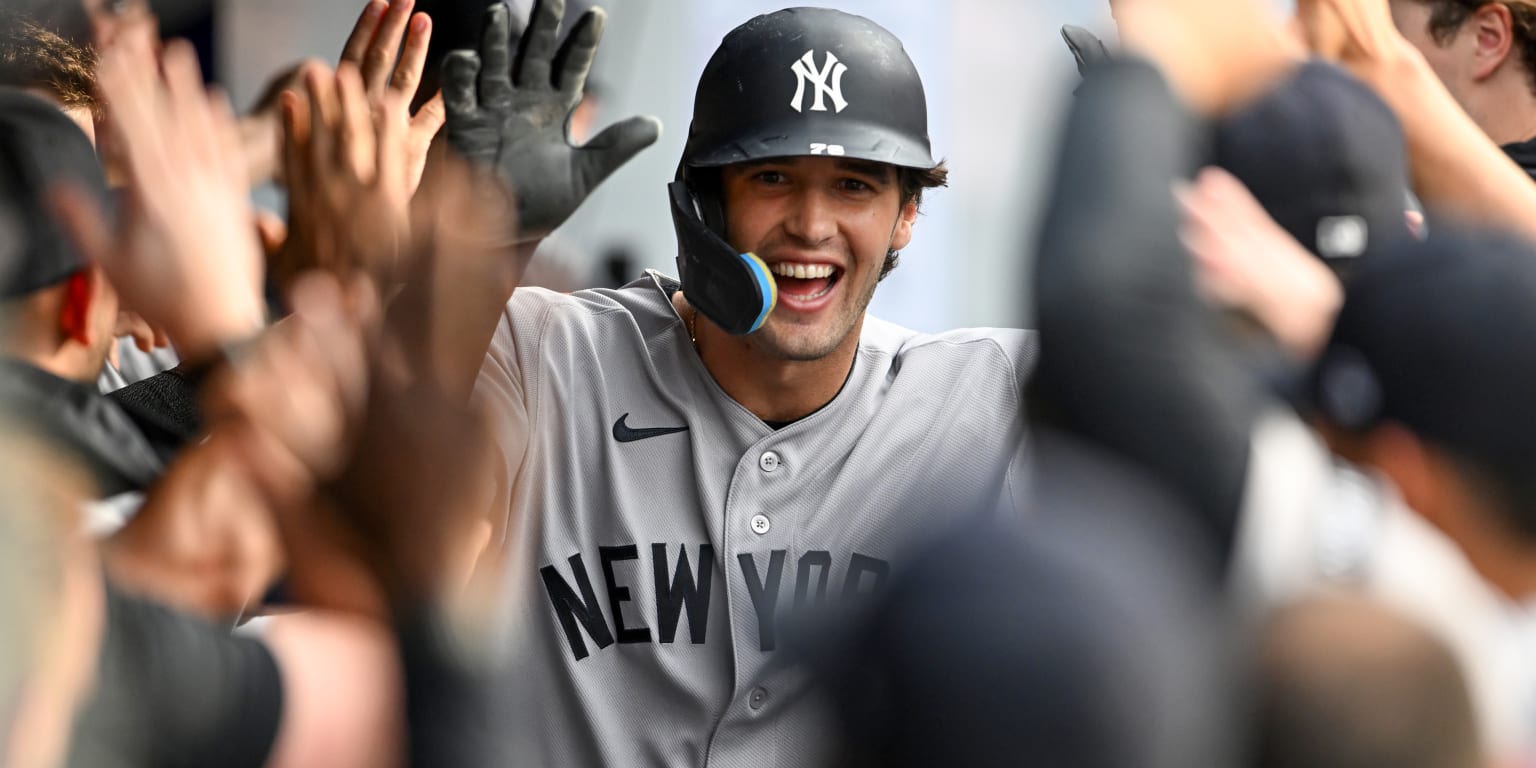
Spencer Jones launched his first career home run 443 feet into the Cleveland night on Tuesday, a Statcast-measured missile that tied together three narratives at once: the 25-year-old prospect's long-promised power finally clearing MLB hurdles, the Yankees' suddenly precarious outfield depth after Aaron Judge suffered a stress fracture of his right first rib, and a roster that may have more offensive flexibility than recent weeks suggested.
The homer against Guardians right-hander Slade Cecconi ranks as the hardest-hit first career blast by any Yankee since Statcast tracking began in 2015—a distinction that matters because it wasn't a mistake pitch Jones capitalized on. Cecconi left a cutter middle-middle, and Jones' 112.2 mph exit velo deposited it to dead center in the ballpark's deepest reach. The ball traveled farther than any hit at Progressive Field this season and ranked third among Yankees bombs this year, trailing only Judge's season-long 456-footer and Giancarlo Stanton's 446-footer. That sequential context—Judge, Stanton, Jones—cuts to the real story. Judge's injury timeline remains foggy (the club has not specified a recovery window), but early June is an inopportune moment to lose a captain for any length of time.
Yet this is where Jones' tape becomes operationally valuable rather than merely statistically loud. He entered Tuesday with a 45% strikeout rate across his 14 prior big-league at-bats—a swing-and-miss profile that had been the primary reason Cleveland and Kansas City passed on him repeatedly before New York drafted him as a prospect-development project. His Minor League resume (85 home runs across four levels) promised power; his big-league ramp-up suggested the contact challenges would persist. One game, obviously, does not erase a year's worth of strikeout data. But the mechanics of his one successful swing—a hitter who sat fastball, recognized an off-speed pitch he could elevate, and generated triple-digit exit velo—sketched a blueprint for what works at this level. If that repeats even sporadically over the next month while Judge rehabbs, the Yankees avoid the cascading lineup adjustments that would otherwise force Paul Goldschmidt or Cody Bellinger into unsustainable volume roles.
For prop bettors, the implication is subtle but actionable. Jones' strikeout rate (45%) will likely remain elevated; one bomb does not rewire a hitter's plate discipline overnight. But his presence in the lineup alters the calculus around Yankees team totals and run-line pricing. Books will be slower to adjust for a fourth-outfield-position plug who carries obvious whiff risk but also demonstrated, on one swing, the ability to generate game-changing leverage with one pitch. The edge sits in the next 5-7 games while the market still prices him as a vertical downgrade from Judge—which he is—without acknowledging that his power ceiling, however narrow the window to access it, can shift a game's expected run environment faster than a conventional replacement would.
The Jones homer also matters as a release valve for Yankees fan psychology. Judge's injury is real, the absence will sting, but the organization did not suddenly lose every offensive tool in the building. A 25-year-old with 85 Minor League homers and a 112.2 mph exit velo on his first big-league blast is not a solution—he is a data point that complicates the narrative of a team in freefall.