Jensen's Contact Revolution: How a Royals Catcher Went From Strikeout Risk to Streak Machine
By Ty Whitney ·
Carter Jensen has slashed his whiff rate in half over 13 games; the mechanical shift that's driving it suggests the improvement is real, not noise.
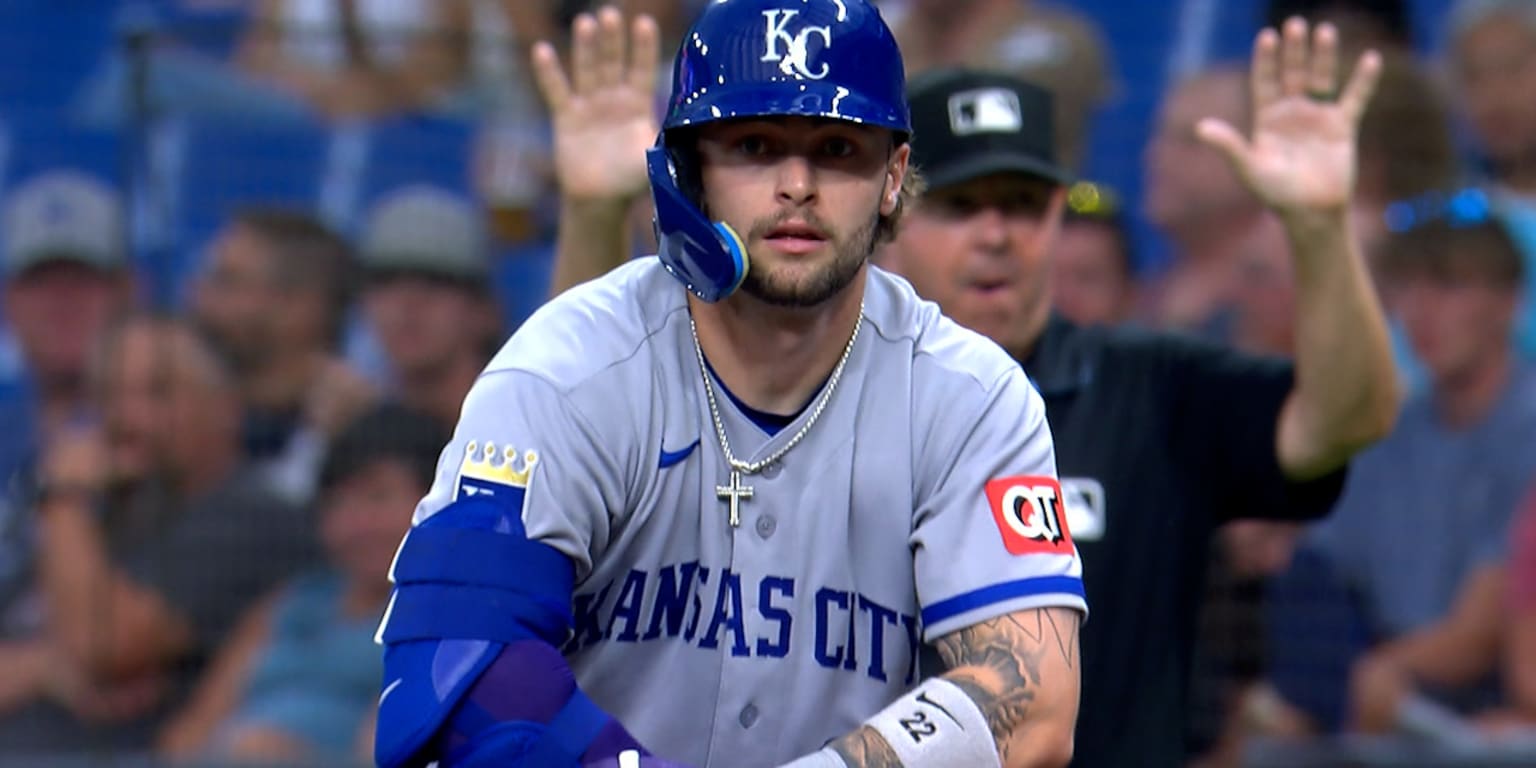
Carter Jensen delivered the go-ahead RBI single Monday night in Tampa Bay, extending his hitting streak to 13 games and lifting Kansas City past the Rays 2-1. The 22-year-old catcher's performance—a 109.2 mph liner up the middle off Drew Rasmussen—is the latest evidence of a dramatic recalibration at the plate that began in early June.
The streak started June 6, when Jensen was a liability at the plate. His strikeout rate sat at 30.2%, his whiff rate at 32.6%, the profile of a young hitter still learning the big-league wavelength. Over the past 13 games, those numbers have inverted entirely: strikeout rate down to 15.5%, whiff rate compressed to 18.4%. That's not margin noise or one hot week. That's a wholesale correction in pitch recognition and bat control. His hard-hit rate, meanwhile, has climbed from 40.2% to 54.8%—he's not just making contact, he's making it matter. The catcher is batting .365 with a 1.070 OPS during the streak, a production level that would rank among the league's elite if sustained.
Mechanically, this matters. Strikeout collapse and whiff reduction typically flag one of three things: improved pitch sequencing recognition, better approach discipline, or a swing adjustment that shortens the zone. Young catchers often struggle with the volume and velocity of big-league pitching; Jensen's trajectory suggests he's stopped chasing. The consistency of the gains—across three separate rate metrics, all moving in the same direction—indicates a learned behavior, not a hot-streak anomaly. His hard-hit velocity bump corroborates it: he's not beating balls weak; he's driving them.
For prop purposes, the immediate angle is Jensen's hit prop lines over his next 5–7 games before the market fully reprices him. He entered Monday batting .219 on the season; the June metrics establish a floor around .285 in a stabilized environment. Most sportsbooks still carry single-game props anchored to his season average, not his recent exit velocity or contact-rate improvement. If Jensen's hit line is offered at 0.5 or 1.5 in the coming week, those are soft targets. The Royals face Atlanta and Houston next—neither defense forces catchers into aggressive chase rates. A catcher with Jensen's recent contact discipline has positive expected value against standard offerings.
Michael Wacha, the veteran starter Jensen was behind the plate for Monday, allowed one run and one walk across seven innings, outpitching Rasmussen despite the Rays' ace bringing a 2.59 ERA into the game. Wacha's strikeout rate (5 K in 7 IP) and walk rate underscore the execution-first approach the Royals are leaning on. For Jensen's next few starts behind the plate, track the opposing pitcher's walk rate and strikeout rate; if he's working with command arms like Wacha, Jensen's contact-improving environment stays favorable.