Griffin's Deadline Leverage: Why Washington's Reclamation Story Matters to Pitching Markets
By PropBetEdge Editorial Team ·
A sub-$6M signing is outproducing $20M+ rotation pieces, and the Nationals face a choice between cashing in or running at a playoff window that didn't exist three weeks ago.
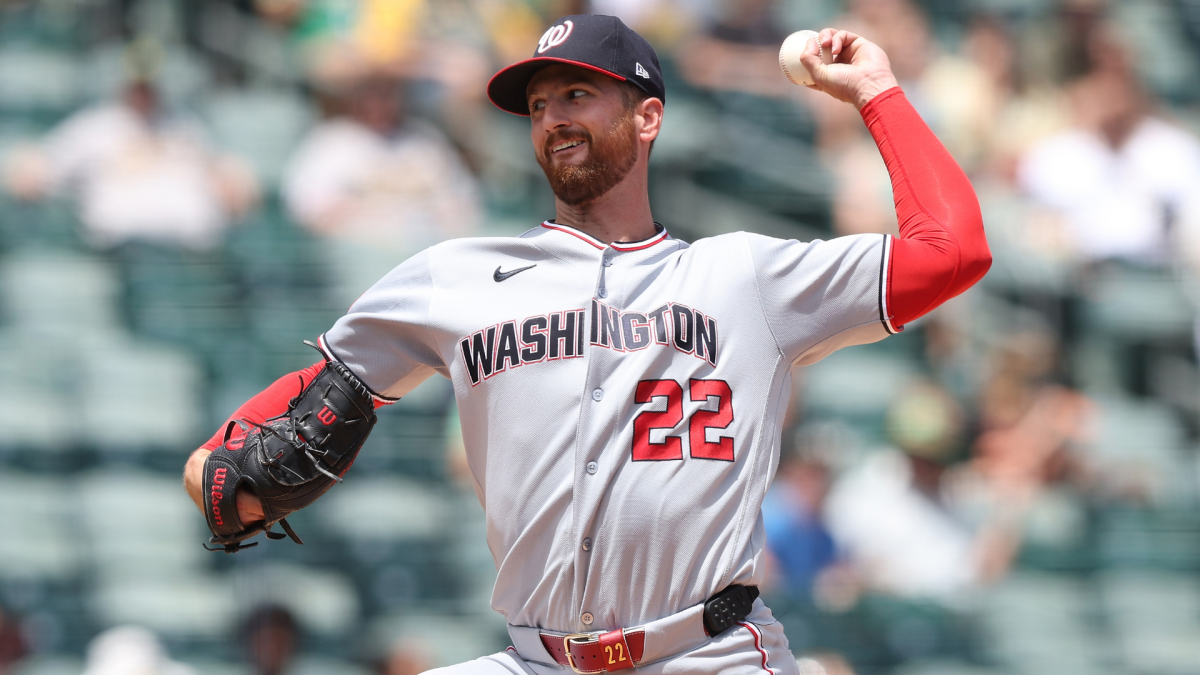
Foster Griffin is 31 years old, threw 371 innings in Japan over three seasons, and the Nationals signed him to a one-year deal for $5.5 million in the offseason because no other team wanted him badly enough to offer more. Five days before the trade deadline, he's one of the most valuable trade chips Washington could move—and the organization is genuinely conflicted about whether to keep him.
The mechanics of his turnaround matter more than the fairy tale. Griffin doesn't blow anyone away: his cutter sits around 89 mph, his four-seam at 91.5 mph. What changed is systematic. During his three seasons with the Yomiuri Giants, he rebuilt his arsenal entirely, adding a sweeper, sinker, and splitter to the pitch mix he carried back to MLB in 2022. This season, he's throwing seven different pitches at least 7% of the time each, none exceeding 33% usage. Against right-handed hitters, he'll deploy a changeup he didn't even throw to lefties. The effect: batters face a guessing game on every pitch, which shows up in contact quality. His 3.97 FIP and 3.89 expected ERA suggest the ERA itself isn't an illusion, but they also signal that his actual run prevention is somewhere between elite (his 2.68 mark) and very-good (his underlying metrics). That gap is the residual risk anyone trading for him absorbs—and why the market will almost certainly overvalue him relative to what he can sustain.
What's remarkable is the context. The Nationals sit 52-51 with a legitimate core: CJ Abrams and James Wood are emerging stars, Cade Cavalli and Luis García Jr. are breaking through, and Curtis Mead has outperformed his acquisition cost all season. This isn't a team punting on 2026; it's a team that stumbled into contention because a lot of young bets started hitting at once. Griffin's eight consecutive starts allowing one earned run or fewer matches Pedro Martinez's September 1996 to May 1997 streak and sets a franchise record in the modern Nationals era. He made the All-Star Game. He's generated 5.2 WAR on a $5.5M contract—only Dylan Cease, Ranger Suárez, Dustin May, and Michael Soroka have better WAR-per-dollar among offseason free agent arrivals. That's the organizational valuation signal: Cleveland, Philadelphia, Atlanta, and Kansas City all got more surplus out of their offseason pitching pickups, but none of them are having the conversation about whether to trade the guy away because they might actually compete.
For betting purposes, this creates a narrow but real angle. Any pitcher traded in the next 10 days at the deadline comes with a narrative tax—deadline acquisitions underperform their regular-season ERAs by roughly 0.35-0.50 runs in the back half, partly due to adjustment lag, partly due to leverage situations and usage pattern changes. But Griffin's price in secondary markets (DFS, season-long prop overs on strikeouts and innings) is built on his eight-start hot streak and All-Star selection, not on a three-year track record. If he stays in Washington, the market will likely re-price his strikeout prop down 5-7% as the streak inevitably breaks; if he moves, the deadline-acquisition penalty applies on top of that normalization. The sharp angle is not to bet Griffin props long right now—wait 48 hours to see if Washington is a buyer or seller. If he's traded, his K prop and innings prop will compress sharply, and unders become the exploitable side. If he stays, the streak will fade anyway, and you get a cleaner entry point on unders after one or two mediocre starts establish a new baseline.
The Nationals have real leverage here because the deadline market is thin on elite starters right now. They can afford to say no to lowball offers. But that same thinness means anyone trying to bet on Griffin's durability should recognize that the current pricing assumes the hot streak continues indefinitely, which it won't. The mechanism is simple: he's throwing more pitches now, working deeper into counts, and batters are adjusting. Historical precedent says his next three starts will include at least one bad outing. If you're fading him in props, you're not betting against his talent—you're betting that an eight-start anomaly regresses to his 3.97 FIP, which says ERA in the 3.40-3.60 range is his true talent level. That's not a cliff. It's inevitability.