Eldridge's Strikeout Cure Opens a Late-Season Power Window
By PropBetEdge Editorial Team ·
A 21-year-old rookie's approach shift against breaking balls has erased his whiff problem just in time for the game's most explosive offensive stretch.
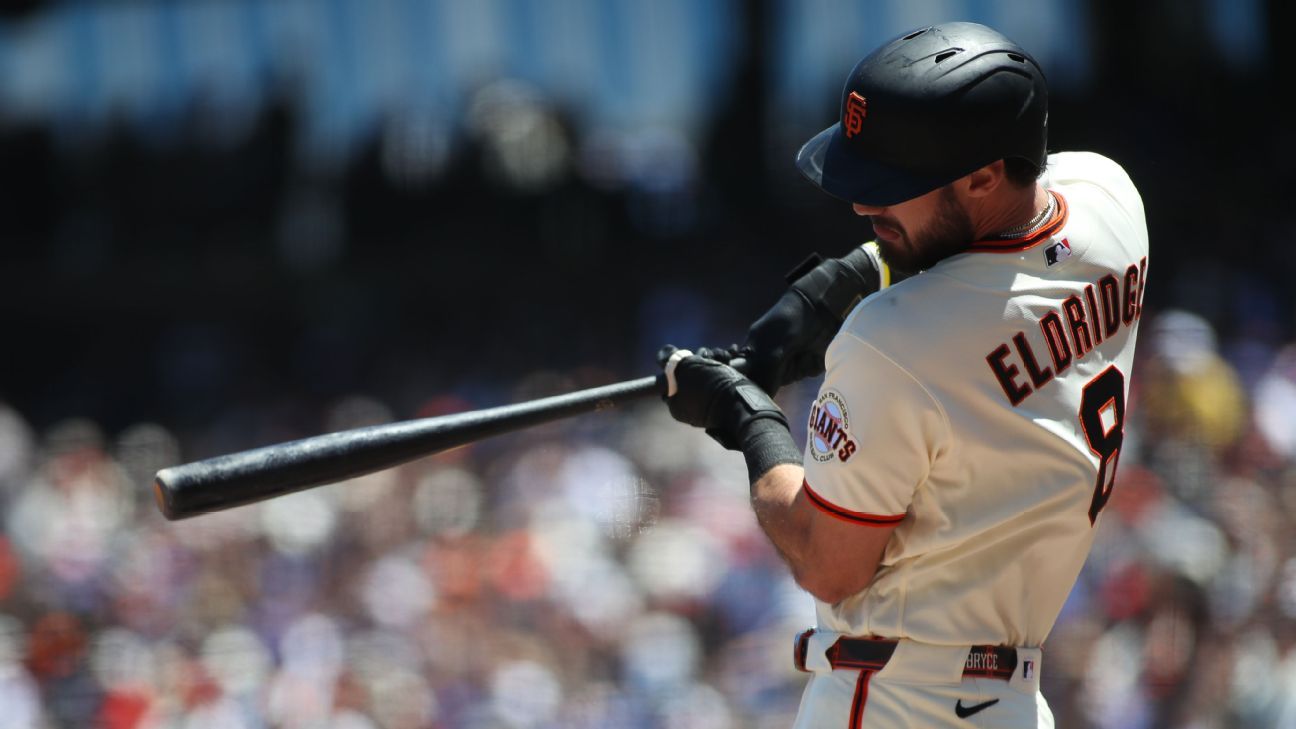
Bryce Eldridge became the youngest player in recorded baseball history to hit a walk-off grand slam on Wednesday, capping a three-game home run streak that feels less like a rookie hot streak and more like the moment a genuinely talented hitter finally developed the discipline to stay in the zone. Through 13 June games, the Giants' 21-year-old DH is hitting .413/.500/.674—a radical departure from his early-season .158 average and 28.7% strikeout rate across his first 26 MLB appearances. The mechanical shift driving the change is concrete: Eldridge's expected wOBA against breaking pitches has jumped 170 points compared to last year, and he's adopted a more fly-ball-oriented swing that generates harder contact on pitches he can elevate.
That approach refinement matters because it addresses the core flaw that made him a liability through May. Eldridge wasn't just striking out; he was chasing. The breaking-ball improvements signal he's learned to identify and lay off the edges—the adjustment young power hitters either make or wash out from. His strikeout rate hasn't evaporated entirely (he's still a volatile hitter), but the quality of contact when he does connect has sharpened enough that the math on his remaining value flips decisively positive. The Giants, who aren't going anywhere this season, have no reason to bench a 21-year-old executing at this level, which means plate appearances shouldn't dry up.
The eligibility wrinkle adds a layer of leverage to his near-term utility in fantasy formats, but it's the roster construction signal that deserves attention from a betting standpoint. San Francisco has been rotating Eldridge and Rafael Devers between DH and first base to manage workload; Eldridge has four starts at first and needs six more to reach 10-game eligibility. That's a floor, not a ceiling—if he maintains this offensive pace, the Giants will find reasons to play him more, not less. The calendar works in his favor: he has four to six weeks of June and July baseball ahead before the trade deadline, plenty of time for clubs to notice what the Giants have and for his plate-appearance floor to rise if they move Devers.
For prop bettors, the angle lives in the second-half volume play, not the one-week spike. Eldridge hit one walk-off grand slam in a single week; that's noise. What isn't noise is a strikeout-rate normalization paired with sustained fly-ball authority over a 13-game sample where he faced varied pitching. If the Giants stay competitive or slide toward selling at the deadline, Eldridge gets more DH at-bats. If they buy and Devers moves, his volume question resolves upward entirely. Either way, the offensive foundation—the swing change, the pitch recognition, the exit velos—persists independent of one week's heroics. Home run totals for the season rest on two variables: how many plate appearances he gets, and what fraction of those result in balls in play with sufficient angle. The first is now more likely than it was two weeks ago. The second has already improved.
The broader youth wave the Giants are riding—Cole Carrigg's debut power at Colorado, Blaze Jordan's contact-plus-power profile with St. Louis—matters less for prop betting than Eldridge's specific case because those players are still establishing baseline consistency. Eldridge's data point is older and more reliable. His June numbers across 13 games dwarf a single weekend. If the market has already priced his home run prop for the remainder of the season at a level that assumes a May-style strikeout rate, it's priced him wrong. The break-ball work is real, the fly-ball swing is real, and the volume is about to expand.