Kyle Harrison's Brewers Rebuild Is Already Paying—And the Books Haven't Caught Up
By Erik Schwartz ·
The Brewers' trade for Harrison this spring has produced one of baseball's sharpest efficiency edges, and his Tuesday matchup with St. Louis reveals structural gaps in how sportsbooks are pricing young breakout arms.
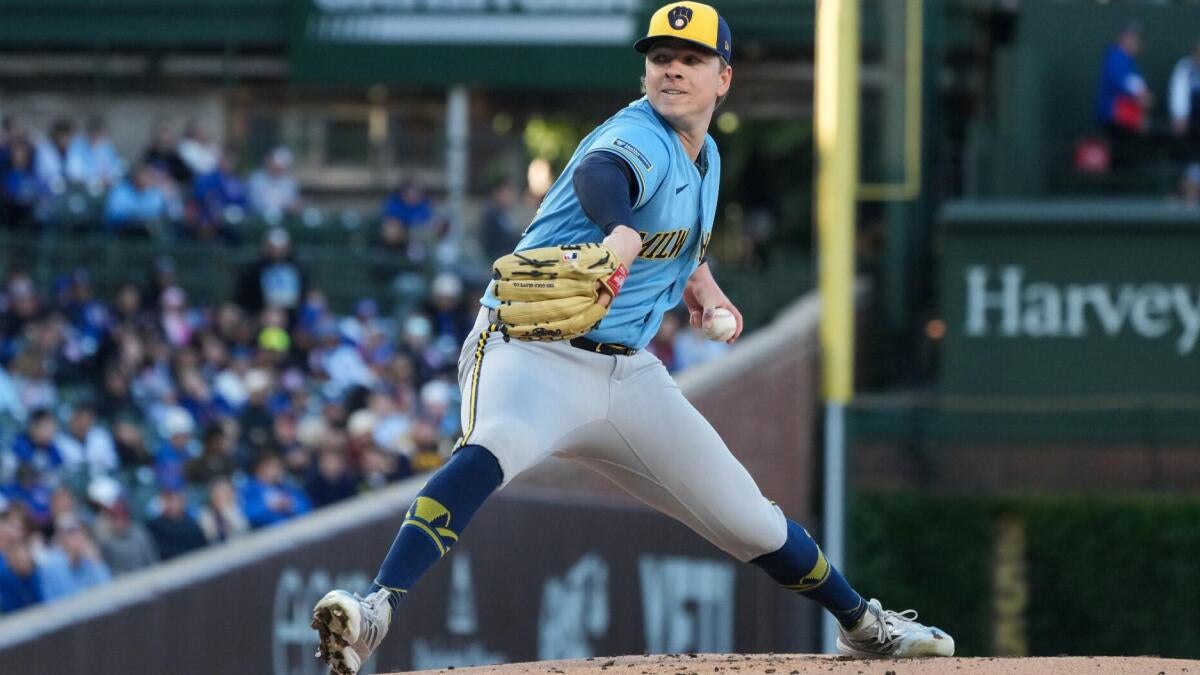
Kyle Harrison takes the mound Tuesday night for Milwaukee against St. Louis as one of baseball's most profitable starting pitchers, yet the betting market treats him as a secondary story. The 24-year-old lefty, acquired from Boston on the basis of minor mechanical adjustments, has compiled a 1.77 ERA, 1.07 WHIP, and 32.2% strikeout rate across nine starts spanning 45.2 innings. A $100 moneyline bet on the Brewers in each of Harrison's nine starts would have netted $433 in profit—a 48% return on investment in a compressed window.
The mechanics behind Harrison's ascent matter as much as the results. The Brewers moved him to the first-base side of the rubber and elevated his arm angle, creating a velocity and deception profile that flipped his trajectory from borderline waiver-wire candidate (three appearances for Boston) to legitimate Cy Young contender. His strikeout rate represents a career high; he is the only National League starting pitcher below 1.85 ERA with a strikeout rate above 30%. The only comparable performance in franchise history is CC Sabathia's 2008 debut with Milwaukee, which produced a 1.60 ERA in his first nine starts. Harrison is not a variance play or a hot streak—he has pitched scoreless ball over his past two outings (Cubs, Padres) while striking out 18 in 12 innings.
St. Louis presents a first-career matchup for Harrison. The Cardinals' lineup has been a pleasant surprise offensively, sitting in first place in the NL Central despite ranking near the league bottom in home runs. Willson Contreras, acquired from Chicago before the season, has extended a nine-game hitting streak to .395 over the run. Michael McGreevy, the Cardinals' right-handed starter for context, carries a 2.40 ERA that masks underlying volatility: his expected ERA sits at 5.83 (bottom 10% of all pitchers). The Cardinals' construction—contact-heavy, power-light—should theoretically give Harrison fewer fastball-middle opportunities, but his strikeout command suggests he can elevate through any lineup.
The SportsLine projection model forecasts Harrison for 4.8 innings, 5.5 strikeouts, and 1.7 earned runs, yet his strikeout-rate track record suggests that 5.5 K projection is conservative. Over his past six starts, the Brewers have won each outing; the market has not fully repriced his arm into moneyline odds (+118 for a personal win is where sharps already have some exposure). The real edge exists in Harrison strikeout volume. His 32.2% K rate, applied to a full six-inning outing against a Cardinals lineup that strikes out at an above-average rate, supports looking at strikeout props on the over side—especially if the line remains anchored to his DraftKings outs-recorded total of 17.5 (roughly 5.8 K equivalent). The one caveat: Harrison's workload is ascending rapidly; monitor his pitch count if the Brewers jump to an early lead and allow him to cruise.
Milwaukee's organizational ability to reshape struggling arms into front-line starters is a real skill, not luck. Harrison is the latest proof, and the sportsbooks have yet to fully acknowledge that this wasn't a trade exception—it was a theft.