Cardinals Clear Third Base by Releasing Urias; Defensive Depth Now Flush with Volatility
By PropBetEdge Editorial Team ·
Ramon Urias's release ends a failed one-year audition and signals St. Louis is willing to cycle through talent at its weakest position rather than commit to a veteran veteran presence.
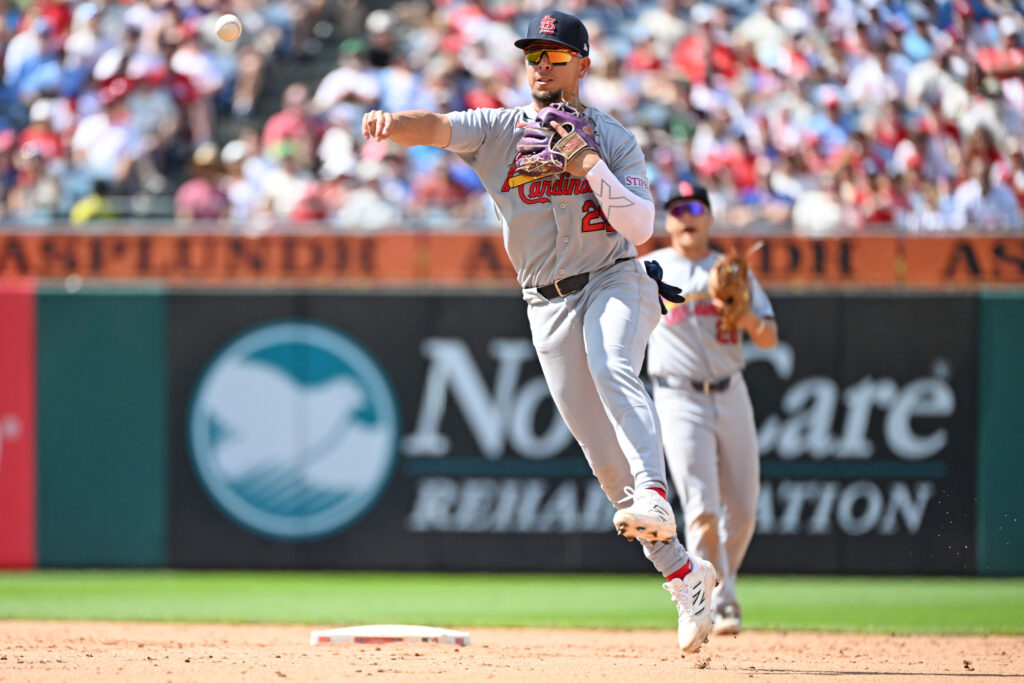
The Cardinals released infielder Ramon Urias on Friday, two days after designating him for assignment to make roster space for JJ Wetherholt. The move closes the book on a disappointing 2026 campaign for the seven-year veteran, who was signed to a one-year, $2 million deal last winter on the promise of versatile infield depth and reliable defense. Instead, Urias appeared in only 43 games, hampered by bilateral elbow problems that first surfaced in May (lateral epicondylitis) and flared again during his rehab assignment. His offensive output collapsed: a .151 average with four home runs in 100 plate appearances, including just four hits in 15 games after his return from injury.
Urias's defensive resume—a 2022 Gold Glove at third base with Baltimore, 21 career Defensive Runs Saved at the position, and 3 DRS this season in 185 1/3 innings at the hot corner—ought to generate interest during the offseason circuit. At 33, with his arm compromised, he's more likely to find a utility role than an everyday gig, but his track record at second and third base provides a floor. What matters for the Cardinals in the here-and-now, however, is what his departure reveals about their infield construction heading into 2027. St. Louis has shuffled seven different options through third base this season and ranks 27th in OPS at the position. The team can field Blaze Jordan, Nolan Gorman, or Thomas Saggese—all internal prospects—but none have demonstrated the consistency or injury resilience to lock down the spot. Wetherholt's emergence at second base was the trigger for Urias's release, but it also underscores a stark organizational choice: bet on youth and volatility rather than lean on veteran depth.
That calculation carries direct betting implications for St. Louis's 2027 infield projections. Third-base production in baseball translates unevenly to team totals, but when a roster cycles through six or seven different hands at a premium defensive position, you're absorbing compounded uncertainty—not just in power and contact rates, but in defensive stability and strikeout risk. Jordan and Saggese carry strikeout profiles (both over 25% K-rate in minor-league assignments), while Gorman has shown flashes of power but consistency concerns. None of them have 500+ major-league plate appearances, which means their offensive floor is genuinely unknowable at the 162-game level. In contrast, a veteran like Urias, whatever his limitations, provided a known quantity: roughly .160-.170 batting average, minimal power, but plus defense. The Cardinals are trading that certainty for upside in a position group where they already rank in the bottom decile of production league-wide.
For bettors, the implication is straightforward: St. Louis's 2027 team total carries elevated baseline volatility. If Jordan or Saggese hit above their minor-league performance profiles—a reasonable but far-from-certain outcome—the team's offensive ceiling rises materially. If they regress to strikeout-heavy contact patterns, the ceiling lowers just as sharply. The roster has other anchors (Masyn Winn at short, Alec Burleson at first), but a third-base position group composed almost entirely of unproven bats introduces a lever that oddsmakers will struggle to dial in until spring training data surfaces. Early-season unders on Cardinals team totals carry reduced upside in this scenario—the youth movement could surprise upward. Conversely, overs tethered to the assumption of veteran production at that spot should be approached with caution; the organization has already signaled it's unwilling to subsidize stability with veteran payroll.