Lopez's 200-Hit Sprint: Six Games to Rewrite Marlins History
By Ty Whitney ·
Otto Lopez needs 15 hits in six games to join an elite franchise club, but the mechanics of his chase reveal why the batting title may already be out of reach.
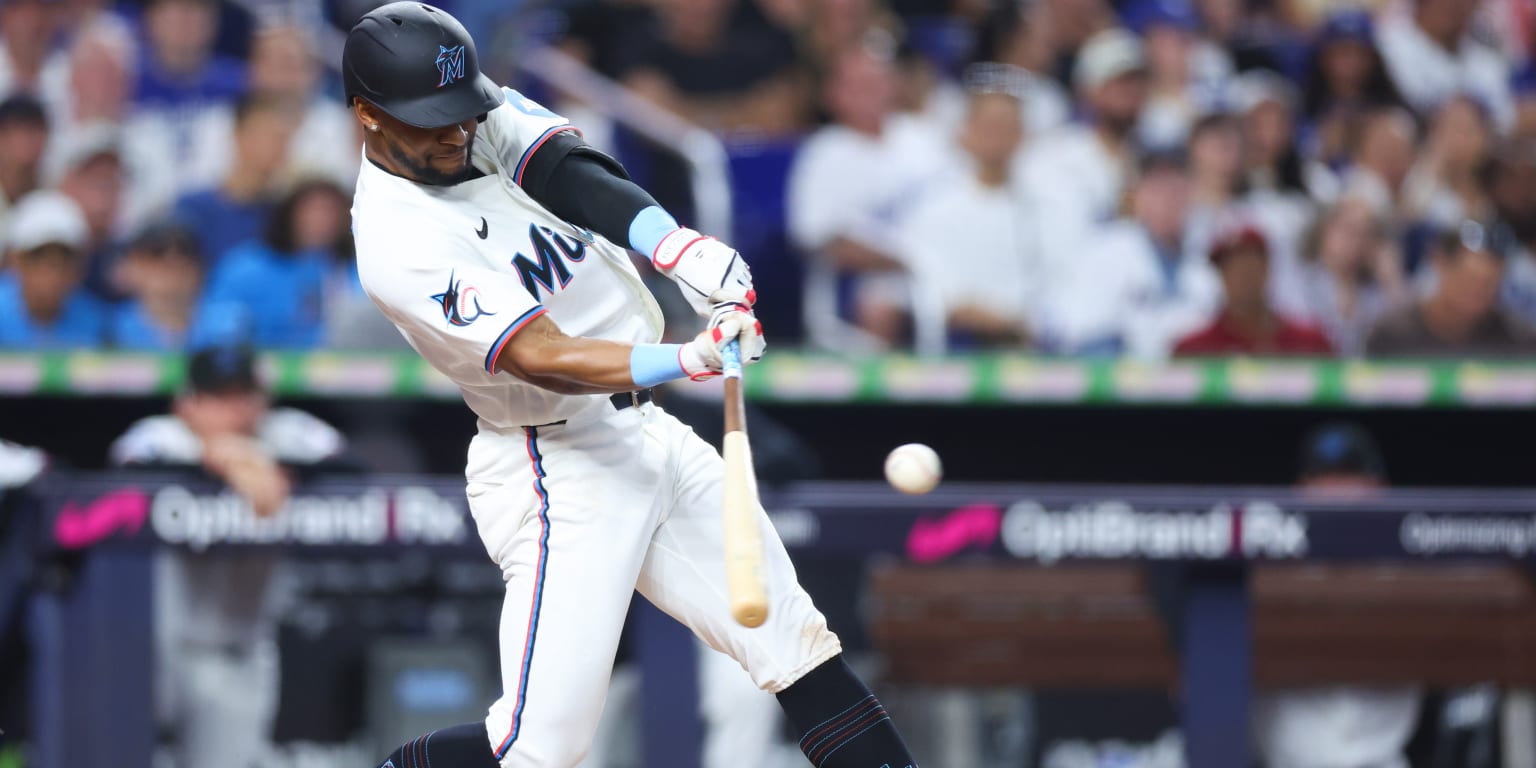
Otto Lopez enters the final week of the regular season with 185 hits, 15 shy of becoming only the seventh Marlin to record a 200-hit season. The All-Star shortstop's pursuit is real—he's done it twice in six-game spans this year (collecting 14 hits each time)—but the statistical architecture of his position relative to Luis Arraez and Gabriel Moreno tells a different story about which chase is actually viable.
Lopez's injury on July 18 left a fracture in his season that never fully healed. He caught a groomer in the face near Milwaukee and, though X-rays cleared him, the psychological damage ran deeper than any radiograph. From July 21 through early September—a 46-game stretch—he posted a .220/.270/.286 slash line, a complete inversion of the .335 average he'd carried into that day. His hitting coach Pedro Guerrero identified the culprit: Lopez's body learned to protect itself, pulling away from inside pitches to guard his ring finger, and by the time the pain subsided, the flinch remained. He's recovered lately, but that mid-season cliff cost him roughly 25-30 hits against a healthy trajectory.
The 200-hit threshold is nominally within reach. Six games at an average of 2.5 hits per contest gets him there. But Arraez's .313 average and Moreno's .307 are another matter entirely. Lopez sits at .305, and the gap widens not because his exit velocity changed but because he's a ground-ball hitter (50% rate) who benefits from infield hits and speed (28.5 ft/sec). He has 30 infield hits—second in baseball—which is elite positioning, but that edge doesn't close a 8-point average gap in six games. Manager Clayton McCullough has indicated Lopez might bat leadoff to accumulate more at-bats, a small lever. If Lopez averages four at-bats per game and goes 13-for-24, he'd match Arraez's current average. But that's a .542 batting average over six games—the kind of performance that happens once per decade, not once per week.
For bettors, the implications track in two directions. Lopez's hit total for the series carries a prop surface that the market has likely already inflated on the back of his narrative chase. The book knows he's 15 away and knows the six-game window; the line on his hits over/under for this final stretch is probably priced around 13.5-14.5, reflecting the surface math without accounting for the quality of those hits. The safer play is to recognize that while 200 hits is possible, the batting title requires a level of sustained excellence that his injury, his ground-ball profile, and his current deficit make improbable. Fade any prop that assumes Lopez catches Arraez; lean on the over for his absolute hit total only if the line dips below 12.5, which would require a market overreaction to a loss in one of these final games.
Lopez's value resides elsewhere: his 5.5 fWAR, his team-leading 185 hits, and his 32 doubles (tied for eighth in the NL) have already cemented a breakout season. The 200-hit club is a cherry on top. The batting title was never in his hands.