Sproat's Early Exit Exposes Brewers Rotation Fragility Mid-Season
By Erik Schwartz ·
A fourth-inning hamstring cramp ends Brandon Sproat's start against Cleveland, forcing Milwaukee back into a bullpen-heavy night just as the rotation depth questions resurface.
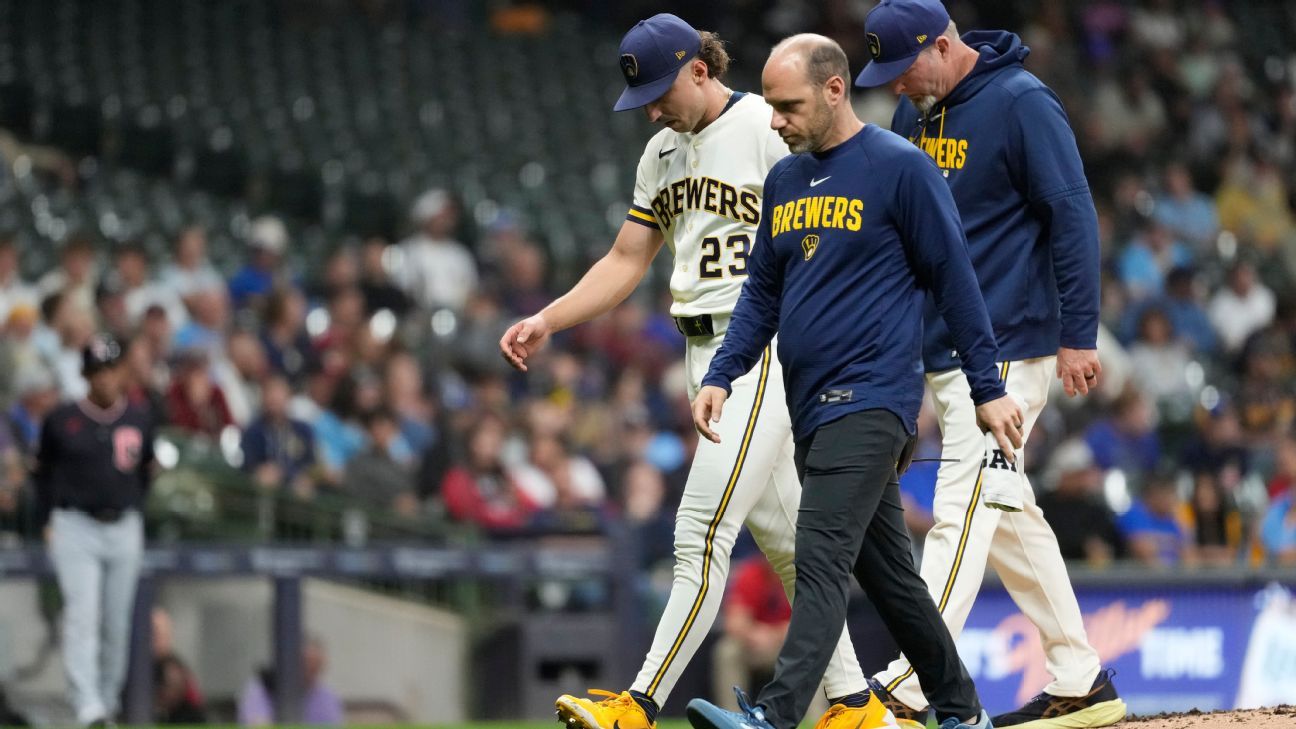
Milwaukee Brewers starter Brandon Sproat exited Wednesday night's game against the Cleveland Guardians in the fourth inning after a right hamstring cramp forced him off the mound. The injury occurred after Sproat threw an 0-1 pitch to Steven Kwan, prompting athletic trainer Brad Epstein to check on the right-hander before Chad Patrick took over in relief. The timing was particularly costly: Sproat had cruised through three innings with nine straight retirements and a 5-0 lead, only to implode in the fourth with two walks and a single before Daniel Schneemann's grand slam narrowed Milwaukee's advantage.
The sequence itself tells a troubling story about Sproat's 2026 campaign. After the Brewers committed significant organizational capital to acquire him in January—trading away two-time All-Star Freddy Peralta to the Mets—Sproat has failed to justify that investment. He enters this game with a 1-4 record and a 5.94 ERA through his first full major-league season. That ERA sits 1.8 runs above league average, and the early exit now raises durability questions that Milwaukee cannot afford in June. The Guardians' offense seized the moment; after watching Sproat dominate early, they capitalized on a sudden mechanical or physical breakdown to draw back within striking distance.
Hamstring injuries in pitchers are categorically different from muscle cramps—a cramp suggests fatigue or hydration, which can resolve within days—but the fact that Sproat could not pitch through discomfort in the fourth inning is a red flag about his conditioning or mechanics. His inability to maintain command after three clean innings mirrors a broader pattern: he has now left three starts this season due to injury-related issues, and each interruption compounds the uncertainty around his workload management. The Brewers are already thin at the back of the rotation; losing Sproat to soft-tissue problems forces them into a reactive bullpen strategy they cannot sustain deep into a pennant race.
From a betting perspective, Sproat's fragility has immediate consequences for Milwaukee's team-total and first-five-inning pricing. When a starter cannot pitch beyond the fourth inning, the bullpen is forced to absorb 5-6 innings against a lineup that has already seen him once. The Guardians came into this game as a talented offensive team with a three-true-outcomes approach; once they tee off against unfamiliar relievers, Milwaukee's ability to manufacture runs dries up. Any prop tied to Brewers run production should fade until Sproat is either fully healthy or removed from the rotation entirely. The market will likely adjust Milwaukee's team total downward for their next contest, but sharps betting live should have pivoted early when Sproat was pulled: a starter who cannot pitch five innings against a middle-tier offense is pricing like a number-three but performing like a bullpen game.