Brewers Bet on May Over Youth: What the Deadline Swap Means for Milwaukee's Rotation
By PropBetEdge Editorial Team ·
The Brewers' trade for Dustin May forces Brandon Sproat to Triple-A, signaling a clear organizational read on the rookie's ceiling and deadline urgency.
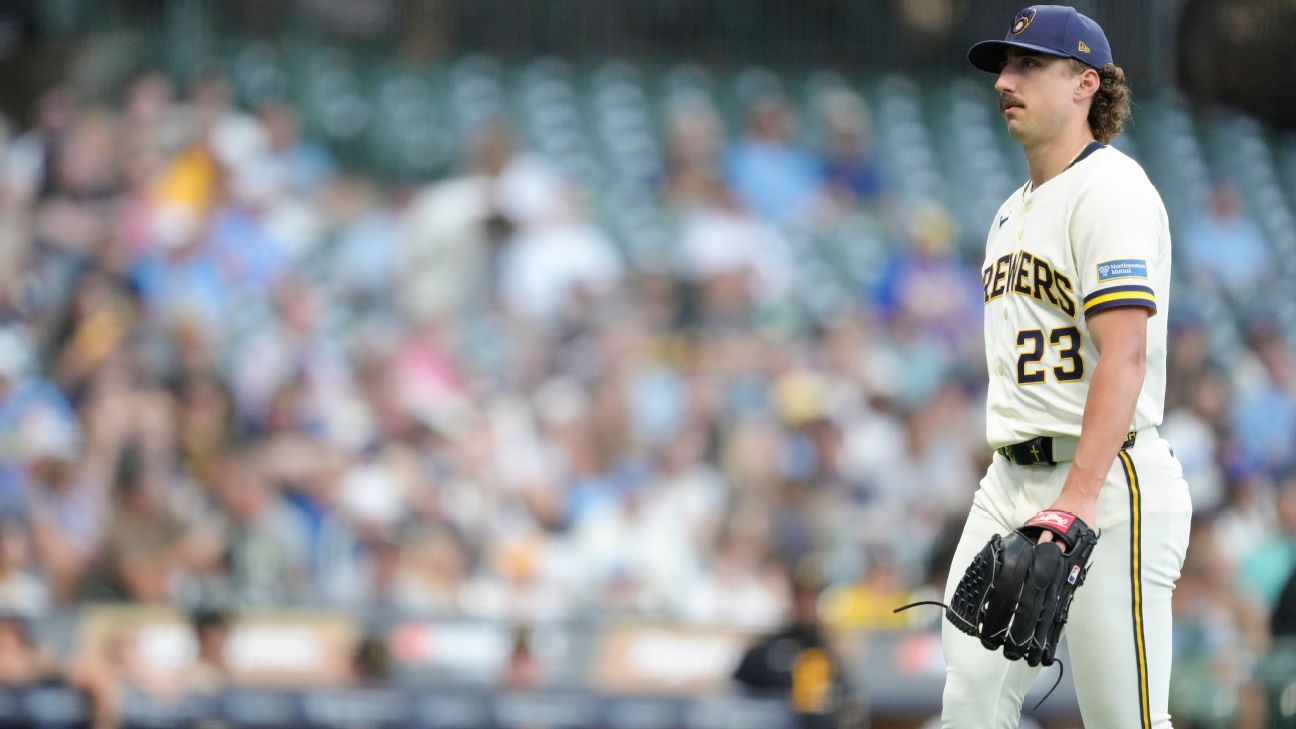
The Milwaukee Brewers optioned Brandon Sproat to Triple-A Nashville on Tuesday, one day after acquiring veteran right-hander Dustin May from St. Louis in a trade-deadline move that repositioned the organization's pitching depth chart. May, who arrived alongside reliever JoJo Romero, is slated to start Thursday against Pittsburgh, while left-hander Kyle Harrison—sidelined since July 9—returns Wednesday. The move crystallizes what had been building for weeks: Sproat's rookie campaign no longer fits the Brewers' timeline or tolerance for uncontrolled variance.
Sproat's numbers read as a cautionary tale of high strikeout velocity married to structural instability. In 95⅔ innings, the 25-year-old struck out 100 batters but walked 48, hit nine, and threw nine wild pitches. That's not volatility—that's a pitcher who can't command the strike zone. Monday's start against Pittsburgh epitomized the problem: four runs in three-plus innings, two consecutive wild pitches leading to his removal, and another loss (he's 3-7 with a 5.27 ERA and winless in five starts since June 30). Manager Pat Murphy didn't mince words: "The free bases, the wild pitches, the walks, hit by pitches, has got to stop. You can't pitch in the big leagues like that."
May arrives as a league-average reclamation project—5-7 with a 4.38 ERA in 21 starts for St. Louis, showing no improvement in July (0-1, 4.62 ERA across six starts). Yet from the Brewers' perspective, he represents predictable downside. They know what they're getting: a pitcher who doesn't walk the ballpark and can eat innings without explosive blowups. Against a rookie whose strikeout-to-walk ratio flirts with disaster, that's organizational clarity.
For bettors, the prop implication hinges on team total and run-line exposure. Sproat's control issues meant Milwaukee batters faced extended innings and higher pitch counts when he took the mound—fewer opportunities for the lineup to accumulate runs in games he started. May's steadier hand and deeper pitch economy mean the Brewers' hitters get more at-bats per start and face lower leverage situations by inning five. Over the next two weeks, when May starts twice and Sproat is in Nashville, Milwaukee's implied run output per game should tick upward by half a run in May's starts relative to recent Sproat outings—not because May is dominant, but because he won't gift extra baserunners through wildness. The market may not adjust for this efficiency gain if it's viewing the trade purely as "replacing a rookie with a vet" rather than pricing the specific mechanical advantage of reduced chaos.
The optioning of reliever Garrett Stallings and earlier acquisitions of reliever Antonio Senzatela from Colorado underscore that the Brewers are treating pitching depth as a solved problem. Sproat's exile signals the organization doesn't believe he'll recover command at the major league level this season—a harsh but data-driven decision that removes a high-variance pitcher from the equation just as Milwaukee enters the most critical stretch of its schedule.