Boyd's Velocity Return Signals Cubs Rotation Stability After Dual Injury Setbacks
By Erik Schwartz ·
Six scoreless innings and a season-high fastball velocity mark Matthew Boyd's clearest step toward reliable starter status, reshaping the Cubs' pitching depth for a stretch run.
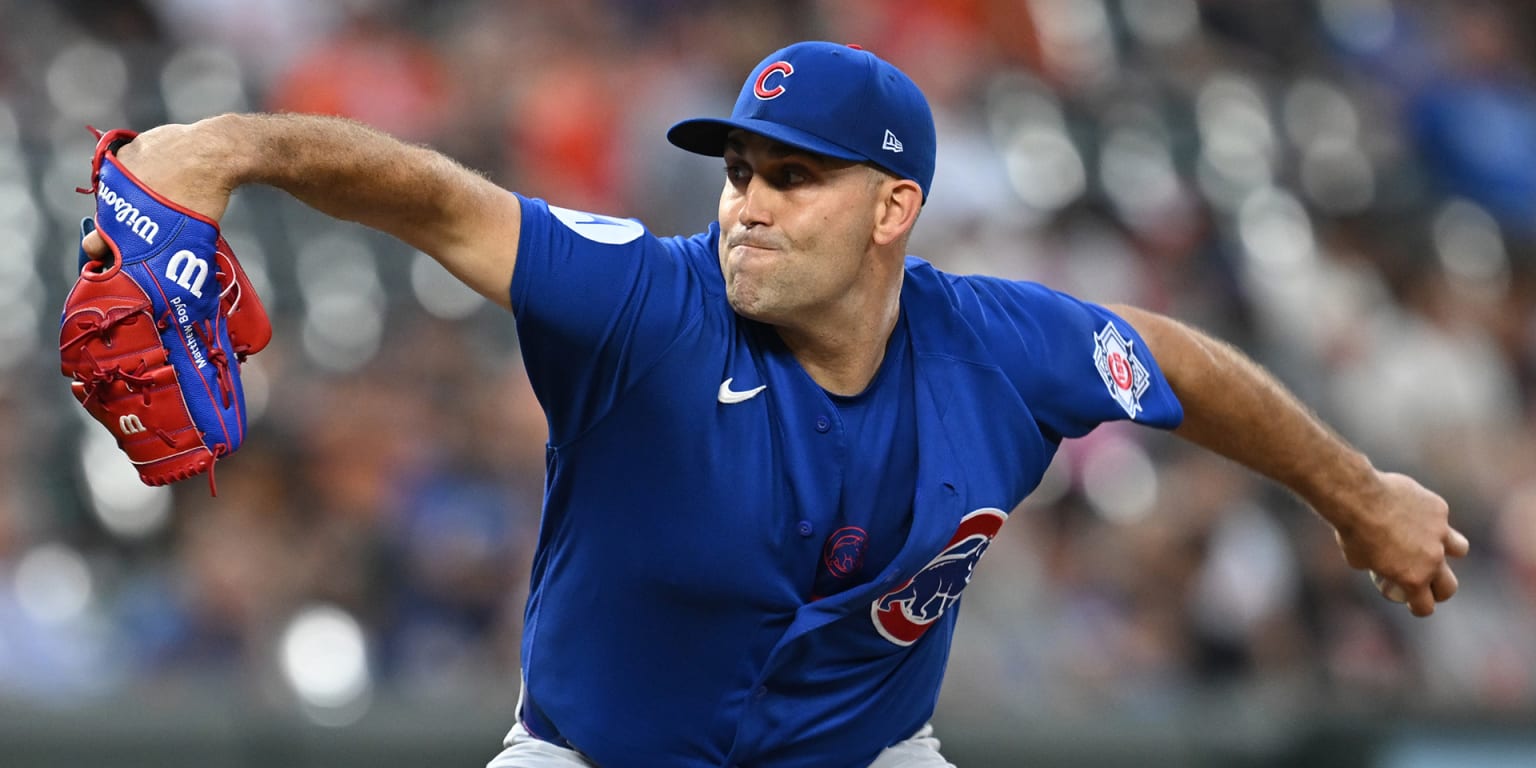
Matthew Boyd delivered the kind of outing that moves markets on Tuesday night—six scoreless innings against Baltimore, 93 pitches, seven strikeouts, and a fastball that touched 95.9 mph, his hardest heater of 2026. The Cubs won 5-2, but the meaningful result was the velocity register: that 95.9 fastball came with a 93.6 mph average on the four-seamer, a full mile better than his season mean of 92.6 mph. After two separate injury stints—a left biceps strain in April and a knee meniscectomy on May 7—Boyd is no longer managing rehab. He's pitching.
The mechanical progression has been methodical. June 25 against the Mets: 4⅔ innings, 76 pitches. June 30 against San Diego: five innings, 76 pitches. Tuesday: six scoreless, 93 pitches, operating with intent and precision. Cubs manager Craig Counsell's framing matters here—Boyd has transitioned out of "injured mode" protection protocols and back into a starter's standard routine. That shift unlocks the arsenal. His slider usage jumped from a season 13% to 22% against the Orioles; in the fourth inning with runners on, he ripped off three consecutive strikeouts using that pitch as a chase weapon. He recorded four K's with runners in scoring position and held Baltimore to 0-for-9 with runners on base, including 0-for-5 in RISP situations.
For bettors, the angle rests on the difference between "comeback" velocity and "healthy" velocity. A pitcher who averages 92.6 mph early in a rehab arc is not the same pitcher who averaged 94+ mph for 179⅔ innings last season and made the All-Star team. Boyd's Tuesday velocity print suggests the arm itself—not just the leg—has recovered. That matters for strikeout projection. His career K/9 against AL East opposition sits at 9.1; his season mark stands at 7.8, suppressed by missed time and lighter workloads. As Boyd builds back to 95+ innings per start, his per-game K output should trend back to that 9.1 ceiling. The Orioles lineup is not the test case—Baltimore struck out nine times in 24 at-bats against him. But the principle holds: recovering velocity + increased pitch volume + elevated slider usage = a K-per-inning profile that markets may still be discounting at 6-7 strikeout props because they're anchored to his injury-season baseline (7.2 K/9 over eight starts). Over his next three or four starts, as the workload climbs toward 100 pitches and opponents are stacked, his K props should normalize upward.
The Cubs rotation was thinned by injury depth all season. Boyd's return to velocity doesn't instantly erase that damage, but it removes the uncertainty around whether a 35-year-old's arm could handle the load post-surgery. Tuesday answered yes. The market is still pricing him like a question mark.