Tatis Ends 207-At-Bat Drought: What the Delay Reveals About His 2026 Arc
By PropBetEdge Editorial Team ·
After 55 games without a home run, Fernando Tatis Jr. finally connected—and his extended power drought maps to a fundamental shift in his approach at the plate.
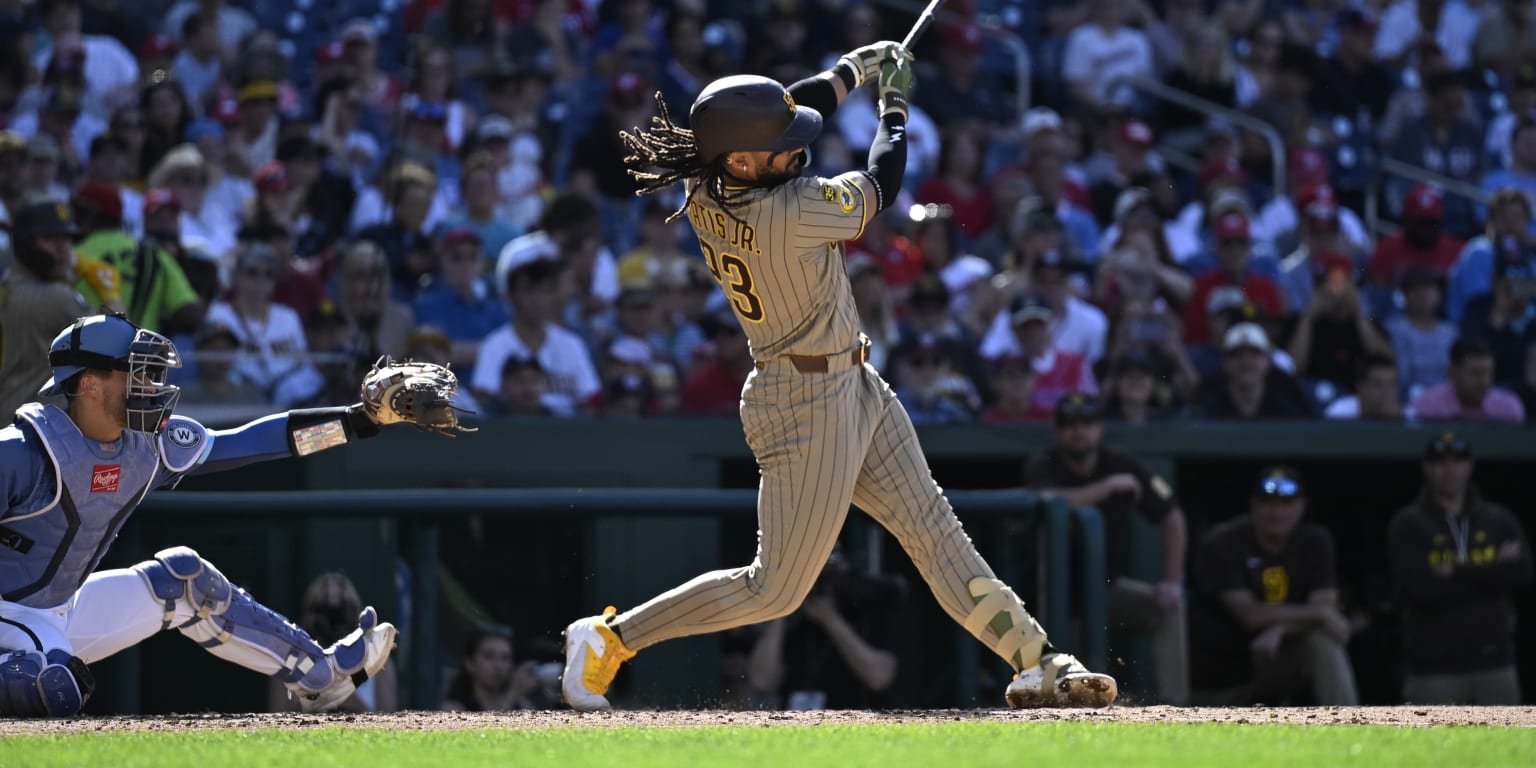
Fernando Tatis Jr. stepped into a 1-0 fastball from Nationals starter Foster Griffin on Saturday and launched it 451 feet into the Washington afternoon, ending one of the most prolonged power droughts of his career. The home run was his first of 2026, arriving after 207 at-bats and 55 games—the second-longest homer-less stretch by any player with a history of 40-plus annual home runs, trailing only Carl Yastrzemski's 57-game void in 1972. For context: Tatis had averaged a home run every 18.5 career at-bats entering the day; at that clip, a full season should yield approximately 11 home runs. The gap between expectation and reality has been staggering.
What's instructive is why the drought occurred—and why it appears to be lifting. Padres manager Craig Stammen offered a pre-game diagnosis that frames the entire season: Tatis stopped hunting home runs and started hunting hits. The strategic recalibration worked. Over his final seven games before Saturday's blast, Tatis hit .480 with improved contact quality. The faked bunt on the first pitch—a tactical choice, not a desperation move—signals a hitter executing a plan rather than chasing power in a vacuum. This isn't a player pressing his way out of a slump; it's a player letting his natural power resurface once the mechanical and mental chains loosened.
The Padres' offensive structure complicates the narrative. Entering Saturday, San Diego sat eight games over .500 despite Tatis' power output evaporating entirely. That suggests depth: leadoff hitter Tatis doesn't carry the full offensive load. But the roster has problems elsewhere. Manny Machado opened the day with a .605 OPS (148th among qualified hitters), while center fielder Jackson Merrill was barely ahead at .606. A 162-game slate exposes these gaps. If Tatis' power remained dormant while surrounding bats underperformed, San Diego risked sliding toward .500 or worse by mid-season. His burst—a 451-foot shot off a top-tier fastball—may signal the end of a correction cycle rather than the beginning of a hot streak.
For prop bettors, the timing and mechanism matter sharply. Tatis' HR prop line had likely adjusted downward across the drought: a player in a 55-game desert gets marked accordingly. Saturday's home run alone doesn't reverse the trajectory—one 451-foot blast is sample-size noise. But the underlying shift—a hitter who stopped forcing power and started trusting his swing—is durable. The .480 average over seven games and the mechanical calmness Stammen identified will persist regardless of one-game variance. If books haven't fully repriced Tatis' HR prop upward yet, early-window bets on his next five-game overs carry edge. His approach has stabilized; the homers were always coming once the cognitive load dropped.
Watch whether Machado and Merrill show similar rebounds in the coming week. If the entire Padres lineup is exiting a synchronized slump—a plausible read given the organizational approach shift—team totals could present value before Vegas fully adjusts the schedule.