Alvarez Erupts for Six RBIs in First Inning as Astros' Cleanup Anchor Enters Elite Historical Company
By Erik Schwartz ·
Yordan Alvarez's two-homer, nine-run first inning against Kansas City joins a 17-year-old David Ortiz performance as the only instances of that caliber in the record book, but the real story is what it reveals about his current plate approach.
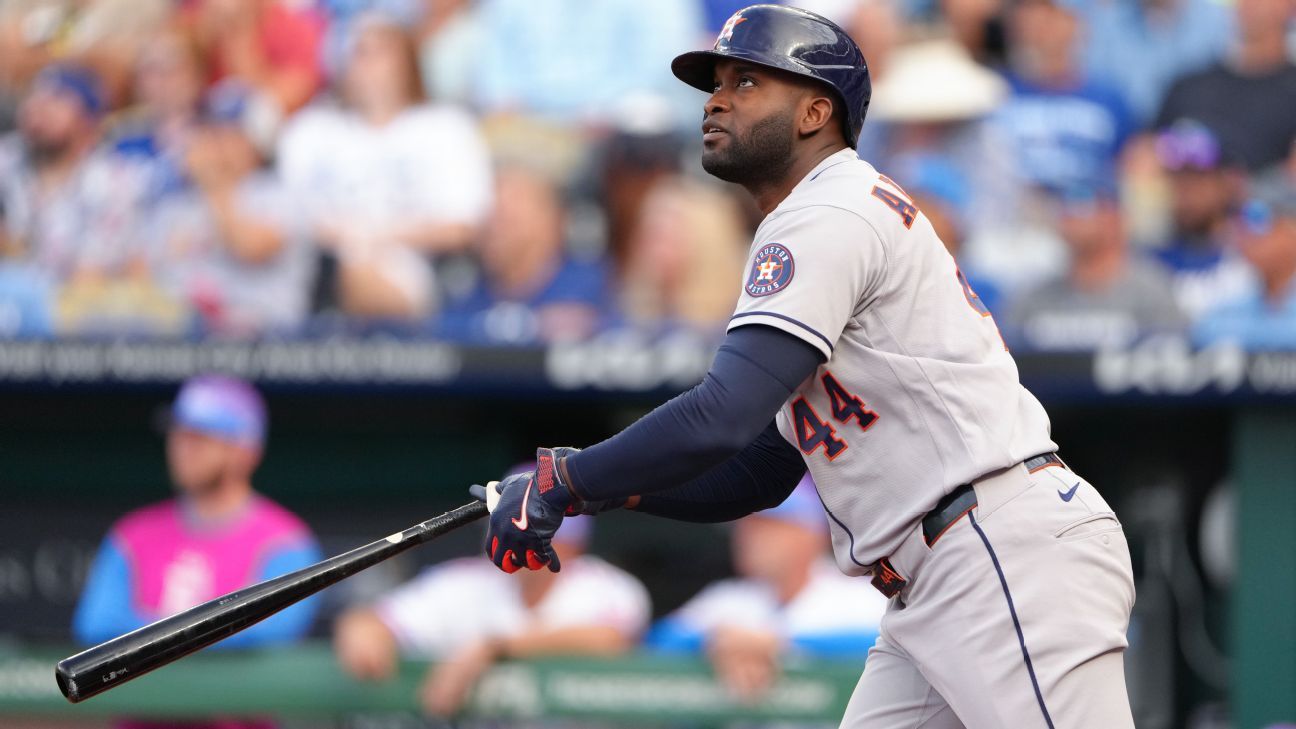
Yordan Alvarez hit a grand slam and a two-run shot in the first inning Friday night, driving in six runs as the Astros overwhelmed the Royals in Kansas City. The back-to-back homers—one opposite-field, one to center—belong to a rarefied historical tier: since 1920, only Alvarez and Hall of Famer David Ortiz (2008) have recorded two home runs and six RBIs in a single first inning. Alvarez, 28, is now tied with Philadelphia's Kyle Schwarber for the MLB home run lead at 24, holding the AL's individual throne entering Friday's action.
The Cuban slugger's explosion carries weight beyond the box score moment. Alvarez is a three-time All-Star and the 2019 AL Rookie of the Year; he was the AL Championship Series MVP in 2021 and drove in six runs in the 2022 World Series that Houston won. That pedigree matters because he doesn't manufacture these nights through variance. He operates with disciplined intent in the batter's box, and two home runs in one inning—particularly an opposite-field shot early followed by a dead-center blast—suggests he's hunting specific pitches and executing with precision rather than chasing the zone wider.
The first-inning context also signals something about how Kansas City pitched to him. A grand slam doesn't happen unless a pitcher leaves something middle-in with bases loaded; a follow-up two-run shot suggests the Royals didn't make mid-game adjustments inside the zone. That's partly on execution, partly on game script—a nine-run first inning forces a bullpen game and neutralizes matchup value. But for betting purposes, Alvarez's performance confirms what we already knew: he's operating near the top of his power curve this season, and he's positioned to see elevated fastball rates from teams playing catch-up.
Prop implications concentrate on two angles. First, Alvarez's home run line sits higher now; books will adjust Friday's performance into Saturday's offerings, but the move will likely be modest because his 24 HRs already priced him as a league leader. The real edge lies in how that adjustment happens—sportsbooks may cap his individual HR prop at 1.5 despite the explosion because one-inning variance is real and boards respect regression. However, if you secured his home run line before first-pitch Friday, that's a one-game winner that won't repeat. Second, his RBI line warrants scrutiny over the next 2-3 games. The Astros put up nine runs in the first; they'll face pitchers trying to stay deep in games and pitch around Alvarez, which compresses RBI opportunity. Fade elevated RBI props temporarily while the lineup normalizes pace.
The historical comparison to Ortiz carries one additional note: Ortiz's 2008 explosion occurred during his final MVP-caliber season at age 32. Alvarez is two years younger and showing no decline markers. Boards should continue to price him as a top-tier power hitter, but casual bettors anchoring on Friday's output may overestimate his daily floor. The angle isn't to fade him outright—it's to recognize that one-inning nuclear events inflate short-term lines without changing the underlying machinery.