Alvarez's Deceptive Breaking Ball Mix Is Reshaping Nationals Pitcher Value
By Ty Whitney ·
The Nationals' left-hander masks pitch identity through velocity compression, creating strikeout and ground-ball edges that the market hasn't fully priced.
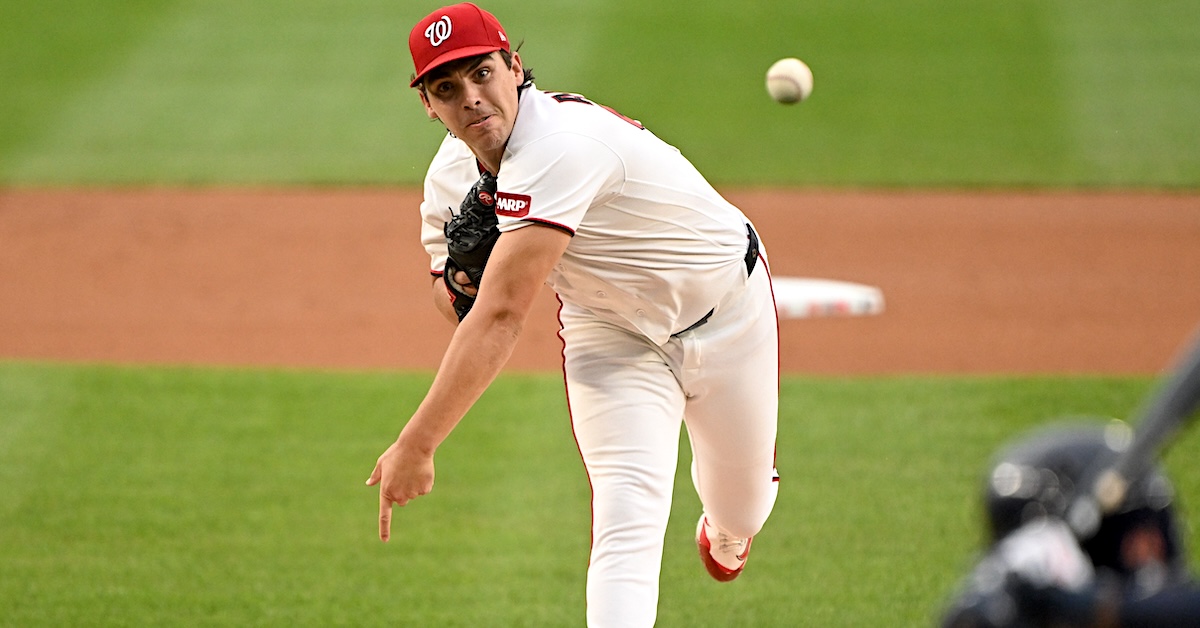
Andrew Alvarez is quietly building a case as one of the most undervalued arms in baseball, and his path to outperformance has nothing to do with radar-gun readings. In his first full major-league season, the 27-year-old southpaw carries a 3.64 ERA and 2.97 FIP across 47 innings and 12 appearances for a Washington Nationals staff ranked among baseball's worst. Tuesday's outing—four hits and five runs allowed over 5 2/3 innings in a loss to Houston—was a blip, not a trend. What matters is the underlying architecture of how Alvarez pitches.
He operates with a five-pitch mix anchored by a fastball that sits at 92.3 mph, a velocity percentile that ranks in baseball's bottom third. By conventional scouting, that should make him an easy target. Instead, Alvarez has weaponized deception through an atypical breaking-ball pairing: a curveball and gyro slider that share nearly identical velocity but produce dramatically different movement patterns. The compression of fastball-to-breaking-ball speed differentials—a hallmark of elite pitch designers—forces hitters into a compressed decision window. Batters cannot reliably separate the curve from the slider based on velocity alone, which destabilizes their ability to track and adjust. The result: a 57.1% groundball rate (tied for sixth among pitchers with 40-plus innings) and a whiff rate in the 65th percentile despite the absence of overpowering heat.
Alvarez's own scouting report reveals the intentional architecture. "I'm not someone who is going to overpower you with stuff," he explained, "but rather keep you off balance, get some weak contact and a little bit of chase here and there." This is not a passive assessment—it's a deliberate operational philosophy. His chase rate sits at the 57th percentile, meaning hitters are swinging at pitches outside the zone at above-average frequencies. The breaking-ball combination forces a cognitive load: if velocity can't differentiate pitch type, movement must, and that latency in decision-making translates to either weak contact or swings at pitches out of the zone.
For prop bettors, the angle is structural and persistent. Alvarez's strikeout rate (25.4%) and ground-ball rate are not statistical noise from a short sample—they flow from a repeatable mechanical philosophy that operates independent of opponent quality. The market has likely priced his ERA around league-average expectations for a 92-mph fastball, but his FIP (2.97) tells a different story: the strikeouts and ground balls are real. Over the remainder of the season, Alvarez strikeout props should offer value at lines built to his fastball velocity rather than his actual K-rate. Similarly, Nationals games with Alvarez on the mound benefit from elevated ground-ball defense leverage, which suppresses scoring variance and shifts total expectations downward relative to surface-level ERA metrics. The deception works because it's embedded in pitch design, not dependent on opponent adjustment or variance reversion.
The Nationals' staff has few anchors to lean on, and Alvarez represents legitimate alpha. As he moves through a schedule where his velocity won't intimidate anyone, the breaking-ball masking effect becomes his most reliable asset—and one that sportsbooks have yet to fully isolate in pricing models built around fastball percentiles and surface ERA.