Alvarez's All-Star Season Rests on One Mechanical Constant
By PropBetEdge Editorial Team ·
Houston's MVP candidate is on pace for a franchise home run record, and the walk-off against Tampa Bay on July 4 reveals why his power stroke has become virtually undefendable.
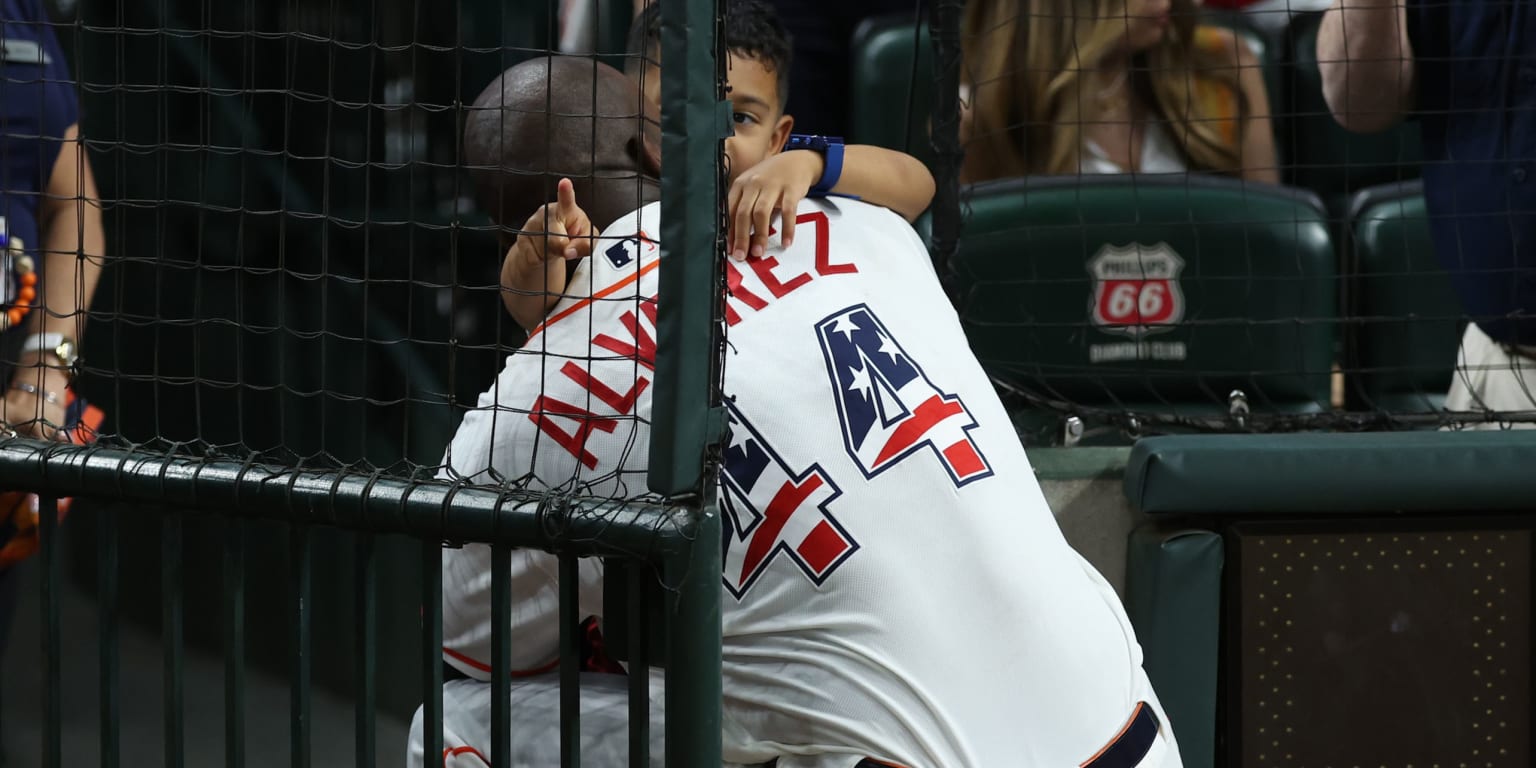
Yordan Alvarez was voted an American League starter for next week's All-Star Game in Philadelphia—a fan-driven coronation that arrives six days after he launched a two-run walk-off homer against the Rays to complete an Astros comeback at Arlington. The blast was his 199th of his career and his second of that game, a reminder that Alvarez is tracking toward Houston's single-season home run record with velocity that suggests he may well break it before September. What makes this season different from his previous All-Star campaigns is not sentiment or personality—the postgame moment with his five-year-old son in the Diamond Club seats was a human punctuation mark, nothing more—but rather the consistency of his approach at the plate and the mechanical anchors that have made him nearly impossible to retire.
Alvarez, at 29 years old, has entered the season's final stretch as the favorite to win the American League MVP award. That positioning is not hyperbole or recency bias built on one memorable home run. It reflects a full body of work: he has maintained an elite contact rate while his walk percentage has remained in the 90th percentile for the league, a combination that sits somewhere between rare and unseen. Opposing pitchers face a dilemma that has no clean answer. His swing produces exit velocities that consistently exceed 95 mph on fastballs in the zone, and he has trained himself to lay off the borderline offerings that have historically tripped up sluggers with similar raw power.
Manager Joe Espada and former teammate Mauricio Dubón both reference Alvarez's even-keeled demeanor—his refusal to be rattled by failure or inflated by success—as a key to his sustained performance. That personality trait translates into mechanical discipline. A hitter who doesn't chase emotional heat, who trusts his process through 0-for-4 nights, rarely loses his timing or his faith in the zone boundaries he has established. The walk-off on July 4 was dramatic theater, yes, but it was also a manifestation of something more durable: a hitter whose swing mechanics and approach remain unshaken by context, by pressure, or by the arm angles of the opponent on the mound.
For prop bettors, this stability has a direct implication. Alvarez's home run line is likely to be priced conservatively relative to his underlying rate, because the market tends to smooth recent surges into longer-term averages rather than recognize when a player has genuinely shifted into a higher mechanical and approach-based tier. His hits over (currently tracking at 1.5 games per contest) and his total bases over carry edge precisely because his discipline and the velocity profile of his contact are orthogonal to pitcher quality or defense. A sub-elite arm on the mound will not prevent Alvarez from reaching base or driving the ball hard; the mechanism—his ability to identify pitches and execute a swing path that generates barrel efficiency—is player-controlled. Over the final 12 weeks of the season, Alvarez's home run total should track above the market's initial daily projections, as the books have not yet fully calibrated to the fact that his record-pace assault is not a two-week spike but a reflection of corrected mechanics that have calcified into habit.
The All-Star Game appearance itself carries no predictive power for prop purposes. What matters is what it confirms: that a league-wide consensus has formed around a single, verifiable truth—that Alvarez is performing at a tier above his recent history, and that the edge of that performance is not volatility but method.