Nationals Offense Erupts Past Athletics; Chaparro's 8-RBI Night Signals Second-Half Momentum
By Erik Schwartz ·
Washington's 23-run demolition of Oakland marks a franchise-historical explosion and a chance to reset an underperforming hitter's trajectory before market repricing.
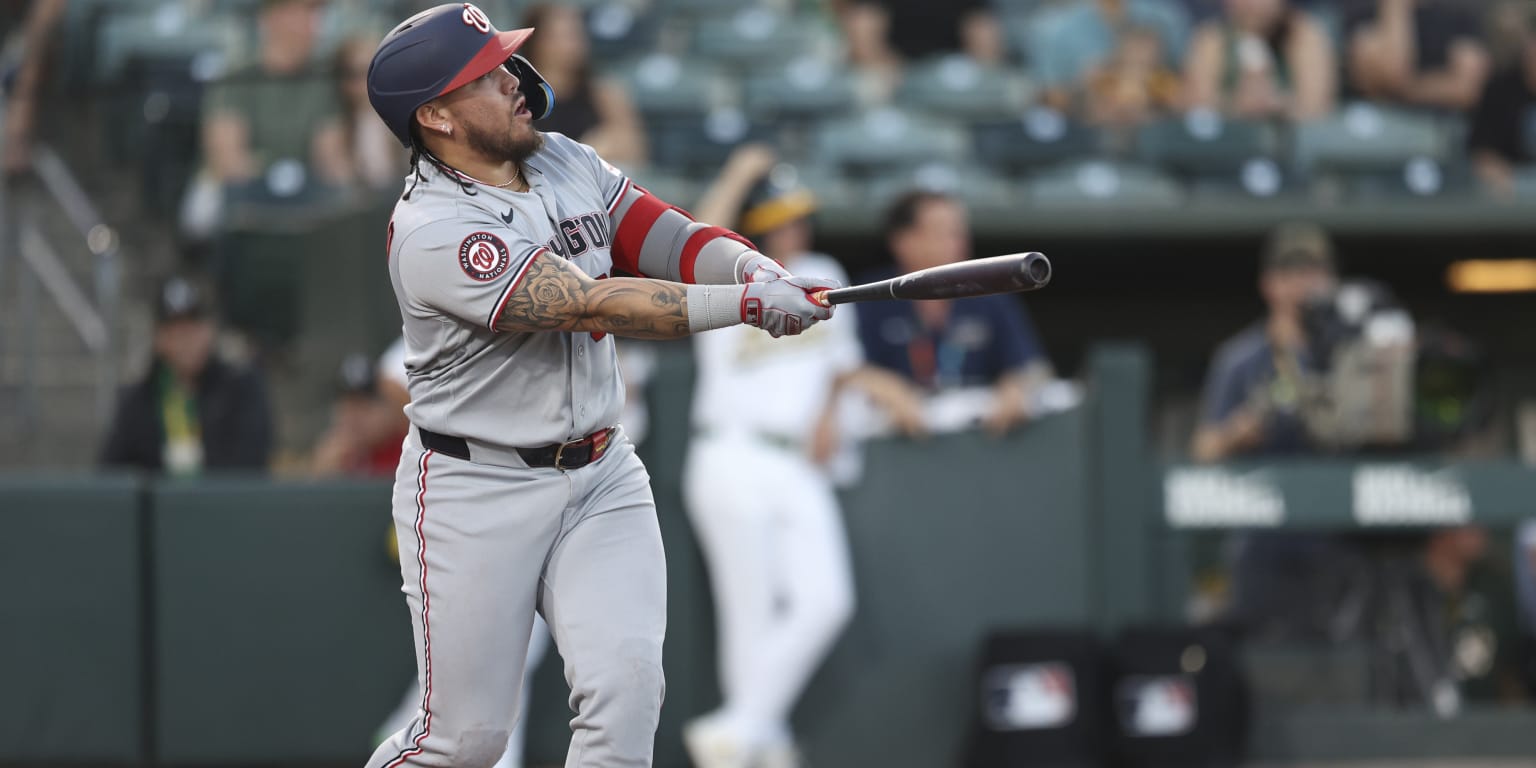
The Nationals came out of the All-Star break firing on Friday, dismantling the Athletics 23-4 in West Sacramento to launch the second half with authority. Twenty-one hits, crooked numbers in four separate innings, and a collective statement that Washington's offense—already leading the majors with 539 runs scored—was not content closing the first half below .500 after a three-game shutdown at the hands of the Yankees. Cade Cavalli took the mound and received an 18-run cushion, allowing him to pitch six innings with nine strikeouts for his sixth win. The Athletics' pitching corps—starting with Gage Jump, continuing through José Suarez and Yunior Tur, and collapsing entirely when position player Carlos Cortes took the ball—could not contain an offense that put all nine starters and a defensive sub into the hit column.
The headline belongs to Andrés Chaparro. The first baseman, who entered Friday batting just .167 with a .585 OPS across 54 plate appearances, delivered four hits and drove in eight runs on a night when the Nationals' entire offensive philosophy—aggressive at-bats early, pressure applied via contact—reached its clearest expression. His fifth-inning two-run home run off Suarez traveled 467 feet, the fourth-longest homer recorded under Statcast tracking by any National since 2015. A three-run shot in the seventh against Tur followed. Chaparro's 8 RBIs marked the most by a National since 2018. In one game, his OPS vaulted nearly 200 points to .776. This was not margin-of-victory padding—it was a meaningful correction of a struggling trajectory.
Context matters here. Chaparro's left-handed splits have historically favored him, and Friday's lineup featured Gage Jump as the Athletics' starter. But the damage extended across pitcher handedness and quality; he was disciplined at the plate (a walk mixed in with four hits), drew better pitches from a collapsing bullpen, and executed the Nationals' game plan with precision. The organization has clearly signaled confidence in Chaparro through playing time—third in the lineup, regular first-base reps—which means the market has already absorbed the baseline. What changed was not opportunity; it was output. A .167 hitter in July 2026 is priced for continued drought. A hitter who puts up an 8-RBI, 467-foot night is repriced at open the following day.
For prop players, the angle is single-game volatility. Chaparro's Friday performance is a statistical outlier—a performance so extreme (four hits, 8 RBIs in one game) that it will likely overcorrect the market within 24-48 hours. Sportsbooks and the casual public will view this as evidence of a breakout; sharp money will recognize it as a variance spike from a .167 hitter facing a compromised pitching staff. His individual props (RBIs, hits, total bases) will be overpriced in Saturday and Sunday games as algorithms and market makers adjust upward from the long-term .585 OPS baseline. For those betting that window, fade elevated Chaparro totals on games two and three of this series. His career-long splits suggest reversion, and the Athletics' pitching depth—better in games two and three than Friday's emergency deployment—will not gift him a second eight-RBI night. Team totals and offensive spreads for Washington have real merit; Nationals run production is genuine and franchise-leading. Chaparro's individual ceiling is real but temporary. Do not confuse a franchise explosion with individual player breakout.